

More news on this day
Aegean Airlines has reported a 5 percent rise in revenue and a 6 percent increase in passenger numbers for 2025, underscoring Greece’s growing influence in European aviation and strengthening air links across the Mediterranean at a time of resilient travel demand.
Get the latest news straight to your inbox!
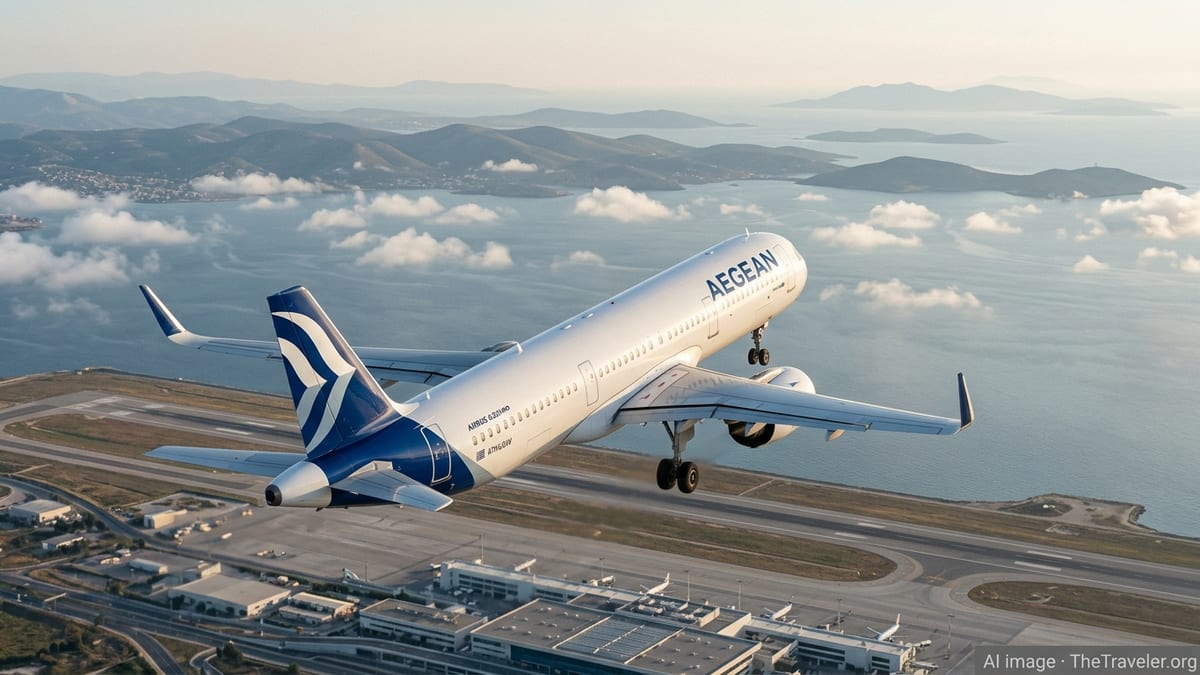
Record 2025 Results Confirm Growth Momentum
According to publicly available financial results for the full year 2025, Aegean Airlines generated consolidated revenue of about 1.86 billion euros, an increase of 5 percent compared with 2024. The carrier transported approximately 17.3 million passengers over the year, up around 6 percent, marking another record in traffic and extending the steady growth trend established before the pandemic and reinforced during the travel rebound of 2022 to 2024.
Reports indicate that profitability also improved, with net profit rising by double digits year on year and earnings before interest, taxes, depreciation and amortization remaining robust. The airline’s management has presented the results as confirmation that the network expansion strategy, particularly in the winter months, is translating into sustained demand and stronger financial performance.
The 2025 numbers build on an already strong 2024, when Aegean first crossed the 1.78 billion euro revenue threshold and passed 16 million annual passengers. The latest figures suggest that the company has managed to grow in an increasingly competitive environment, with more carriers deploying capacity into Greece and the wider Eastern Mediterranean.
Industry coverage notes that Aegean’s growth is especially notable given higher operating costs, fuel price volatility and continued infrastructure constraints at key airports in the region. The airline’s ability to grow both revenue and passengers at mid-single-digit rates under these conditions is seen as a sign of operational resilience and disciplined capacity management.
Strengthening Greece’s Role in European Aviation
Aegean’s 2025 performance reinforces Greece’s status as a significant aviation hub within Europe, centered on Athens International Airport and a dense network of island and regional gateways. Athens continues to handle steadily rising traffic volumes, and Aegean remains the country’s largest carrier by market share, connecting Greece with major European capitals and secondary cities.
Public data on traffic trends show that much of this growth is being driven by inbound tourism, with Greece continuing to attract record numbers of visitors from across Europe and beyond. Aegean’s dual focus on domestic and international routes enables it to funnel tourists into both well-known destinations such as Santorini, Mykonos and Crete and less familiar islands that are increasingly appearing on European travelers’ itineraries.
At the same time, the carrier plays a crucial role for Greek residents, maintaining year-round connectivity between the mainland and islands that rely on air service for business, health care and education. The 6 percent increase in available seats in 2025, reported in the company’s results, reflects a deliberate effort to broaden access beyond the peak summer season, particularly during the previously quieter winter months.
Observers note that this evolving year-round model supports the Greek government’s broader ambition to de-seasonalize tourism and spread visitor flows more evenly across the calendar, which in turn eases pressure on infrastructure and local communities during the summer peak.
Network Expansion and Fleet Modernization
Aegean’s financial and traffic growth in 2025 was closely linked to its continued network and fleet expansion. Company disclosures indicate that the airline offered around 21 million seats during the year, about 6 percent more than in 2024, as it added frequencies on existing routes and opened new city pairs within Europe and the Middle East.
Fleet development has been a key pillar of this strategy. In 2025, Aegean introduced additional Airbus A320neo and A321neo aircraft as well as turboprop equipment for regional links. These newer-generation aircraft offer improved fuel efficiency, lower noise levels and higher seating capacity, helping the airline to reduce unit costs while accommodating more passengers on core routes.
Industry analysts point out that the balance between narrowbody jets for medium-haul services and turboprops for shorter domestic legs allows Aegean to fine-tune capacity to seasonal and route-specific demand. This flexibility is considered important in a market like Greece, where traffic patterns can shift quickly based on tourism trends, geopolitical developments and macroeconomic conditions in source markets.
Published coverage also highlights the role of partnerships and code-share agreements with other European and international carriers, which help to feed additional passengers into Aegean’s Athens hub. These partnerships extend the airline’s reach into long-haul markets without the need to operate intercontinental aircraft itself, while still capturing revenue from connecting traffic to Greek and regional destinations.
Implications for Mediterranean Travel and Tourism
The combination of higher revenue and more passengers at Aegean in 2025 is reshaping the connectivity picture across the Eastern Mediterranean. Travelers now have access to more frequent flights between Athens and destinations such as Cyprus, Israel, Egypt, Italy and the Balkans, as well as expanded links between Greek islands and European cities.
Travel industry reports suggest that this improved connectivity is helping Mediterranean destinations diversify away from exclusively summer-focused tourism. Additional winter capacity on selected routes supports city breaks in Athens and Thessaloniki, cultural and culinary tourism, and off-season stays on islands that remain open year-round. For travelers, this can translate into more competitive fares and a wider choice of departure dates and airports.
For the hospitality sector in Greece and neighboring countries, Aegean’s growth in 2025 provides greater visibility and stability when planning investments in hotels, vacation rentals and tourism services. Regular, reliable air links are also viewed as essential for attracting conferences, sporting events and cultural festivals that extend beyond the peak summer months.
There are environmental considerations as well. While increased air traffic raises questions about emissions, the introduction of more fuel-efficient aircraft and the gradual renewal of older jets are cited in industry analyses as partial mitigants. Discussion in the sector increasingly centers on how carriers like Aegean can combine route growth with sustainable aviation fuel usage and operational efficiencies to moderate their climate impact.
What Travelers Should Know for 2026 and Beyond
Looking ahead, Aegean’s 2025 results set the stage for further adjustments to its schedule, pricing and product offering. Based on current announcements, travelers can expect continued emphasis on hub operations in Athens, more point-to-point links between overseas cities and Greek islands, and selective expansion into underserved European and Middle Eastern markets.
For leisure travelers planning Mediterranean trips, this is likely to mean more departure options from regional airports across Europe, additional early-morning and late-evening services that enable weekend breaks, and gradually improving connectivity in shoulder and winter seasons. Travel advisors are already highlighting Athens as a convenient connecting point for multi-stop itineraries that combine mainland Greece with islands or nearby countries.
For business travelers, the increased frequencies on core European routes and a more stable year-round schedule improve the viability of same-day trips and short-notice travel. Corporate travel managers monitoring airline financial health also view Aegean’s positive 2025 trajectory as a sign of operational stability, which is an important factor when negotiating fare agreements and capacity commitments.
While uncertainties remain around fuel prices, geopolitical risks and broader economic conditions in Europe, Aegean’s 5 percent revenue growth and 6 percent increase in passenger numbers in 2025 position both the airline and Greece more broadly as central players in the evolving European and Mediterranean air travel landscape.