

More news on this day
AEGEAN Airlines has suspended flights to Tel Aviv, Dubai, and Riyadh amid the rapidly escalating Middle East security crisis, leaving thousands of passengers stranded across key hubs and intensifying a wave of global travel disruption.
Get the latest news straight to your inbox!
Widening Flight Cancellations Across a Volatile Region
The suspension of AEGEAN Airlines services to Tel Aviv, Dubai, and Riyadh comes at a moment when carriers worldwide are reassessing exposure to Middle Eastern airspace, following a sharp deterioration in regional security and ongoing military activity. Publicly available flight tracking data and media coverage indicate that hundreds of services to Israel and Gulf states have been canceled or rerouted in recent days, straining airport capacity and airline resources.
AEGEAN, a key player connecting European cities with the Eastern Mediterranean and the Gulf, had expanded its network to destinations including Tel Aviv and major Gulf hubs in recent years. Those routes are now on hold as airlines review risk assessments, insurance considerations, and overflight permissions in light of the latest crisis. Network planners appear to be prioritizing aircraft and crews for more stable markets, while leaving open the possibility of a phased resumption once conditions improve.
The decision affects both point-to-point traffic and a substantial volume of connecting passengers who have relied on AEGEAN’s Athens hub as a bridge between European capitals and the Middle East. Many of those travelers are now caught mid-journey, facing abrupt cancelations and lengthy delays as they attempt to rebook through alternative gateways.
Reports from regional and international outlets describe a broader pattern of disruption, with several global carriers limiting or temporarily halting services to Tel Aviv while reassessing operations to Gulf airports. The result is a patchwork of schedules that can change by the hour, complicating travel planning for both tourists and business travelers.
Thousands Stranded as Hubs Struggle With Overflow
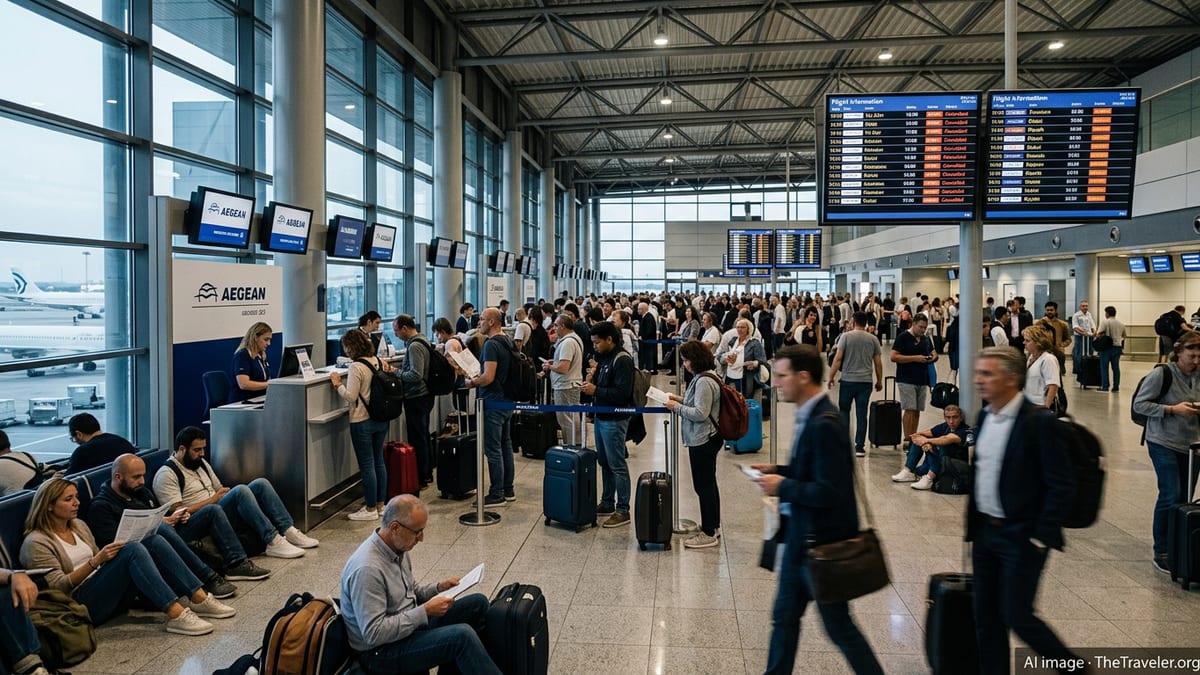
The halted routes have had an immediate human impact, particularly at Athens International Airport and major Middle Eastern hubs where passengers are finding themselves unexpectedly grounded. Social media posts and local coverage show crowded check-in halls, improvised overnight sleeping areas, and long queues at service desks as travelers seek clarity on their options.
With Tel Aviv’s Ben Gurion Airport already under pressure from widespread cancellations and diversions, the additional loss of connectivity via AEGEAN further constrains exit routes for those attempting to leave Israel or reach the country for urgent reasons. Dubai and Riyadh, traditionally used as alternative transit points during previous crises, are themselves experiencing rolling schedule changes as airlines respond to shifting risk calculations and airspace restrictions.
Travelers with complex itineraries involving multiple carriers face particular challenges. Industry reports note that interline agreements and alliance partnerships are being tested as airlines attempt to reaccommodate passengers on remaining services, many of which are running close to capacity. In some cases, travelers are being rerouted via secondary airports or more circuitous paths through Europe or Asia, adding many hours or even days to their journeys.
Airports are deploying additional staff and making use of auxiliary seating and rest areas where possible, but the pace and scale of cancellations mean that many passengers are still relying on ad hoc arrangements for food, lodging, and onward travel. Travel insurers and booking platforms are also reporting spikes in inquiries as stranded customers seek reimbursement or alternative arrangements.
Knock-On Effects for Tourism, Business Travel, and Cargo
The suspension of AEGEAN’s flights to Tel Aviv, Dubai, and Riyadh is expected to reverberate well beyond immediate passenger inconvenience. Tourism boards and hospitality operators in Greece and across the Eastern Mediterranean had counted on steady flows of visitors from Israel and the Gulf, particularly as the region approaches the busy spring and summer travel seasons.
Industry analysis suggests that group tours, cruise connections, and religious travel itineraries linking Israel, Greece, Cyprus, and other regional destinations are among the most affected. With fewer nonstop options and less reliable connections, travelers may postpone or cancel trips altogether, hitting hotels, guides, and small businesses that depend on seasonal arrivals.
Business travel and cargo operations also face headwinds. Dubai and Riyadh function as major commercial gateways, and links via AEGEAN’s network supported trade, corporate travel, and conference traffic between Europe and the Middle East. Reduced capacity on these corridors can slow deal-making and complicate supply chains, especially for sectors that rely on fast, high-value air freight.
Airline financial statements and previous crisis data show that extended suspensions on key routes can weigh heavily on carriers’ revenues. While some demand may eventually shift to alternative routes or rebound once services resume, prolonged instability in the region risks reshaping long-term travel patterns, with travelers and companies favoring destinations perceived as more predictable.
Travelers Confront Uncertain Timelines and Shifting Advice
For passengers currently booked on AEGEAN services to or through Tel Aviv, Dubai, and Riyadh, the most pressing concern is how long the suspensions will last. As of mid-March 2026, public statements by airlines and aviation authorities across the region emphasize that schedules remain under continuous review and may be adjusted at short notice, depending on security assessments and regulatory guidance.
Travel advisories issued by governments in Europe, North America, and Asia highlight the fluid nature of the crisis, urging travelers to monitor updates from their carriers and to maintain flexible plans. In some cases, waivers are being offered that allow passengers to change dates or routes without standard penalties, but availability on remaining flights is limited, especially on popular Europe–Middle East corridors.
Analysts note that previous episodes of regional instability have sometimes led to a phased restart of services, beginning with reduced frequencies or daytime-only operations before a full schedule returns. However, the current crisis involves multiple conflict zones and shifting airspace restrictions, making it harder to predict when airlines like AEGEAN will be in a position to restore regular operations to affected cities.
Travel planners recommend that passengers with nonessential trips to the region in the coming weeks review cancellation policies, consider alternative destinations, or route via more stable hubs where possible. Those who must travel are being advised to build in generous connection times, keep digital copies of all documents, and remain prepared for last-minute gate changes or overnight delays.
What AEGEAN’s Decision Signals About the Broader Aviation Outlook
AEGEAN’s suspension of flights to Tel Aviv, Dubai, and Riyadh is being viewed within the aviation community as a barometer of wider industry sentiment toward operating in the Middle East under current conditions. The airline has traditionally maintained a presence in Israel and the Gulf as part of its wider strategy to connect Southeast Europe with neighboring regions, meaning that pulling back from these markets represents a significant step.
Observers point out that airlines often move cautiously in and out of conflict-affected areas, weighing commercial pressures against heightened safety and insurance costs. With global traffic still recovering from earlier shocks to the industry, carriers may be less willing to absorb the financial risk associated with flying near active conflict zones, particularly when alternative routes can be deployed elsewhere.
The latest crisis is also prompting renewed debate about the resilience of global aviation networks that depend heavily on a handful of major hubs in politically sensitive regions. Continued instability could accelerate a shift toward more distributed routing patterns, with travelers increasingly funneled through secondary gateways in Europe, Central Asia, or North Africa to avoid high-risk airspace.
For now, passengers and industry stakeholders face a period of heightened uncertainty. While AEGEAN and other airlines signal that they aim to restore services when conditions allow, the evolving security landscape across the Middle East means travelers may need to adapt to a new normal of rapidly changing schedules, complex routings, and persistent volatility on some of the world’s most important air corridors.