

More news on this day
Greece’s flag carrier Aegean Airlines has temporarily suspended services to Tel Aviv, Beirut, Dubai and several other Middle Eastern cities as security tensions and airspace restrictions surge across the region, creating fresh uncertainty for tourists and travel businesses that rely on Greece–Middle East links.
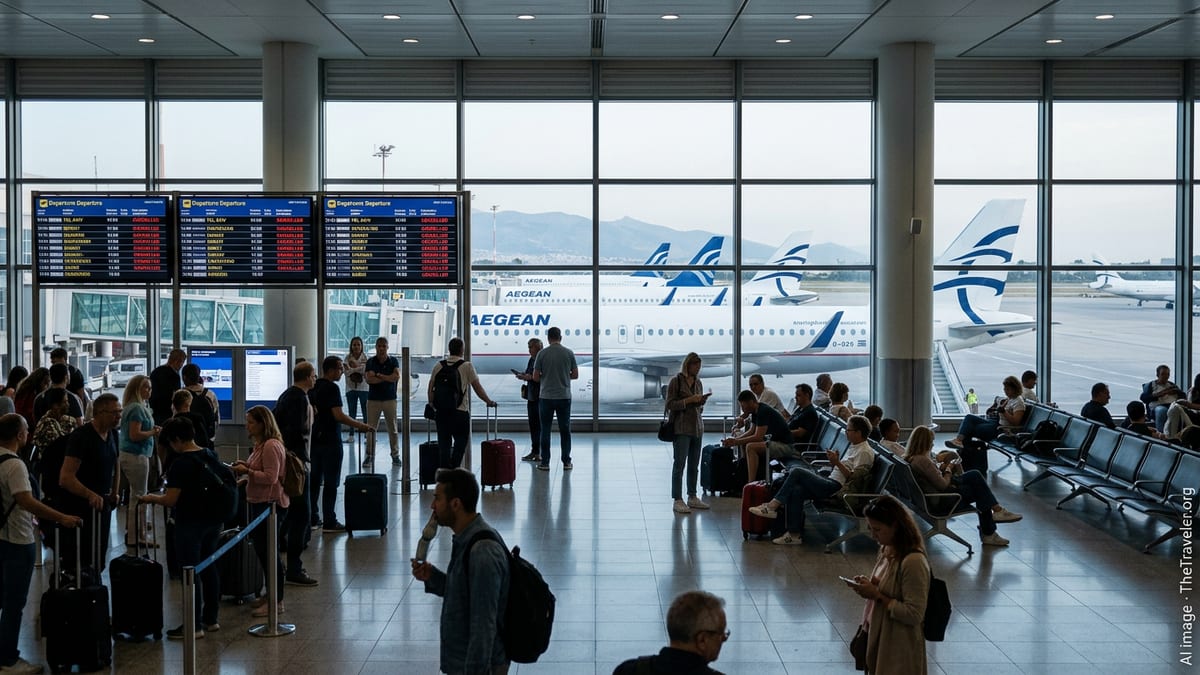
Which Aegean routes are suspended and for how long
Aegean Airlines announced that it has cancelled flights to and from Tel Aviv, Beirut, Erbil, Baghdad, Dubai and Abu Dhabi following a sharp escalation of conflict affecting airspace across the wider Middle East. The carrier cited “recent developments in the Middle East” and coordination with aviation authorities as the basis for its decision.
According to the airline’s latest travel advisory, flights on the Tel Aviv, Beirut and Erbil routes are cancelled from 28 February through 2 March 2026, including all departures and returns during that period. Services to Baghdad are suspended from 28 February through 3 March, while flights to Dubai and Abu Dhabi are cancelled between 28 February and 1 March.
Aegean has also introduced a broader flexible policy for upcoming trips. Passengers holding tickets to or from Tel Aviv, Beirut, Erbil, Baghdad, Dubai and Abu Dhabi on flights scheduled up to and including 10 March 2026 can change their travel dates without reissue fees or fare differences for new travel up to 31 March, or opt to cancel and receive a refund or credit voucher.
The airline stresses that the suspensions are currently time limited but subject to extension if the security picture deteriorates or regional airspace closures widen, leaving travelers and tourism operators braced for further schedule changes.
Security fears ripple through regional aviation
Aegean’s move comes amid a broader wave of flight cancellations affecting the Middle East after United States and Israeli strikes on Iran triggered retaliatory actions and temporary airspace shutdowns. Governments and aviation regulators have issued a flurry of security notices, prompting airlines to reroute or ground aircraft serving conflict-adjacent hubs.
Major international carriers in Europe, North America and Asia have suspended or curtailed flights to destinations including Tel Aviv, Beirut, Dubai, Abu Dhabi, Amman, Erbil, Tehran, Dammam and Riyadh, with some airlines publishing waivers that allow free date changes and refunds. Analysts say the pattern mirrors previous spikes in regional tensions but with a wider geographic footprint because Dubai and Abu Dhabi are global connecting hubs.
For Greek aviation, the impact is particularly visible at Athens International Airport, where Aegean and other carriers rapidly pulled Middle East services at the start of the crisis. Local media report dozens of cancellations and diversions in and out of Athens tied to Israel–Iran hostilities and associated airspace risks, underscoring how quickly a conflict several hours away can disrupt Greece’s role as a crossroads between Europe, the Levant and the Gulf.
Aegean has indicated that it will continue to reassess its timetable in close contact with European and regional aviation authorities, suggesting that rapid reinstatement of flights will depend on both security assurances and the reopening of key flight corridors over and around Iran and its neighbors.
Tourism and trade links between Greece and the Middle East
In recent years Greece has cultivated the Middle East as a high-value tourism and investment market, with visitors from Israel, Lebanon and Gulf states drawn to Greek islands, city breaks in Athens and Thessaloniki, and luxury resorts on the Aegean and Ionian coasts. Direct air links on Aegean and Gulf carriers have been central to that strategy, feeding both leisure arrivals and business travel.
The current suspensions threaten to interrupt this momentum at the start of the spring shoulder season, a period when city tourism and early island breaks typically pick up. Travel agents in Greece report that clients from Tel Aviv and Beirut in particular have long relied on Aegean’s nonstops for weekend and short-stay trips, while Dubai and Abu Dhabi provide onward connectivity from Asia and Australasia into Greece via Middle East hubs.
Beyond leisure tourism, the pause in flights could weigh on trade and diplomatic engagement. Greece has deepening energy, maritime and defense relationships with partners in Israel, the United Arab Emirates and other regional states, and delegations often use commercial air services between Athens and Middle Eastern capitals. Extended disruption may shift some of that traffic to indirect routings through alternative European hubs, adding time and cost.
Tourism officials, however, note that the core peak season for inbound travel from the Middle East runs later in the year, concentrating around late spring, summer and key holiday periods. If flights resume in the coming weeks, much of the 2026 season could still be salvaged, though booking patterns may become more last minute as travelers watch security developments.
What affected passengers from Greece and abroad should do
Aegean is urging passengers booked on suspended routes to check the status of their flights before heading to the airport and to use its call center or their travel agent to manage changes. Customers with cancelled flights can request full refunds, receive a credit voucher for future travel or rebook on alternative dates until 31 March 2026 without incurring reissue fees or fare differences, provided they stay within the same route.
Travelers holding tickets for upcoming flights to Tel Aviv, Beirut, Erbil, Baghdad, Dubai and Abu Dhabi through 10 March, even if their specific flight is not yet cancelled, are also covered by a flexible waiver. They may change their journey to later in March at no extra cost, cancel for a refund, or convert their ticket value into a voucher. Aegean says affected customers will be notified directly by email or through their travel agencies.
Consumer advocates advise passengers to retain all documentation, including booking confirmations and receipts for any additional costs, in case they need to claim compensation under European air passenger rules. However, because these suspensions are linked to extraordinary circumstances related to security, compensation beyond refunds and rebooking options may be limited.
Those still planning to travel between Greece and the broader Middle East are being encouraged to build in longer connection times, consider alternative routings via less affected hubs, and maintain close contact with airlines as the situation remains fluid.
Outlook for Greece–Middle East air travel
How long Aegean’s suspensions last will largely hinge on the evolution of the security climate and the reopening of airspace over and around Iran, Iraq and neighboring states. If deescalation efforts gain traction and regulators lift restrictions, airlines are expected to rebuild schedules cautiously, initially with reduced frequencies before restoring full timetables.
Industry observers point out that Aegean and other European carriers previously suspended and then gradually resumed flights to Tel Aviv and Beirut following earlier crises, adjusting capacity in line with demand and risk assessments. That playbook is likely to be repeated, although any direct threat to major Gulf hubs such as Dubai or Abu Dhabi could delay a return to normal operations.
For Greece’s tourism sector, the episode underscores the vulnerability of long-haul and regional traffic flows to geopolitical shocks beyond the country’s borders. While Greece remains a sought-after destination with strong demand from Europe and North America, restoring confidence among Middle Eastern travelers will require both reliable air services and a perception that transit through the region is safe.
Until then, hoteliers, tour operators and policymakers in Greece will be closely watching Aegean’s updates and the broader aviation picture, aware that the speed and scope of the airline’s return to Tel Aviv, Beirut, Dubai and other suspended cities could shape Middle Eastern visitor numbers for the rest of 2026.