

More news on this day
Aeroflot flight SU1854 from Moscow to Baku diverted mid-route and returned to Sheremetyevo Airport for an emergency landing, according to live flight-tracking data and local media reports.
Get the latest news straight to your inbox!
Flight Turns Back Shortly After Departure
Publicly available flight-tracking information shows that Aeroflot flight SU1854, operating between Moscow Sheremetyevo and Baku Heydar Aliyev International Airport, departed Moscow on its scheduled morning rotation before abandoning its southbound route. Instead of continuing toward the Azerbaijani capital, the Boeing 737 on this service entered a holding pattern north of Moscow and then initiated a return toward Sheremetyevo.
Data from tracking platforms indicates that the aircraft climbed to cruising altitude on a typical corridor heading toward the Caucasus region before its route abruptly changed. The track shows a series of turns and altitude adjustments consistent with a diversion decision, followed by a controlled descent back into the Moscow area.
Russian and regional news outlets report that the crew declared an in-flight emergency and requested priority handling back to Sheremetyevo. The aircraft subsequently carried out an expedited approach, with airport operations briefly focused on accommodating the unexpected arrival.
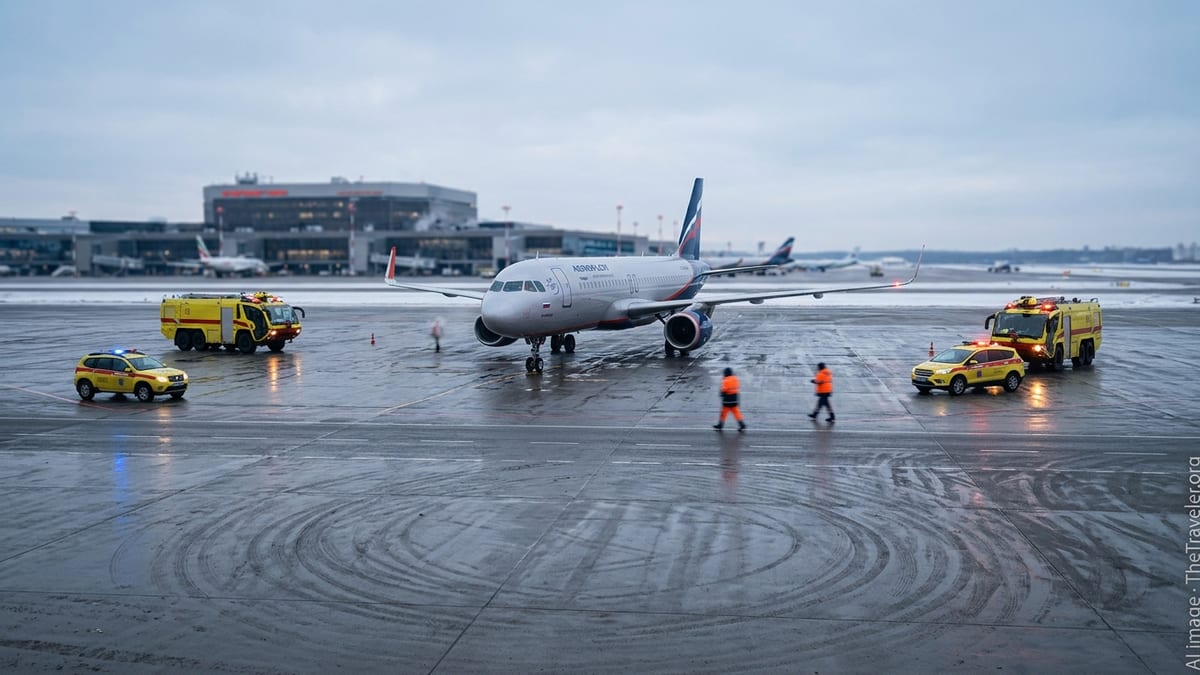
There were no early indications from open sources of a fire or visible structural damage to the jet during its return. Images circulating on social media shortly after landing appeared to show the aircraft intact on the runway as emergency response vehicles approached.
Emergency Landing and Runway Response
According to operational details referenced in local coverage, the returning jet landed at Sheremetyevo under emergency conditions, with fire and rescue services pre-positioned along the runway. Flight-tracking timelines suggest the aircraft had been airborne for a relatively short period, limiting the amount of fuel burned before touchdown compared with a full-length sector to Baku.
Following the landing, airport services initiated a standard safety protocol, including a runway inspection to verify that no debris or leaked fluids posed a risk to subsequent movements. This type of check is routine after an emergency arrival and typically results in a short pause to traffic on the affected runway.
Passengers were reported to have disembarked at Sheremetyevo, with ground staff coordinating onward travel and further information. As of early reports, there were no publicly confirmed serious injuries among those on board, and no immediate indication of damage severe enough to be visible from a distance.
While emergency responses at major hubs can appear dramatic due to the number of vehicles deployed, aviation specialists note that such mobilizations are precautionary and form part of a well-rehearsed safety framework at large international airports.
Possible Technical Issue Still Under Review
As of the latest publicly available information, the specific cause prompting the diversion of SU1854 had not been formally detailed in open sources. Early aviation commentary has pointed to the profile of the flight path and the timing of the return as consistent with a suspected technical malfunction rather than external factors such as weather or security alerts, although this remains unconfirmed.
In similar cases, crews may decide to return to the departure airport when faced with cockpit alerts, system anomalies, or other concerns that affect performance or reliability. The decision frame is generally conservative: remaining close to an airport with full maintenance facilities and emergency services is widely regarded as the safest course of action when the status of the aircraft is in doubt.
Any technical findings from inspections at Sheremetyevo are likely to feed into internal reporting and, where required, regulatory documentation. These processes typically take place out of public view and can continue for days or weeks while engineers review data logs, perform tests, and, if necessary, replace components.
Industry observers note that, while diversions capture public attention, they are statistically infrequent compared with the large number of routine flights operated daily and are designed to maintain safety margins rather than indicate a systemic failure.
Impact on Passengers and Operations
The diversion of SU1854 disrupted travel plans for passengers expecting to arrive in Baku on the scheduled service. Based on usual practice in such situations, travelers would be rebooked on alternative flights where possible or offered revised itineraries once the status of the aircraft and the route became clearer.
Operationally, an unscheduled emergency arrival can create short-term complexity for airport controllers managing runway slots and ground movements. Sheremetyevo, as one of the region’s busiest hubs, maintains contingency plans to absorb such events, reallocating arrival and departure sequences to keep delays within manageable limits.
Airline scheduling may also be affected if the aircraft is removed from service for enhanced checks. This can trigger knock-on adjustments to other rotations using the same equipment, with carriers often bringing in spare aircraft from their fleets or consolidating services to maintain coverage on key routes.
Travelers with upcoming bookings on the Moscow to Baku route are advised, based on standard travel best practice, to monitor their flight status closely and allow extra time at the airport in case of changed schedules or aircraft substitutions.
Safety Context and Regional Air Travel
The diversion of Aeroflot flight SU1854 highlights the operational complexities of air travel between Russia and the South Caucasus, a corridor that remains an important link for business, family, and tourism travel despite broader geopolitical tensions. Moscow to Baku is a well-established route, operated regularly and typically without incident.
Commercial aviation relies on layers of redundancy, from onboard systems and crew training to airport emergency capabilities. Diversions and precautionary landings form part of that multi-layered safety net. When an aircraft returns to its departure point shortly after takeoff, it is usually a sign that the safety protocols have been activated as designed.
Regional travelers have grown accustomed to monitoring route changes and schedule adjustments in recent years, reflecting shifts in airspace availability, sanction regimes, and fleet deployment strategies. Within that broader context, individual flight disruptions stand out in the moment but are generally absorbed into a wider pattern of operational adaptation.
As more information emerges from publicly available sources about the circumstances behind SU1854’s emergency landing, the event is expected to be examined in detail by aviation analysts, adding another case study to the industry’s ongoing focus on risk management and flight safety.