

More news on this day
Travelers planning domestic trips across Argentina are facing fresh uncertainty after Aerolíneas Argentinas reportedly canceled more than 15 additional flights, disrupting popular routes to Bariloche, Iguazú, Córdoba and other major destinations at the height of the late-summer travel period.
Get the latest news straight to your inbox!
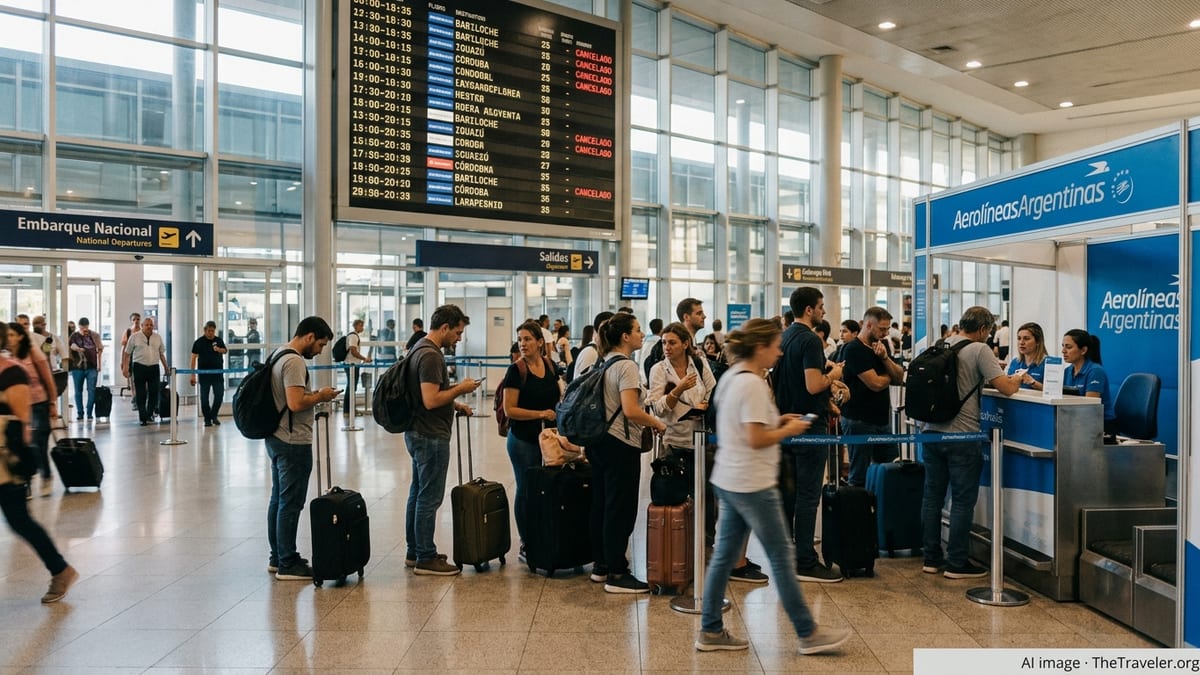
Wave of New Cancellations Hits Peak Travel Period
Recent schedule updates and local coverage in Argentina indicate that Aerolíneas Argentinas has withdrawn or reprogrammed over a dozen flights on short notice, affecting services on some of the country’s most heavily used domestic routes. The latest round of cancellations comes on top of a year already marked by operational adjustments and prior mass disruptions tied to labor actions and capacity changes.
Publicly available reporting in Argentine media during February and March 2026 pointed to significant strains on the national carrier’s domestic operation, including earlier days when more than 200 flights were either canceled or rescheduled in a single 24-hour period during industrial action at airports. While the current tally of more than 15 newly canceled services is smaller in scale, the concentration on core tourist and business destinations has amplified the impact on travelers.
The timing is particularly difficult for visitors, with many international tourists still in the country for Patagonia’s late-summer season and local travelers taking advantage of shoulder-season fares. The sudden loss of capacity on select days has left some passengers scrambling to rebook at higher prices or reshape carefully planned overland itineraries.
Bariloche and Iguazú Among the Worst Affected
San Carlos de Bariloche and Puerto Iguazú, two of Argentina’s marquee leisure destinations, are among the routes most affected by the latest Aerolíneas Argentinas cuts, according to domestic travel advisories and booking-system snapshots reviewed in recent days. Both cities are heavily reliant on air links from Buenos Aires and regional hubs such as Córdoba and Rosario, meaning even a small reduction in frequencies can cause knock-on pressure across the network.
Bariloche, gateway to the Lake District and a key base for trekking and lake excursions, has already experienced periodic reductions in flight options over the past two years. Travelers on forums and social platforms have frequently described needing to reroute through other cities or replace flights with overnight buses when direct services disappeared or were rescheduled at short notice. The newest cancellations have revived concerns about the reliability of air access into Patagonia during periods of labor tension or operational adjustment.
In the northeast, Puerto Iguazú, the Argentine side of the world-famous Iguazú Falls, is seeing a similar effect. Domestic itineraries that once depended on straightforward hops from Buenos Aires or Córdoba now show tighter availability on certain dates, and some travelers report being moved to different days or times as Aerolíneas Argentinas trims its schedule. For visitors with limited vacation windows, even a single canceled leg can mean losing valuable time at the falls or skipping other destinations further along their route.
Córdoba and Secondary Hubs Feel Network Strain
The latest cancellations are not limited to tourist hotspots. Córdoba, one of Argentina’s main internal aviation hubs and a critical connecting point for flights to both Bariloche and Iguazú, is also feeling the effects as Aerolíneas Argentinas adjusts frequencies. Public airport information shows that Córdoba normally serves as a bridge between Buenos Aires and a broad network of provincial cities; when flights are dropped or retimed, connections throughout the interior can quickly unravel.
Travel planning data and recent passenger accounts suggest that some services linking Córdoba with destinations such as Mendoza, Neuquén, and other Patagonian and northern cities have faced last-minute changes, either in departure times or operating days. While not all of these adjustments qualify as outright cancellations, the cumulative disruption has complicated multi-stop itineraries that rely on smooth same-day transfers.
Smaller markets, including cities in Patagonia and the far south, are particularly vulnerable when national carriers consolidate flights. Earlier cuts to frequencies in places such as Río Grande, documented in regional press in 2025, highlighted how even a reduction to a single daily service can affect local residents and visitors alike. The new round of adjustments underscores how thinly stretched some domestic routes remain, despite a gradual return of tourism volumes.
Labor Actions and Operational Pressures in the Spotlight
The latest disruptions come against a backdrop of ongoing labor tensions and operational pressures across Argentina’s aviation sector. In recent weeks, unions representing airport and airline workers have called strikes or work stoppages affecting more than two dozen airports, generating waves of delays and cancellations for multiple carriers. Public statements from labor groups and airport authorities have cited disputes over pay, staffing levels, and working conditions.
Earlier this year, Argentine newspapers reported that Aerolíneas Argentinas had on one occasion canceled or rescheduled more than 250 flights in connection with industrial action, stranding tens of thousands of passengers across the network. While the current figure of more than 15 newly canceled flights is far lower, it forms part of a broader pattern in which any labor dispute or infrastructure bottleneck can quickly cascade through the carrier’s tightly scheduled domestic operation.
Beyond labor, operational complexity and aircraft utilization are also factors. As Aerolíneas Argentinas juggles maintenance cycles, seasonal demand patterns, and competition from low-cost rivals on key domestic corridors, certain routes can see their schedules compressed or consolidated with limited warning. This can be especially challenging on days when weather delays ripple through the network, forcing the airline to prioritize core trunk routes at the expense of less frequent services.
What Travelers Can Expect and How to Adapt
For travelers currently in Argentina or planning trips in the coming weeks, publicly available information from airline websites, airport boards and recent passenger experiences points to a more volatile environment than usual on domestic flights. It is not uncommon for departure times to shift by several hours in the days leading up to travel, and in some cases flights are removed entirely and replaced with alternative options.
Experienced visitors to Argentina increasingly recommend building additional flexibility into itineraries that involve Aerolíneas Argentinas or other local carriers, especially when connecting to onward international flights or remote destinations with limited daily service. Buffer days in gateway cities such as Buenos Aires or Córdoba, as well as refundable accommodation and transport bookings, can help absorb schedule shocks.
Some travelers are also turning to alternative airlines on popular leisure routes, including low-cost carriers that operate between Buenos Aires and destinations like Bariloche, Iguazú, and El Calafate. However, public discussions and consumer reports caution that these airlines, too, have faced scrutiny over high cancellation rates at times, suggesting that reliability concerns are not confined to the national flag carrier.
In the short term, the new round of more than 15 cancellations is likely to heighten anxiety among visitors heading to Bariloche, Iguazú, Córdoba and other affected destinations. Until there is clearer stability in labor relations and airline scheduling, travelers may need to watch their bookings closely and prepare for last-minute changes as part of the Argentine travel experience.