

More news on this day
Aeromexico is restoring its seasonal nonstop service between Monterrey and New York John F. Kennedy International Airport with increased capacity, marking a renewed push to capture growing holiday and summer demand on one of northern Mexico’s most internationally focused routes.
Get the latest news straight to your inbox!
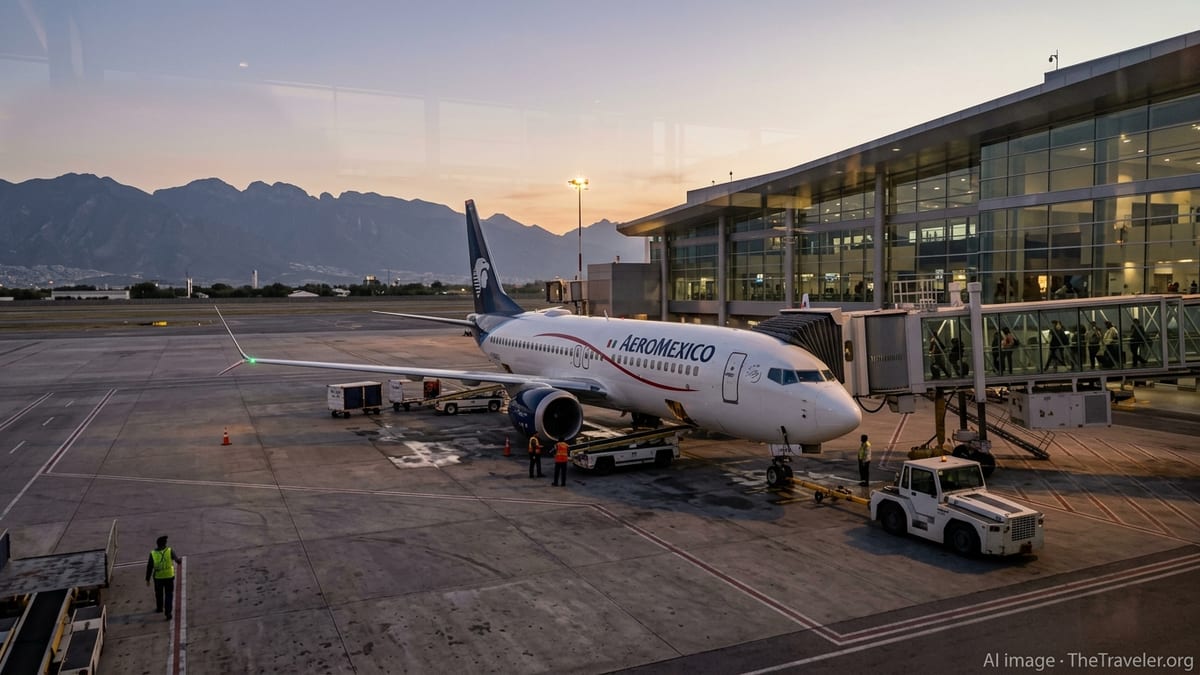
Seasonal Service Returns on a High-Demand Corridor
The Monterrey to New York JFK route has re-emerged in Aeromexico’s network as a key seasonal link after several years of intermittent operation. Publicly available schedule data shows the airline brought the route back in May 2024 on a daily basis after it was last served in March 2020, initially with Embraer 190 aircraft operated by Aeromexico Connect. Subsequent seasonal planning for the 2024–2025 and 2025–2026 peak periods has focused on concentrating capacity during windows of strongest demand.
Timetables for the upcoming northern summer indicate that the route will operate on a seasonal pattern rather than year-round, positioned around vacation peaks and periods of heightened business travel between northern Mexico and the U.S. East Coast. The service complements Aeromexico’s broader transborder network developed alongside its joint venture with Delta Air Lines, providing alternative access to New York beyond the airline’s core Mexico City hub.
The decision to keep Monterrey–JFK seasonal reflects a strategy increasingly common among carriers on long cross-border routes. Airlines are prioritizing flexibility to adjust capacity to demand cycles, while preserving slot access and brand visibility in competitive gateway markets such as New York.
Increased Capacity Through Larger Aircraft and Densified Schedules
Industry schedule trackers show that Aeromexico’s latest iteration of the Monterrey–JFK route is defined less by new frequencies and more by the size and configuration of aircraft assigned. The service, which initially returned with Embraer 190 regional jets, is moving toward more seat-rich narrowbody aircraft such as the Boeing 737 MAX family during certain peak periods. This represents a substantial increase in available seats per departure compared with the smaller regional jets that previously dominated the route.
The use of larger aircraft aligns with Aeromexico’s wider fleet modernization, as the carrier continues to deploy next-generation narrowbodies on routes with a mix of premium and price-sensitive traffic. The airline can add capacity on the Monterrey–New York sector not only by upgauging aircraft but also by fine-tuning day-of-week schedules to align departures from both ends of the route with connecting banks in Monterrey and New York.
Traffic reports from Grupo Aeroportuario del Centro Norte, the operator of Monterrey International Airport, indicate a steady rise in international volumes through late 2025. Those figures list the Monterrey–New York JFK sector as a seasonal operation for Aeromexico, underscoring the route’s role as a targeted capacity lever during high-demand months rather than a continuous year-round presence.
Strategic Importance for Monterrey’s International Hub
Monterrey has consolidated its position as the leading air hub in northern Mexico, and the seasonal JFK link supports that status by offering direct access to one of the world’s most important financial and tourism centers. Airport data shows Monterrey handling a growing portfolio of international routes, with New York JFK appearing among a set of seasonal transborder destinations that also includes U.S. leisure markets.
For the region’s manufacturing, automotive and technology sectors, the nonstop flight to New York shortens travel times to key partners, investors and corporate headquarters. At the same time, it taps into strong visiting-friends-and-relatives traffic in both directions, as well as tourism demand from U.S. travelers drawn to Monterrey’s business events, outdoor attractions and proximity to other northern Mexican cities.
By reactivating the Monterrey–JFK route with higher capacity, Aeromexico also strengthens its role within the SkyTeam ecosystem. The New York gateway provides onward connectivity to a wide range of domestic U.S. and transatlantic destinations, while Monterrey functions as a secondary hub feeding domestic Mexican routes and select international services, allowing travelers to bypass the more congested Mexico City airports.
Competitive Landscape and Regulatory Backdrop
The seasonal restart comes against a complex competitive and regulatory backdrop for Mexico–U.S. air travel. Over the past two years, Mexican carriers have adjusted routes and capacity as U.S. authorities revisited air services agreements and scrutinized new transborder routes. While many of the most restrictive measures have focused on services touching Mexico City’s main airports, the environment has still encouraged airlines to be cautious about where and when they deploy new capacity.
Within this context, Aeromexico’s decision to emphasize seasonal, capacity-optimized service from Monterrey to New York allows the airline to maintain a presence in a high-profile U.S. market without overcommitting year-round. Competing carriers on Mexico–U.S. routes have likewise been leaning on seasonal adjustments, using aircraft swaps and schedule changes to track demand more closely.
For travelers, increased capacity on a seasonal nonstop route can translate into more fare options and improved availability during peak periods. However, the limited operating window also means that outside the designated season, passengers must rely on connections via Mexico City or other hubs to reach New York, underscoring the importance of advance planning for those targeting the nonstop service.
Outlook for Future Seasons
Forward schedules published by Aeromexico and industry timetable providers suggest the Monterrey–New York JFK route is likely to remain a seasonal fixture tied to the northern hemisphere summer and end-of-year travel peaks. Indications of continued deployment of modern narrowbodies on the route point toward a strategy of consolidating demand on fewer, larger flights rather than adding multiple daily frequencies.
Airport traffic reports for Monterrey show that international passenger numbers have been trending upward, providing a supportive backdrop for future iterations of the service. As airlines finalize their plans for the 2026 northern summer and subsequent holiday seasons, the Monterrey–JFK link appears poised to continue as one of Aeromexico’s key point-to-point transborder offerings outside Mexico City.
For now, the return of Aeromexico’s seasonal flights from Monterrey to New York JFK with increased capacity underlines how Mexican and U.S. carriers are reshaping their networks to capture peak demand while preserving flexibility. Travelers between northern Mexico and the New York metropolitan area gain a more direct option during the busiest months, while Monterrey strengthens its position as a growing international gateway in its own right.