

More news on this day
Aeromexico is sharpening its Latin America network strategy with an expanded Quito–Mexico City schedule that strengthens Ecuador’s one-stop access to long-haul destinations such as Paris, Montreal, Cancún, Rome and Tokyo via the airline’s main hub.
Get the latest news straight to your inbox!
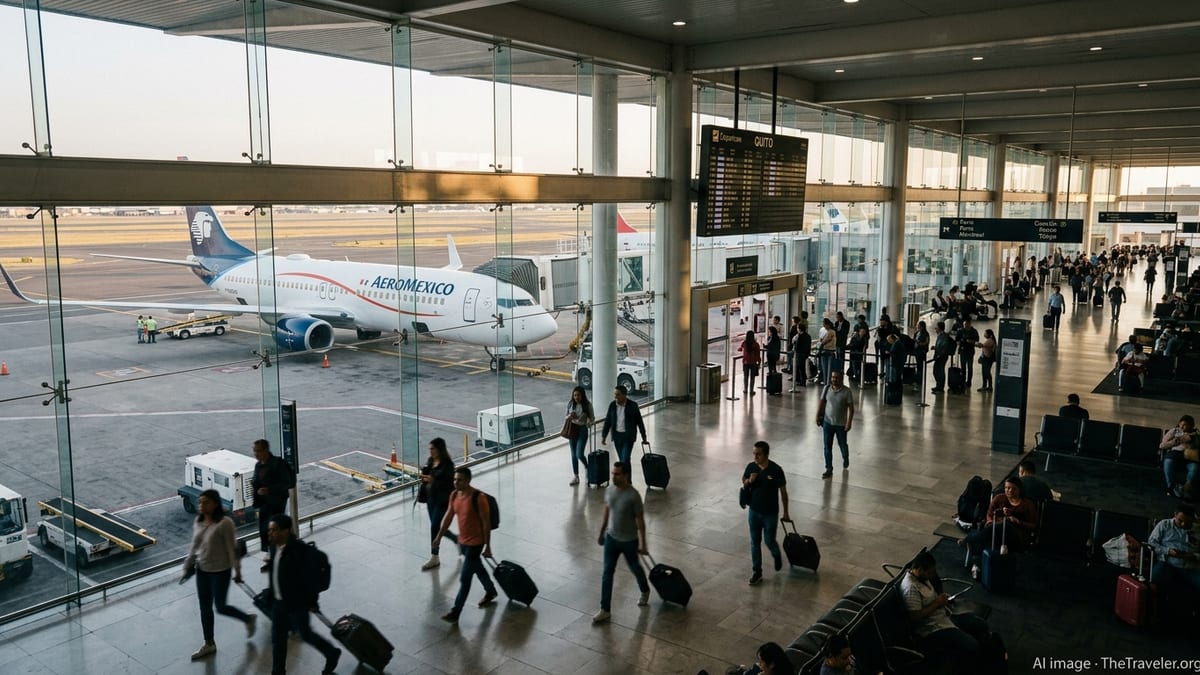
More capacity on a key Andean–Mexico trunk route
The Quito–Mexico City corridor has become an important bridge between Ecuador and Aeromexico’s global network, and the airline is now adding capacity and schedule tweaks designed to improve connectivity over its Mexico City hub. Publicly available booking data for upcoming seasons shows additional weekly frequencies and time adjustments that better align with late-night and early-morning banked departures from the Mexican capital.
The route is typically served with narrowbody aircraft configured for regional operations, but timed to connect with Aeromexico’s long-haul Boeing 787 widebody flights out of Mexico City International Airport. The latest changes concentrate more seats on peak days and seasons when demand from business travelers, visiting friends and relatives, and leisure passengers to onward destinations is strongest.
For Quito-origin passengers, the strengthened schedule reduces layover times on many connections and opens up more same-day options in both directions. It also gives Aeromexico more inventory to sell in key markets such as Europe, Canada and Asia where Mexico City acts as a natural connecting point for the Andean region.
On the Mexico side, the added Quito capacity fits into a broader network realignment in which the airline is reinforcing routes that reliably feed its long-haul services. The Ecuador link complements existing flows from Colombia, Peru and other South American countries that also bank through Mexico City.
One-stop access to Paris, Rome and other European gateways
One of the main benefits of the enhanced Quito–Mexico City link is smoother one-stop connectivity to Europe. From Mexico City, Aeromexico and its partners operate non-stop flights to major European gateways including Paris and Rome, with schedules built around overnight transatlantic departures and daytime arrivals.
For Quito travelers, this means leaving Ecuador in the afternoon or evening, connecting in Mexico City, and reaching Europe the following day without backtracking through traditional South American hubs. In many cases, total travel time is competitive with routings via Bogotá, Panama City or São Paulo, particularly for western European destinations.
The bolstered Quito–Mexico City schedule also improves access to secondary European cities reachable via partners. Once in Paris or Rome, passengers can continue onward to a broader network across France, Italy and neighboring countries, using coordinated timetables that target early-morning wave arrivals in Europe.
Tourism bodies in both Ecuador and Mexico have highlighted the importance of better European access for attracting visitors to the Galápagos, the Andes and Mexican beach destinations. Enhanced connectivity through Mexico City positions the Aeromexico network as a viable alternative for European travelers heading to Ecuador, especially during peak holiday periods.
Improved links to Montreal, Cancún and North American leisure markets
North America is another major beneficiary of the strengthened Quito–Mexico City route. Mexico City is already a key hub for Aeromexico flights to Canadian cities such as Montreal as well as popular leisure destinations including Cancún, and the schedule changes give Quito-origin passengers more options to tap into those flows.
Additional Quito frequencies increase the number of viable same-day connections into Montreal-bound services, which typically depart Mexico City in banked waves that support both corporate and leisure traffic. For Canadian travelers, the reverse direction offers streamlined itineraries into Ecuador, useful for winter escapes or adventure tourism itineraries that combine Quito, the Amazon and the Galápagos.
On the domestic front within Mexico, improved connectivity to Cancún and other resort areas gives Ecuadorian travelers simpler access to one of Latin America’s busiest beach regions. Many itineraries can now be booked with coordinated connection times in Mexico City, avoiding long overnight layovers and making long-weekend or short-break trips more practical.
These patterns are reflected in publicly available booking engines, where Quito–Mexico City itineraries now often display a wider range of same-day options into and out of both Montreal and Cancún, reducing the need for multi-stop or mixed-carrier journeys.
Gateway to Tokyo and the wider Asia–Pacific region
Aeromexico’s hub in Mexico City also serves as a bridge to Asia, most notably through non-stop flights to Tokyo. The expansion of the Quito–Mexico City route strengthens this intercontinental corridor by providing more reliable feed from the Andean region into Asia-bound services.
Schedules show that many Quito–Mexico City arrivals are now better aligned with onward departures to Tokyo, giving Ecuador-based travelers a one-stop option to reach Japan. This can be particularly attractive for business travelers and for those connecting to broader Asia–Pacific destinations via Japanese partner networks.
The enhanced connectivity may also encourage growing tourism flows from Asia into Ecuador, as travelers from Tokyo and beyond look for efficient one-stop options into South America. Quito’s role as a jumping-off point for nature and cultural tourism gives it a distinct appeal for long-haul visitors seeking multi-center itineraries that combine Mexico, Ecuador and other countries in the region.
While Asia–Latin America traffic remains a relatively small segment compared with transatlantic or North American flows, network upgrades such as the Quito–Mexico City expansion are a key part of how airlines gradually build up demand on long-haul flights by feeding them with diverse regional markets.
What travelers need to know when booking through Mexico City
For passengers considering the strengthened Quito–Mexico City route, several practical factors stand out. First, Mexico City International Airport is a busy global hub with significant connecting traffic at peak times, so the improved schedule does not eliminate the need to plan for possible congestion at security and immigration checkpoints.
Travelers connecting onward to Paris, Montreal, Cancún, Rome, Tokyo and other cities typically need to remain within the international transit flow, but requirements can vary depending on nationality and final destination, so passengers are advised to verify entry and transit rules in advance. Airlines and airports often update guidance seasonally, and publicly available advisories may change as governments adjust regulations.
From a planning perspective, the expansion of the Quito–Mexico City route means it is increasingly worthwhile to compare one-stop itineraries via Mexico City against other regional hubs. Factors such as total travel time, layover length, checked baggage policies and schedule reliability can differ considerably between competing routings, even when headline journey times appear similar.
The additional capacity also has potential implications for pricing. Greater seat availability on the Quito–Mexico City sector can translate into more fare options in some seasons, although final ticket costs depend heavily on demand on the long-haul legs to destinations such as Paris, Montreal, Cancún, Rome and Tokyo. Travelers with flexible dates may find that shifting departure by a day or two yields more favorable combinations across the entire itinerary.