

More news on this day
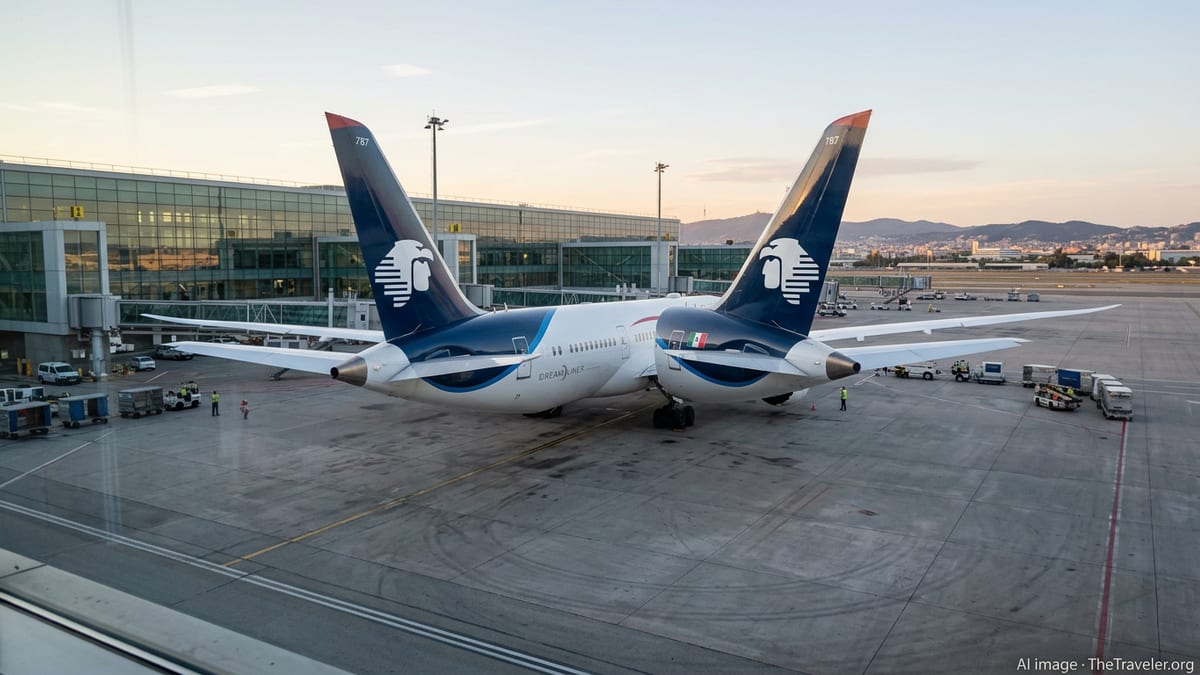
Aeromexico is set to resume nonstop flights between Mexico City and Barcelona in late March 2026, restoring a key Europe–Latin America link and expanding its Boeing 787 Dreamliner network that already connects the Mexican capital with Amsterdam, Paris, Madrid and London.
Get the latest news straight to your inbox!
Mexico City–Barcelona Route Returns in March 2026
Publicly available schedules and airport information show that Aeromexico will restart its Mexico City to Barcelona route from March 26–28, 2026, after a pause of several years. The service will operate between Mexico City International Airport and Josep Tarradellas Barcelona El Prat Airport, reinstating a direct link between one of Latin America’s largest hubs and a major Mediterranean gateway.
Reports from aviation industry outlets indicate the route will be offered six times per week, giving the Barcelona market close to daily connectivity with Mexico City during the northern summer season. Capacity forecasts suggest more than 3,000 weekly seats on the route, reflecting growing demand for business, leisure, and visiting friends and relatives travel between Spain and Mexico.
Barcelona joins an expanding European map for Aeromexico, which has been rebuilding its long haul network following its restructuring earlier in the decade. The move comes as transatlantic demand between Europe and Latin America continues to recover and diversify beyond traditional gateways such as Madrid and Paris.
Part of a Broader Europe–Latin America Strategy
According to published coverage from network-planning and aviation data specialists, Barcelona’s return sits within a wider Aeromexico push in Europe. The airline already links Mexico City with Amsterdam, Paris Charles de Gaulle, Madrid Barajas and London Heathrow, positioning the Mexican capital as a key north–south hub for flows between Europe and Latin America.
The restored Barcelona flights are scheduled to complement existing services rather than replace them, adding another entry point into the Iberian Peninsula. Industry analysis highlights that Aeromexico plans to grow its total Spain frequencies to around 40 per week in summer 2026, counting flights not only to Madrid from multiple Mexican cities but also the renewed Barcelona operation.
Aeromexico’s strategy appears aimed at capturing both point to point traffic and connecting passengers. Mexico City functions as a gateway to major destinations across Mexico and South America, while European partners and interline agreements in Amsterdam, Paris, Madrid and London provide onward access to the rest of the continent.
Dreamliner Fleet at the Core of the Expansion
Fleet information published by Aeromexico and independent databases shows that the Mexico City–Barcelona service will be operated by Boeing 787 Dreamliner aircraft, specifically the 787-8 and 787-9 variants that already serve the carrier’s main European routes. These widebody jets form the backbone of Aeromexico’s long haul operations.
The 787-8 and 787-9 offer a combination of fuel efficiency and passenger comfort that is particularly suited to transatlantic sectors of around 11 to 12 hours. The larger 787-9 typically features more seats and a business class cabin arranged in a 1-2-1 configuration, while the 787-8 carries a slightly smaller premium cabin in a 2-2-2 layout, according to publicly available seat maps and fleet descriptions.
The use of a consistent Dreamliner product across Amsterdam, Paris, Madrid, London and now Barcelona allows Aeromexico to standardize its onboard offering on key Europe–Latin America routes. For travelers, this means lie flat seating in the premium cabin on most aircraft, modern in flight entertainment systems, larger windows and cabin pressurization designed to reduce fatigue on long overnight flights.
Strengthening Barcelona’s Transatlantic Profile
Information released by Barcelona’s promotional and airport development bodies describes the Mexico City route as an important addition to the city’s long haul network. Barcelona El Prat has been progressively building its presence as a transatlantic gateway, with direct connections to major cities in North America, the Middle East and increasingly Latin America.
Aeromexico’s return reintroduces direct connectivity to Mexico City from Barcelona, a route that has previously seen intermittent service. Industry observers note that the Mexican carrier will share the market with at least one other long haul airline linking the two cities, creating fresh competition on fares, schedules and product.
The new flights are expected to support tourism, trade and investment between Catalonia and Mexico. Tourism data in recent years has shown robust flows of visitors in both directions, and business organizations on both sides of the Atlantic have highlighted the value of nonstop air links for corporate travel and cargo-sensitive sectors.
Competitive Dynamics Across Amsterdam, Paris, Madrid and London
By adding Barcelona back into its schedule, Aeromexico reinforces a five-strong network of European gateways from Mexico City alongside Amsterdam, Paris, Madrid and London. Publicly available route maps show that these cities serve as key pillars in the carrier’s transatlantic offering, each feeding different geographic and commercial segments.
Amsterdam and Paris provide strong connectivity into northern and central Europe through their roles as major alliance and interline hubs. Madrid and Barcelona give Aeromexico an extensive footprint in Spain, where demand for travel to Mexico is sustained by cultural ties, tourism and diaspora communities. London offers access to the United Kingdom’s sizeable outbound long haul market and onward links into the wider British and Irish regions.
Aviation analysts suggest that the combined network, all operated with Boeing 787-8 and 787-9 aircraft, is designed to balance origin and destination traffic with connecting flows. With Barcelona rejoining the schedule from March 2026, Aeromexico strengthens its competitive posture in the Europe–Latin America corridor and underscores the strategic importance of Dreamliner operations out of Mexico City.