

More news on this day
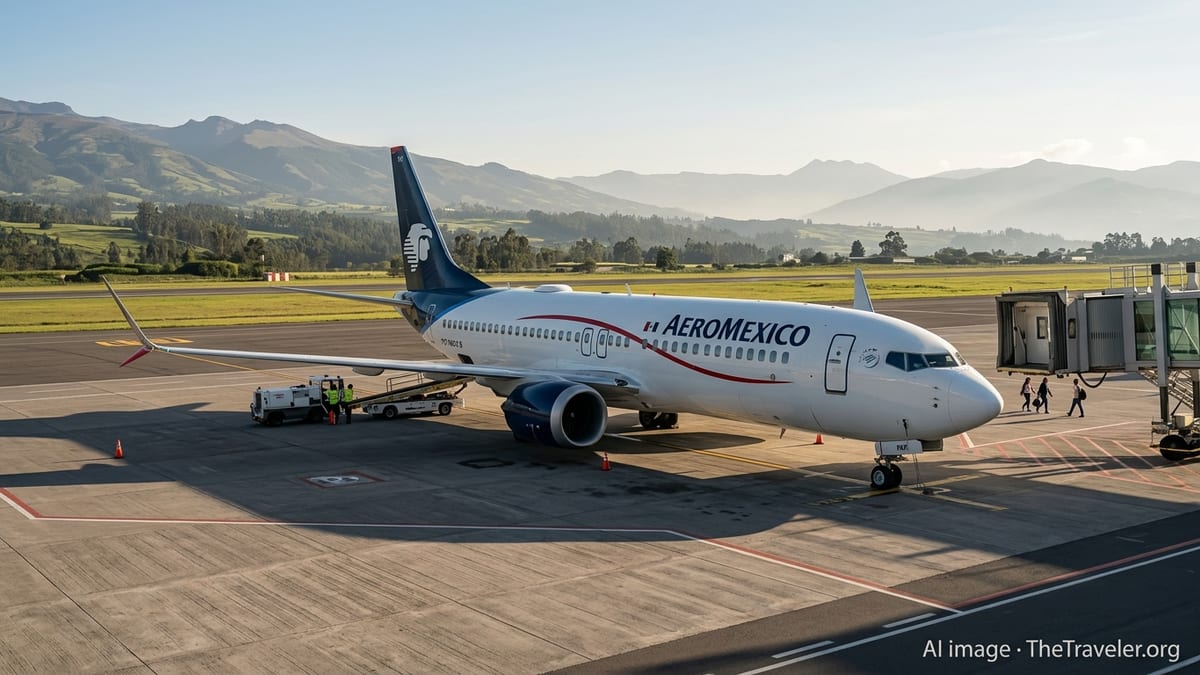
Aeromexico is set to restore nonstop service between Mexico City and Quito from March 23, 2026, returning to the Ecuadorian capital with four weekly flights after nearly two years of suspension.
Get the latest news straight to your inbox!
Service Returns After 2024 Suspension
Publicly available schedule data shows that Aeromexico last operated the Mexico City–Quito route until mid-2024, when flights were withdrawn amid heightened political tensions between Mexico and Ecuador. Industry reports note that the connection was halted around late June and early July 2024, cutting a direct link that had offered several weekly frequencies between the two capitals.
Routes coverage published in February 2026 indicates that the airline now plans to resume the service from March 23, 2026, with operations programmed at four flights per week. The move places Quito back on Aeromexico’s South American map at a time when the carrier is steadily rebuilding and reshaping its international network.
Prior to the suspension, Aeromexico had been using Boeing 737 MAX 8 aircraft on the Quito route, providing a narrow-body product with lie-flat business-class seats on certain configurations and modern cabin features. Current filings for the restart show the same aircraft type scheduled for the renewed service, suggesting a similar onboard experience for travelers.
Flight Schedule and Aircraft Details
According to timetable information compiled by specialist air-service trackers, Aeromexico’s restored Mexico City–Quito operation is scheduled to run four times weekly, avoiding departures on specific midweek days. The planned flight pattern positions the southbound service as a late-morning departure from Mexico City, reaching Quito in the afternoon, while the northbound leg leaves Ecuador late morning and arrives in the Mexican capital early afternoon.
The route is set to be operated with Boeing 737 MAX 8 aircraft, reflecting Aeromexico’s broader strategy of deploying this fuel-efficient narrow-body across mid-haul Latin American markets. The aircraft’s range and performance are well suited to operations into Quito’s high-altitude Mariscal Sucre International Airport, which requires careful performance planning because of its elevation in the Andean valley.
Capacity-wise, four weekly rotations on the MAX 8 translate into thousands of monthly seats each way, restoring a non-stop option for business, leisure, and visiting-friends-and-relatives traffic between central Mexico and Ecuador. The daytime schedule in both directions also offers viable same-day connections over Mexico City to cities across North America, Europe, and Asia within Aeromexico’s long-haul network and that of its SkyTeam partners.
Strategic Role in Aeromexico’s Latin American Network
The decision to return to Quito comes as Aeromexico continues to consolidate its position as a regional connector between North and South America. In recent months the airline has announced additional long-haul services and frequency increases on key cross-border routes, while also adjusting capacity to respond to demand trends in major U.S., Central American, and Caribbean markets.
By reinstating Ecuador’s capital, Aeromexico restores a link that strengthens its South American offering alongside destinations such as Bogotá, Lima, and Santiago. The Mexico City–Quito sector is positioned to capture flows not only between the two capitals but also connecting passengers traveling from the United States and Canada to Ecuador, as well as Ecuadorian travelers heading to Mexico’s tourist centers and beyond.
Industry observers note that the restart underscores the importance of political normalization and improving air services between Mexico and Ecuador. While the route suspension in 2024 was tied in part to a challenging diplomatic backdrop, the renewed schedule from March 2026 suggests that commercial conditions have again become favorable enough to sustain regular operations.
Benefits for Quito’s Connectivity and Tourism
Information shared by aviation-focused publications in Ecuador highlights that the return of Aeromexico will enhance Quito’s long-haul connectivity by reinstating a direct link to one of Latin America’s major hubs. Mexico City offers an extensive bank of onward connections, and reintroducing four weekly services effectively plugs Quito back into a broader mesh of destinations across North America and Asia accessed via Aeromexico and its partners.
For Quito and the surrounding region, the service is expected to support both inbound and outbound tourism. Nonstop flights from Mexico City lower travel times for Mexican visitors heading to Ecuador’s highlands, Amazon gateways, and Galápagos itineraries via domestic connections. At the same time, residents of Ecuador gain more seamless access to Mexican beach destinations and urban centers through one-stop itineraries over Aeromexico’s main hub.
Business travel and trade ties also stand to benefit. Regular air service between the two capitals simplifies corporate travel, facilitates participation in regional events, and supports sectors such as manufacturing, services, and energy that rely on reliable connectivity. Travel industry analysts point out that even a four-times-weekly schedule can have an outsized impact in markets where alternative routings require lengthier or less convenient connections.
Booking Outlook and Market Response
Searchable booking data on Aeromexico’s website indicates that round-trip itineraries between Mexico City and Quito in late March and April 2026 are already available, with dynamic pricing that reflects typical seasonal demand for the region. The early appearance of published fares suggests the airline is moving ahead with sales well before the inaugural flights at the end of March.
Travel agencies and online intermediaries are expected to incorporate the reinstated route into their Latin America offerings in the coming months, particularly for multi-stop itineraries that combine Mexico and Ecuador. As schedules settle, observers will be watching load factors and fare behavior to gauge how quickly the market absorbs the restored capacity.
While the four weekly flights represent a modest step compared with Aeromexico’s busiest regional routes, they may be a foundation for future growth. If demand proves robust and the broader political and economic environment remains stable, analysts consider it plausible that the carrier could adjust frequencies or capacity over time to further strengthen the Mexico City–Quito corridor.