

More news on this day
African governments and regional bodies are sharpening their focus on rural tourism, looking to China’s village-based development model as a blueprint to unlock cultural preservation, job creation and broader economic growth in the continent’s countryside.
Get the latest news straight to your inbox!
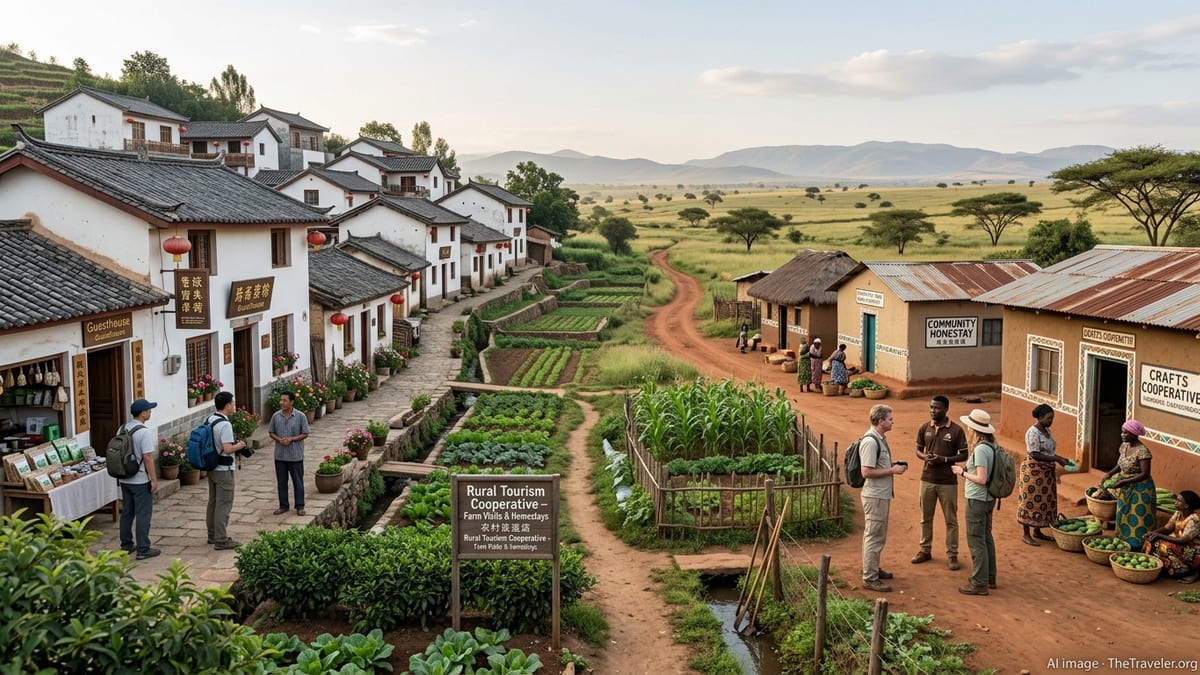
China’s Rural Tourism Model Moves Into the Spotlight
Publicly available data on China’s development trajectory highlights how structured rural tourism policies have been used to cut poverty and revitalize remote areas. Research drawing on national tourism statistics indicates that more than 10 million rural residents moved out of poverty between 2010 and 2015 as tourism projects were rolled out in poor villages, with additional gains targeted in the years that followed. Reports from provinces such as Yunnan and Ningxia describe how homestays, farm experiences and cultural performances have been packaged to attract visitors while keeping income streams anchored in local communities.
China’s wider poverty alleviation effort, credited with lifting hundreds of millions of people out of extreme poverty over four decades, increasingly frames tourism as a complementary industry alongside agriculture and light manufacturing. Recent case studies compiled by international tourism bodies and Chinese think tanks detail how villages have pooled land, upgraded infrastructure and created cooperatives to run guesthouses and agritourism activities. In these accounts, the emphasis falls on integrating tourism with farming, crafts and food processing so that value chains reach beyond a single guesthouse or scenic site.
Global tourism organizations have taken note. A 2024 compilation of best practices on rural revitalization through tourism lists multiple Chinese villages where upgraded homestays, digital marketing and village-level governance reforms have been combined. According to this material, the approach is seen as exportable, particularly to regions with strong cultural assets but limited industrial bases, a description that fits many rural districts across Africa.
Africa’s Untapped Rural Tourism Potential
Across Africa, policymakers and industry analysts point to a long-recognized tourism strength that remains heavily concentrated in a few flagship destinations. Safaris in East and Southern Africa, beach resorts along the Indian Ocean and cultural city breaks in North Africa continue to dominate arrivals. At the same time, large parts of the continent’s rural interior receive relatively few visitors despite landscapes, heritage sites and living traditions that rival better-known hotspots.
Recent assessments by regional tourism platforms argue that rural tourism could serve as a critical complement to extractive and urban-centered growth models. Community conservancies in Kenya’s Maasai Mara, for example, demonstrate how local landowners can receive lease payments and employment from wildlife tourism while maintaining traditional practices. In Rwanda, tightly managed gorilla trekking in Volcanoes National Park is frequently cited as an illustration of how high-value, low-volume tourism can fund conservation and local livelihoods in remote mountain communities.
Project profiles from Southern and West Africa highlight similar trends. Small-scale ecolodges, cultural villages and farm-based experiences in countries such as Namibia, Ghana and Senegal are starting to attract travelers who seek slower, more immersive journeys. Industry observers note that these pilots remain fragmented and often depend on individual operators or non-governmental organizations, but they show that demand exists and that rural tourism can generate cash incomes in areas with limited formal employment.
Policy Convergence: Learning from China’s Village Playbook
Comparative analyses appearing in development and tourism journals over the past two years increasingly draw direct links between China’s village strategies and emerging African policy thinking. Commentaries in international media outline how China’s integration of tourism with agriculture, infrastructure and digital services could inform African approaches to rural planning. These pieces point to China’s experience with consolidating small plots, improving road access and providing training for homestay operators as elements that could be adapted to African contexts rather than copied wholesale.
Reports summarizing exchanges under platforms such as the Forum on China Africa Cooperation describe study visits where African officials tour Chinese villages that have built branded homestay clusters, cultural streets and farm-based attractions. Documentation of these programs notes that visiting delegations have shown interest in the way local cooperatives share revenue, how branding emphasizes ethnic heritage, and how central and provincial authorities provide targeted grants or credit lines for small tourism businesses.
Tourism-focused organizations are also spotlighting China’s role in global rural tourism initiatives. UN Tourism materials on the Best Tourism Villages program, for example, list Chinese villages alongside destinations from Europe, Latin America and the Middle East as models of how tourism can be managed for community benefit. Commentaries on these listings suggest that African contenders can draw lessons on criteria such as resident participation, heritage conservation and diversification into food production, handicrafts and outdoor recreation.
New Rural Tourism Experiments on the Ground in Africa
On the continent itself, recent project announcements indicate that a new generation of rural tourism initiatives is beginning to incorporate lessons associated with the Chinese model. In East Africa, conservation-oriented hospitality companies continue to expand partnerships that combine small camps with community landholding structures. Publicly available company information describes how revenue-sharing agreements, training schemes and local procurement targets are being used to direct a portion of tourism earnings back into schools, clinics and small enterprises in surrounding villages.
In North and West Africa, governments are promoting cultural routes that link rural craft centers, historic towns and agricultural landscapes. Published tourism strategies from countries such as Morocco and Ghana refer to the potential of guesthouses, women-led cooperatives and gastronomy trails to keep value in rural districts. Analysts draw parallels with Chinese examples where once-isolated villages now market pottery, tea, fruit or traditional performances to domestic and international visitors via online platforms and organized tours.
Smaller-scale pilots are emerging in less established tourism markets as well. Development program documentation has highlighted projects in Ethiopia, Rwanda and Madagascar where farmers diversify into homestays, guided walks and farm-to-table dining. According to these reports, success depends not only on building rooms for visitors but also on strengthening local governance, clarifying land use rights and investing in skills such as digital marketing and foreign languages, mirroring themes that recur in China’s rural revitalization literature.
Obstacles, Safeguards and the Road Ahead
Despite growing enthusiasm, analysts caution that rural tourism is not a simple fix for deep-rooted development challenges. Academic work on both China and Africa notes that benefits can be uneven if local residents lack bargaining power, if land rights are unclear or if profits are captured by outside investors. In several Chinese case studies, researchers have documented tensions where villagers receive low wages while enterprises gain most of the returns from scenic branding. Commentaries on African projects raise similar concerns, particularly where communities have limited access to information about contracts and revenue flows.
Environmental and cultural safeguards are another focus. Conservation organizations operating in African landscapes warn that an influx of visitors to fragile ecosystems can damage wildlife habitats or disrupt traditional livelihoods if not carefully managed. International tourism bodies advocate frameworks that cap visitor numbers, channel a share of fees into conservation funds and require impact assessments for new developments. Analysts highlighting Chinese parks and heritage villages note that management plans, carrying capacity limits and zoning rules have been central to mitigating pressure on local environments and historic sites.
Looking ahead, policy papers and industry commentary converge on several priorities for Africa if it is to adapt lessons from China’s model successfully. These include investing in rural transport and digital connectivity, supporting community cooperatives to co-own tourism assets, and building long-term training systems for guides, homestay operators and artisans. Observers argue that with the right safeguards, rural tourism could move from scattered pilot projects to a substantial pillar of Africa’s wider development agenda, transforming villages into hubs of cultural exchange and entrepreneurial activity rather than zones of permanent outmigration.