

More news on this day
African destinations are sharpening their focus on rural tourism, looking to China’s rapid expansion of village-based travel as a template for turning remote communities into engines of cultural and economic growth.
Get the latest news straight to your inbox!
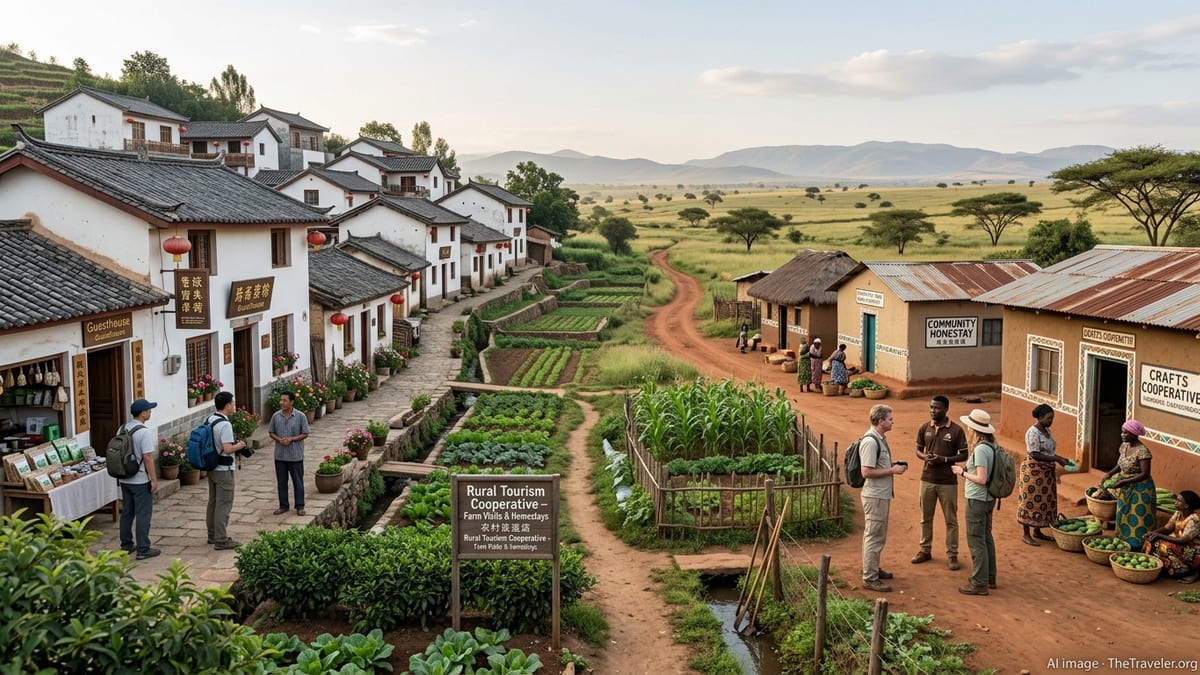
Image by Travel and Tour World – Tourism, Airline, Destination, MICE, Gobal Travel Market, Hotel news that you will find only over here.
Rural Tourism Moves to the Center of Africa’s Growth Agenda
Rural tourism is moving from the margins to the mainstream of Africa’s development debate as countries seek new ways to share the benefits of a tourism rebound. Publicly available information from UN Tourism shows that Africa welcomed around 75 million international tourist arrivals in 2024, close to pre-pandemic levels, renewing interest in how more of this spending can reach villages beyond capital cities and beach resorts.
Reports from regional tourism bodies and development agencies indicate that rural areas are being repositioned as destinations in their own right, offering homestays, cultural festivals, nature experiences and community-run lodges. Governments are pairing these efforts with infrastructure investments in feeder roads, digital connectivity and basic services to make it easier for visitors to stay in villages and small towns.
Analysts note that this shift reflects wider global trends, with travelers seeking slower, more meaningful experiences and destinations under pressure to spread visitor flows away from congested hotspots. For Africa, where a large share of the population still lives in rural areas and depends on small-scale agriculture, the opportunity to add tourism income without displacing traditional livelihoods is gaining traction.
Within this conversation, China’s experience in using rural tourism as a pillar of poverty alleviation and rural revitalization is drawing growing attention among African policymakers and industry groups as a potential reference point.
China’s Village Tourism Model Offers a Playbook
China’s expansion of rural tourism over the past decade is widely cited as one of the most ambitious experiments in using travel to transform countryside economies. Research summaries and industry reports indicate that the output value of China’s rural tourism sector exceeded the equivalent of 900 billion yuan in 2023, supported by hundreds of thousands of homestays and farm-based tourism businesses. National strategies on poverty alleviation and rural revitalization have explicitly promoted leisure agriculture and village tourism as tools for raising incomes and upgrading local infrastructure.
Studies of Chinese pilot regions describe a series of institutional models that share risk and revenue between private operators and villagers. These include approaches summarized as “enterprise plus village collective plus farmers” or “party branch plus company plus households,” in which outside investors or tourism firms develop attractions and accommodation while village collectives contribute land and labor and receive dividends. Local governments often provide supporting measures such as small grants, branding campaigns and training in hospitality and digital marketing.
Recent case material points to counties where rural tourism has generated millions of annual visits, with clustered development of farm stays, homestays and cultural performance venues. In some villages, tourism-related jobs close to home are reported to have reduced outward migration while encouraging investment in public spaces, heritage buildings and environmental restoration. Researchers argue that this combination of institutional innovation, targeted finance and cultural programming is central to the model’s effectiveness.
Observers caution, however, that China’s approach is rooted in its own governance structures and planning capacity, and that any attempt to translate elements of the model to Africa will need to account for very different land tenure systems, community dynamics and levels of public investment.
African Initiatives Begin to Mirror Key Chinese Strategies
Across Africa, a patchwork of initiatives is beginning to echo elements of China’s rural tourism playbook, particularly the focus on linking tourism to broader rural development goals. UN Tourism’s Best Tourism Villages program, which recognizes rural destinations with strong cultural and natural assets and sustainable practices, has highlighted several African villages for their efforts to blend heritage protection with community-based tourism and small-scale agriculture.
New partnerships between international foundations and tourism agencies are also emerging. In 2024, UN Tourism and the TUI Care Foundation launched a small grants initiative targeting rural artisans in African destinations, offering financial support and mentoring to help craftspeople connect with tourism markets. Public information on the program describes aims such as strengthening local value chains, improving product design and supporting youth and women entrepreneurs in remote areas.
Individual countries are designing their own versions of rural tourism zones and circuits. Rwanda has invested heavily in nature-based and lakeside tourism that ties in nearby communities through guesthouses, guided walks and cultural experiences, with sector data showing rapid growth in private tourism establishments over recent years. In East Africa, community conservancy models in Kenya and neighboring states are demonstrating how local landowners can lease land for conservation and tourism, receiving lease fees and employment while maintaining cultural traditions.
Regional visa reforms are expected to complement these efforts. A new multi-country visa scheme in parts of Southern Africa, modeled on a Schengen-style arrangement, is being promoted as a way to encourage visitors to explore lesser-known rural areas across borders in a single trip, potentially spreading tourism revenue across remote communities and supporting cross-border cultural routes.
Opportunities and Risks for Communities and Culture
Experts in sustainable tourism and rural development note that the potential benefits for African villages are substantial. Rural tourism can diversify incomes beyond rain-dependent agriculture, create markets for local food and crafts, and incentivize the preservation of languages, music, architecture and ritual practices that form the backbone of cultural identity. When managed carefully, visitor interest in traditional farming, storytelling and ceremonies can provide resources for cultural transmission to younger generations.
Lessons from China underscore the importance of putting community institutions at the center of rural tourism ventures. Cooperative structures and village collectives have been used there to negotiate with outside investors, oversee benefit-sharing agreements and reinvest part of tourism earnings into public goods. African observers are exploring how similar mechanisms could work through cooperatives, community trusts or customary leadership structures, giving residents a stronger voice in decisions about land use, business models and cultural representation.
At the same time, researchers warn of risks if tourism development outpaces local governance capacity. Experiences in both China and other global destinations point to challenges such as speculative real estate development, rising living costs, cultural commodification and environmental stress on fragile landscapes. Advocates for community-based tourism stress the need for clear zoning, visitor caps where necessary, transparent contracts and continuous dialogue between residents and operators to avoid displacement and ensure that tourism complements rather than replaces traditional livelihoods.
The rapid spread of digital booking platforms and social media marketing adds another layer of complexity. While online visibility can bring new visitors to remote African villages, it can also concentrate demand in a handful of photogenic sites. Observers suggest that destination managers will need to use data and careful planning to promote broader regional circuits and manage seasonality, much as Chinese authorities have experimented with “four-season tourism” offerings to spread visitor flows throughout the year.
Building a Distinctly African Path to Rural Revitalization
Policy analysts emphasize that Africa’s engagement with China’s rural tourism model is less about replication and more about adaptation. China’s experience offers proof that coordinated policies, investment in basic services and creative institutional arrangements can turn villages into dynamic tourism hubs. For African countries, the priority is to weave these ideas into local realities, from communal land tenure in parts of Southern Africa to strong craft traditions in West Africa and rich agricultural landscapes in East Africa and the Sahel.
Regional organizations are increasingly framing rural tourism as part of a broader push for inclusive and resilient growth. Collaborations between UN agencies, national tourism boards and agriculture ministries aim to align tourism with strategies on food systems, climate adaptation and digital inclusion, echoing earlier global initiatives that promoted rural tourism as a way to strengthen rural economies while conserving ecosystems.
Observers of the sector expect experimentation to accelerate over the next few years, as pilot projects test combinations of homestays, heritage trails, agro-tourism and conservation-focused tourism. As African governments refine their policies and communities gain experience in managing visitor flows, proponents argue that rural tourism could become a defining feature of the continent’s tourism offer, while also offering a distinctive response to the challenges of rural poverty, cultural erosion and climate vulnerability.
In that sense, the dialogue between African and Chinese experiences is likely to deepen, with case studies, training exchanges and research partnerships helping policymakers and practitioners identify which elements of the Chinese model are most relevant, and how they can be adapted to support a uniquely African vision of rural revitalization through tourism.