

More news on this day
A dense plume of African dust swept across Crete on April 1, sharply reducing visibility, triggering flight cancellations at Heraklion’s main airport and casting an eerie red haze over the island’s key tourist centers.
Get the latest news straight to your inbox!
Flight Cancellations Snarl Travel at Heraklion Airport
Heraklion’s Nikos Kazantzakis Airport, the busiest gateway to Crete, experienced widespread disruption as thick African dust made safe landings and takeoffs difficult. Publicly available information from local and international outlets indicates that multiple international and domestic services were unable to operate to schedule, with a mix of outright cancellations, delays and diversions to other Greek airports.
Reports from Greek media describe a rapid deterioration in visibility on Wednesday afternoon, with conditions in some parts of the Heraklion area described as extremely poor. Coverage from several outlets indicates that at least nine international flights and several domestic sectors were canceled, while other aircraft were rerouted to airports such as Chania, Athens and Corfu when landing at Heraklion was no longer considered viable.
Travelers arriving from the United Kingdom and other European countries were among those affected, with some aircraft diverted mid-route after dust moved in more quickly than expected. Additional published coverage notes that at least two flights, including services from London and Brussels, were forced to abandon approaches to Crete and continue on to alternative airports as conditions worsened.
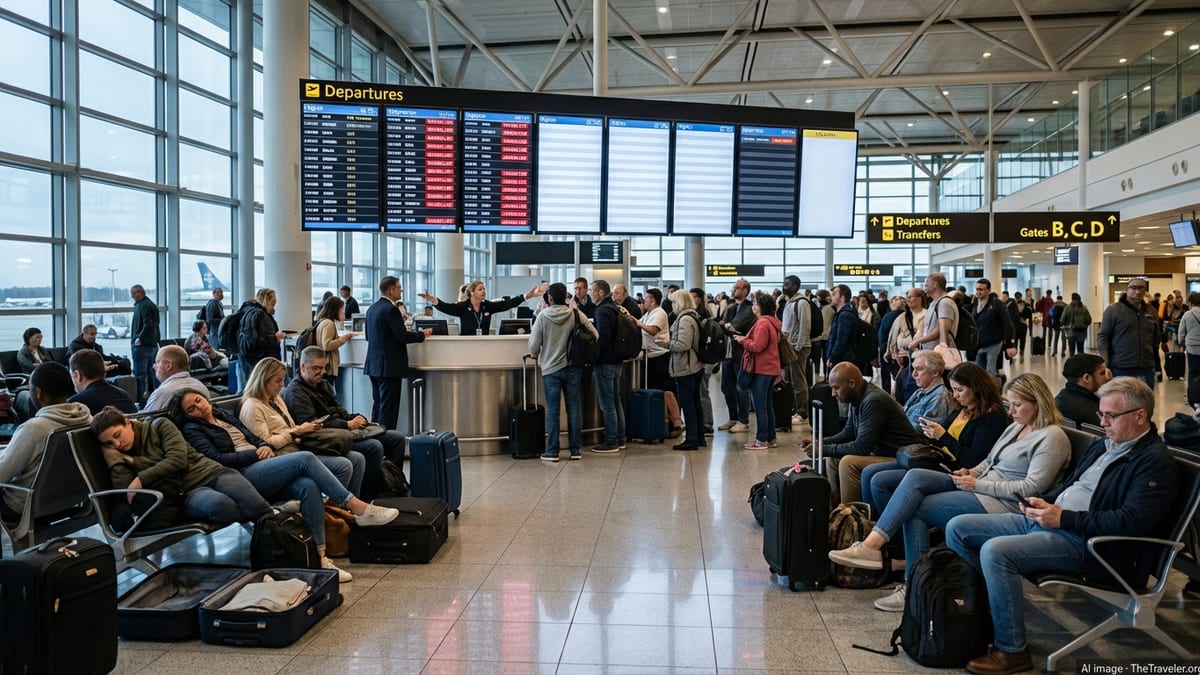
Inside Heraklion Airport, images shared by local media and travelers point to crowded departure halls, long lines at service counters and passengers resting on the floor while awaiting updates. Airlines were reportedly working to rebook stranded travelers on later flights or arrange overnight accommodation where necessary, although capacity was limited at short notice.
Eerie Skies as Saharan Dust Blankets Crete
The latest dust incursion reached Crete from North Africa in the wake of strong southerly winds associated with a larger weather system moving across the eastern Mediterranean. Reports indicate that the phenomenon, often described as African or Saharan dust, covered large parts of the island, including Heraklion, Rethymno and Chania, turning skies orange and casting a reddish tint over sea and landscape.
Photographs and video clips circulated by regional news platforms show streets, cars and balconies coated in a fine layer of reddish-brown dust, with familiar cityscapes rendered almost unrecognizable under the thick haze. In some neighborhoods, visibility reportedly dropped to a few hundred meters or less, giving the impression of a sandstorm more commonly associated with desert regions than with the Aegean.
Local observatories and weather services have been tracking elevated concentrations of particulate matter across southern Greece in recent weeks, highlighting Crete as one of the regions most exposed to recurring dust events. Earlier advisories in March had already warned that successive plumes from Libya and Egypt could lead to episodes of poor air quality and reduced visibility, especially in eastern and southern parts of the island.
While African dust outbreaks over the eastern Mediterranean are not unusual in late winter and spring, this episode stands out for its intensity and timing, coinciding with the busy Easter and early-season travel period. For many visitors, the surreal light and muted colors provided striking, if unsettling, visuals that contrasted sharply with the bright blue skies typically associated with Crete’s tourism image.
Health Advisories and Local Impact on Daily Life
As the dust thickened, health agencies and meteorological services issued public advisories urging residents and visitors, particularly vulnerable groups, to limit outdoor activity. According to information cited in Greek coverage, monitoring stations in parts of Crete recorded fine particle concentrations significantly above recommended daily thresholds, prompting warnings for people with respiratory or cardiovascular conditions.
Residents in low-lying and urban areas were encouraged to keep windows closed, avoid strenuous exercise outdoors and use protective masks if they needed to move around in the worst-affected zones. Pharmacies and clinics on the island reported heightened interest in respiratory medications and masks, reflecting local concern about the potential short-term effects of breathing in high levels of suspended dust.
The dust also complicated everyday tasks beyond the airport perimeter. Local reports describe schools and outdoor events adjusting schedules or scaling back activities, while drivers encountered challenging conditions on key road corridors as dust combined with gusty winds and intermittent rain. In some cases, the wet weather produced so-called “mud rain,” leaving vehicles and building facades streaked with reddish residue.
For businesses reliant on outdoor trade, from seafront cafes to open-air markets, the combination of poor visibility, gritty air and intermittent showers temporarily reduced foot traffic. While most establishments continued to operate, some shifted customers indoors or shortened their operating hours until the worst of the dust had passed.
Travelers Face Ripple Effects Across the Region
The disruption at Heraklion had knock-on effects across Greece’s domestic and regional air network. Diversions of incoming flights to Chania, Athens and other airports added pressure to ground handling and rebooking operations there, while connecting travelers bound for Crete found themselves delayed or temporarily stranded on the mainland.
Travel industry observers note that the timing of the dust episode creates particular challenges for airlines and tour operators ramping up schedules for the summer season. Many carriers have only recently introduced their expanded spring timetables, leaving less flexibility in aircraft and crew rotations when unplanned weather events intervene.
Publicly available schedules indicate that Heraklion is set to handle a growing volume of direct European services in the coming months, underlining its importance for package holidays and independent travelers alike. Any extended closure or repeated interruptions would complicate logistics for both airlines and ground transport providers, but current forecasts suggest that the latest dust plume is likely to ease within a relatively short window.
Hotel operators and local tourism bodies are monitoring developments closely, mindful that images of dust-shrouded resorts may circulate widely on social media. Early indications from published reports, however, suggest that the disruption, while serious for affected travelers, is being viewed as a short-lived meteorological event rather than a broader threat to the upcoming season.
Forecasts Point to Gradual Improvement, but Recurring Risk
Meteorological updates issued on April 1 point to a gradual clearing of the dust cloud over Crete from late Wednesday into Thursday, as shifting winds and precipitation help disperse and wash out particulate matter. Some forecasts referenced in local coverage caution that a further, though weaker, wave of African dust may follow, but with less severe impacts than the initial episode.
Climate and air-quality researchers have increasingly highlighted the eastern Mediterranean as a corridor for Saharan dust transport, with Crete and southern Greece often on the front line of these incursions. While such events are natural and long-standing, some studies suggest that changing atmospheric circulation patterns could influence their frequency or intensity in coming decades.
For travelers planning trips to Crete in the coming weeks, publicly available guidance from airlines and tourism services emphasizes the importance of monitoring flight status, allowing extra time for airport procedures and maintaining flexibility where possible. Travel planners suggest that, although Tuesday’s and Wednesday’s disruptions were significant, conditions typically normalize once visibility improves and aircraft can safely resume regular patterns of arrivals and departures.
As the latest dust plume begins to lift, attention on the island is turning back to preparations for the peak summer influx. For many in Crete’s tourism sector, the episode serves as a reminder that, even in a well-established destination, natural phenomena can still reshape the travel experience with little warning.