

More news on this day
Long treated as a marginal player in global aviation, Africa is now emerging as one of the world’s most dynamic air travel markets, with fresh forecasts suggesting the continent could become a dominant growth engine for global passenger traffic by 2040.
Get the latest news straight to your inbox!
A Continent Moving From Underserved to Unmissable
Recent industry forecasts show Africa shifting from the periphery of global aviation to its forefront. While the continent today accounts for a relatively small share of worldwide passenger traffic, projections from major industry bodies anticipate some of the fastest growth rates anywhere over the next two decades. Analyses drawing on data from the International Air Transport Association and the International Civil Aviation Organization indicate that Africa’s passenger traffic is expected to more than double between the mid‑2020s and early 2040s, outpacing traditional markets in North America and Europe.
Boeing’s 2025 Commercial Market Outlook highlights Africa as one of the key emerging regions, projecting average annual passenger traffic growth around 6 percent through 2044, a rate that puts the continent close to or ahead of most regions outside Asia. The company expects the African commercial fleet to more than double to well over 1,600 aircraft to meet demand. Similar long‑term assessments referenced by African and global aviation planners describe Africa as a future “aviation powerhouse,” with a rising share of the world’s new travelers originating on the continent.
Despite this bullish outlook, the current baseline is low. IATA’s latest market analysis shows African airlines still account for a small fraction of worldwide passenger volumes. That contrast between today’s limited share and tomorrow’s rapid expansion is driving a sense that Africa’s aviation story over the next 15 to 20 years will be one of the industry’s most transformative shifts.
Demographics, Urbanization and Trade Set the Pace
Underlying Africa’s aviation boom are structural changes in population, income and economic integration. The continent has the world’s youngest population profile, and its working‑age cohort is projected to grow faster than in any other region through 2040. As incomes slowly rise and a larger middle class emerges, more people are expected to move from long‑distance road or bus journeys to air travel, especially for business, education and family visits across borders.
Urbanization is another powerful driver. African cities are expanding rapidly, with several projected to join the ranks of the world’s largest metropolitan areas by the 2030s and 2040s. Economic reports indicate that as metropolitan regions become denser and wealthier, demand for both domestic and intra‑regional flights accelerates, particularly along business corridors and tourism routes. Air travel also compensates for weak ground infrastructure in many countries, where limited paved roads and long distances make flying the only practical option for time‑sensitive trips.
New trade frameworks are reinforcing these demographic trends. The African Continental Free Trade Area, which aims to create a single market for goods and services across most of the continent, is expected to spur cross‑border business and logistics once fully implemented. Tourism authorities and aviation analysts report that stronger air connectivity is already supporting safari tourism in East and Southern Africa, beach and cultural tourism in North and West Africa, and niche segments such as conferences and medical travel, all of which are feeding into rising passenger numbers.
Infrastructure Megaprojects and New Hubs Redraw the Map
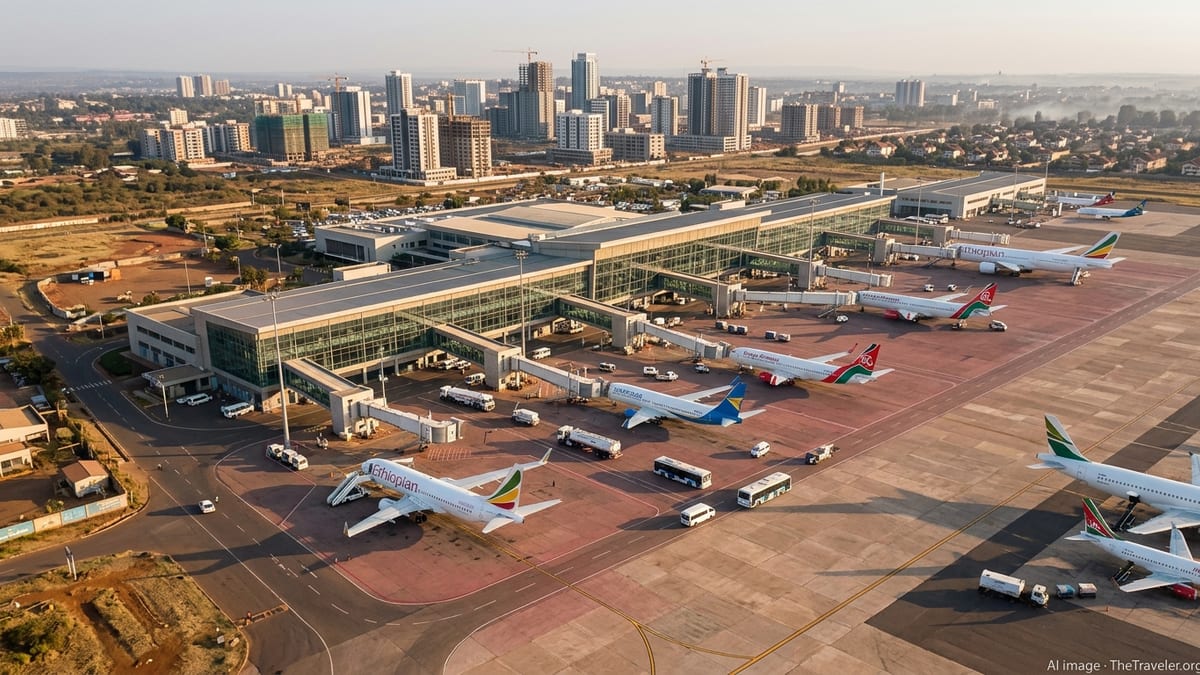
Airport and airspace investments are reshaping Africa’s aviation geography. A decade of new terminals and runway expansions has created a growing network of modern facilities in cities such as Addis Ababa, Nairobi, Kigali, Lagos, Accra and Johannesburg. Industry white papers focusing on Africa’s air connectivity identify these hubs as key nodes in an emerging continental system designed to rival established centers in the Gulf and Europe.
One of the most closely watched projects is Bishoftu International Airport in Ethiopia, a planned mega‑hub located southeast of Addis Ababa. Publicly available project documents describe an ambitious multi‑phase development intended to ease capacity constraints at the country’s existing main airport and ultimately handle tens of millions of passengers per year. Similar expansion efforts are underway or planned in Morocco, Nigeria, South Africa and Egypt, where authorities and private investors are upgrading terminals, cargo facilities and navigation systems to accommodate larger aircraft and higher traffic volumes.
Smaller regional airports are also being upgraded to international standards, broadening access to secondary cities and tourism areas. Newly designated international gateways in markets such as Nigeria, as well as modernized terminals in cities from Alexandria to Mogadishu, point to a strategy of spreading traffic beyond a few mega‑hubs. Analysts say this infrastructure wave is critical: without substantial new capacity on the ground, the demand projected in long‑term forecasts would quickly overwhelm existing facilities.
Policy Liberalization Aims to Unlock Pent‑Up Demand
Alongside bricks‑and‑mortar investments, aviation policy reform is seen as central to unlocking Africa’s growth potential. The Single African Air Transport Market, a flagship initiative of the African Union, seeks to open skies between participating states, reduce regulatory barriers and allow designated airlines to operate more freely across borders. Infrastructure and economic studies note that fuller implementation of these liberalization efforts could significantly increase route options, lower fares and encourage new entrants.
Currently, fragmented regulations, bilateral constraints and relatively high aviation taxes and charges remain obstacles. Industry assessments warn that Africa’s high operating costs and limited competition have historically made tickets more expensive than in comparable markets, limiting the customer base. However, there are signs of change: several countries have moved to ease visa requirements, streamline airport processes and renegotiate bilateral air service agreements, all measures that can improve connectivity and stimulate demand.
New and revived national carriers are also shaping the landscape. Airlines in countries such as the Democratic Republic of the Congo and Algeria have launched or expanded operations with a focus on regional connectivity, while established players in Ethiopia, Kenya, Morocco and South Africa are renewing fleets and opening new routes. Passenger growth figures released in 2025 showed African airlines recording some of the fastest year‑on‑year increases globally, indicating that where capacity and competitive pricing are available, travelers are responding.
Challenges Could Determine How Far Africa Can Climb
The scale of Africa’s projected aviation boom is not guaranteed. Forecasts consistently stress that realizing the continent’s potential will depend on addressing structural weaknesses in infrastructure, regulation and safety oversight. Capacity bottlenecks at airports, insufficient air traffic management systems and gaps in maintenance and training facilities could constrain growth if not resolved in parallel with rising demand.
Financial sustainability is another concern. Many African airlines operate on thin margins and face difficulties accessing affordable capital for fleet renewal. Market analysts caution that without careful management, rapid expansion could lead to overcapacity on some routes, exacerbating financial pressures. At the same time, relatively low passenger load factors in parts of the continent point to the need for better network planning and marketing to stimulate passenger volumes.
Environmental considerations are increasingly part of the conversation. As Africa’s air traffic expands, pressure is likely to grow for carriers and airports to adopt more efficient aircraft, sustainable aviation fuels where feasible and greener ground operations. International climate frameworks are being integrated into national aviation plans, and the decisions made in the next decade will shape how Africa balances connectivity gains with emissions responsibilities.
For now, however, the momentum is undeniable. With demographic tailwinds, rapid urban growth, new trade links, ambitious hubs and emerging liberalization, Africa is on course to become one of the defining stories in global aviation. If current projections hold, by around 2040 the continent’s skies could be among the busiest on the planet, reshaping how people, goods and ideas move between Africa and the rest of the world.