

More news on this day
A new generation of African aviation hubs, led by O.R. Tambo in Johannesburg, Addis Ababa Bole, Cairo International, Hurghada and Cape Town, is reshaping passenger flows across the continent and anchoring wider economic growth as traffic climbs beyond pre‑pandemic levels.
Get the latest news straight to your inbox!
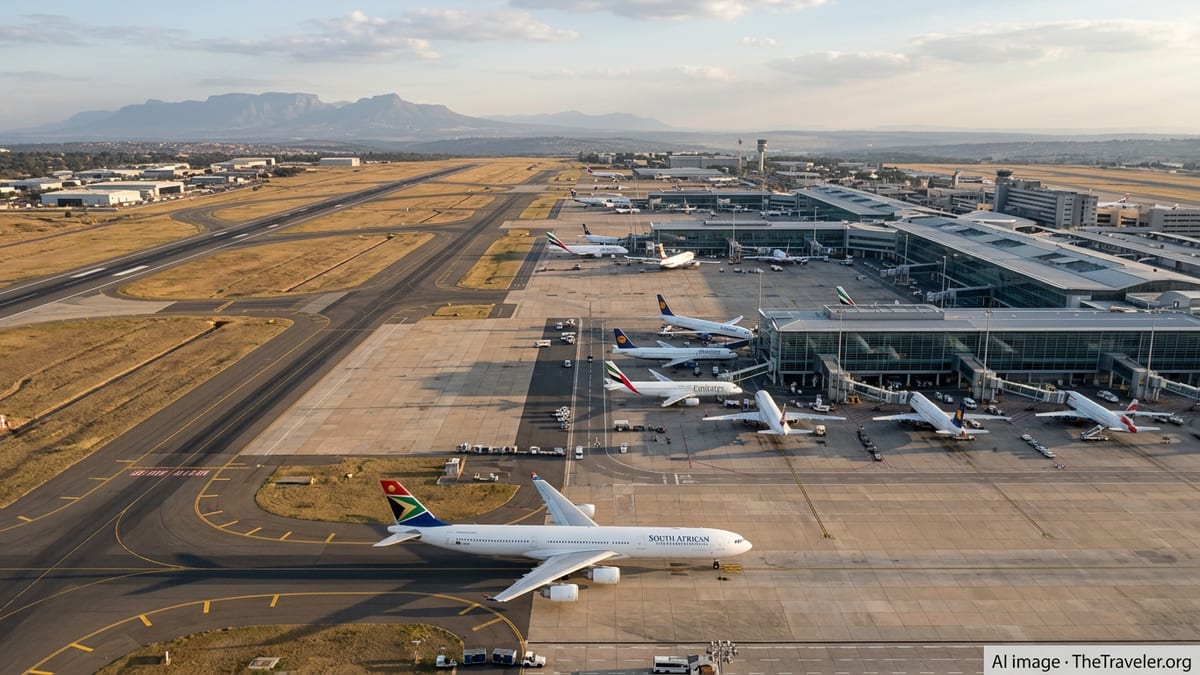
Five Powerhouse Hubs Dominate Africa’s Skies
Recent traffic data shows that Africa’s busiest airports are increasingly concentrated in a handful of strategic hubs spanning South Africa, Egypt, Ethiopia and Morocco. Cairo International Airport currently tops most continental rankings by annual passengers, with data compiled from industry analyses indicating close to 29 million travelers in the latest full year of reporting. These volumes reflect Egypt’s resurgence as a tourism and transit gateway connecting Europe, the Middle East and Africa.
Johannesburg’s O.R. Tambo International Airport has consolidated its position as Africa’s second‑busiest hub, with passenger numbers reported at more than 18 million in the most recent year, supported by both domestic and long‑haul networks. Addis Ababa Bole International Airport in Ethiopia follows closely, handling nearly 12 million passengers and benefitting from extensive intra‑African and intercontinental connectivity.
Egypt’s Red Sea gateway, Hurghada International Airport, and South Africa’s Cape Town International Airport round out the continent’s top five. Hurghada’s sharp rise in leisure demand has pushed annual traffic toward the 10 million mark, while Cape Town has surpassed 10 million passengers as international airlines add new routes into the Western Cape. Together, these airports have emerged as the principal engines of Africa’s air travel recovery.
Beyond the top tier, Morocco’s Casablanca Mohammed V International and South Africa’s Durban King Shaka International are among the airports vying for higher rankings as capacity grows. However, it is the combined performance of Johannesburg, Cape Town, Cairo, Hurghada and Addis Ababa that is currently setting the pace and redefining what it means to be a continental hub.
South Africa’s Network Climbs Back Above Pre‑Pandemic Levels
South Africa’s main airports have moved from recovery to renewed expansion, reinforcing the country’s role alongside Egypt and Ethiopia in Africa’s aviation hierarchy. Airports Company South Africa’s integrated reporting for the 2024 financial year highlights that its network has approached or exceeded 2019 passenger benchmarks, with domestic demand particularly robust and international volumes steadily rising.
O.R. Tambo International remains the dominant gateway, accounting for the largest share of South African passenger movements and serving as a primary transfer point for regional connections into southern and central Africa. Cape Town International, now firmly entrenched within Africa’s five busiest airports by passenger volume, has become one of the continent’s most dynamic long‑haul markets as new services from Europe, North America and the Middle East take hold.
Durban’s King Shaka International and Port Elizabeth’s Chief Dawid Stuurman International have also recorded solid gains in arrivals, pointing to a broader recovery that extends beyond the two flagship hubs. Recent tourism and transport coverage notes that South African airports have posted nearly 8 percent year‑on‑year growth in passenger arrivals, underscoring renewed confidence among airlines and travelers.
This resurgence is backed by substantial investment plans. Publicly available corporate reporting outlines multibillion‑rand capital programmes focused on refurbishing existing terminals, expanding apron and runway capacity, and modernising baggage and security systems. These upgrades are designed to support sustained growth while maintaining operational resilience during peak seasons.
Ethiopia and Egypt Build Global Super‑Connectors
While South African airports anchor the south of the continent, Ethiopia and Egypt are strengthening Africa’s north‑south and east‑west aviation links. Addis Ababa Bole International functions as a major transfer node for passengers travelling between Africa, Europe, the Middle East, Asia and the Americas, positioning Ethiopia as a pivotal connector in long‑haul traffic flows.
Industry briefings and airline network data show that Addis Ababa has outpaced many African peers in restoring and then expanding its route map, with passenger growth surpassing pre‑pandemic levels. Plans for a new mega‑hub near Bishoftu, designed to eventually handle tens of millions more passengers per year, signal a long‑term strategy to cement Ethiopia’s status among the world’s leading transfer hubs.
In Egypt, Cairo International Airport serves as the primary international gateway and Africa’s busiest airport by passenger count. Its growth has been driven by a combination of rising inbound tourism, expanding regional connectivity and the development of low‑cost and charter operations. Hurghada International, once a primarily seasonal leisure airport, has transitioned into a year‑round volume driver as demand for Red Sea resorts accelerates.
Together, Cairo and Hurghada give Egypt a dual‑hub profile that blends business, government and connecting traffic with high‑density leisure flows. This mix helps to stabilise annual volumes and supports a wide range of airlines, from full‑service intercontinental carriers to regional and charter operators.
Passenger Growth Translates into Wider Economic Gains
The rise of Africa’s top five busiest airports carries economic implications far beyond terminal walls. Higher passenger volumes support thousands of direct jobs in ground handling, security, retail, hospitality and maintenance, and many more indirectly across tourism, logistics and business services. Local media and industry analyses consistently link airport expansion to higher visitor spending and increased foreign exchange earnings.
In South Africa, stronger throughput at O.R. Tambo and Cape Town strengthens tourism value chains that extend into hotel development, guided tours, wine and nature‑based experiences and events. The Western Cape’s tourism authorities, for example, have attributed record visitor numbers in part to improved air access and additional international frequencies into Cape Town International.
In Ethiopia and Egypt, the hub strategy is closely tied to national development ambitions. Addis Ababa’s role as a transfer point attracts business travel and supports conference, cargo and service‑sector growth, while Egypt’s airport expansion amplifies the impact of its coastal resort developments and cultural tourism assets. As capacity increases at Cairo and Hurghada, surrounding communities often see new infrastructure, expanded service industries and rising demand for skills.
Analysts also note that the concentration of traffic in a limited number of major hubs can encourage investment in surface transport links, such as highways and rail lines, connecting airports to city centres and tourism regions. These improvements in turn enhance the competitiveness of the wider economy, not just the aviation sector.
Balancing Expansion with Sustainability and Regional Connectivity
The surge in traffic at Africa’s leading airports also heightens focus on environmental and operational sustainability. Policy studies examining aviation‑related emissions have identified Cairo, Addis Ababa, Cape Town and Durban among the continent’s higher‑impact airports in terms of carbon output, reflecting their role as major traffic generators. This has intensified debate over how to align rapid air travel growth with climate commitments.
Airports and airlines are responding through a combination of fleet renewal, improved air traffic management and more efficient terminal design. New projects and modernisation programmes in South Africa, Ethiopia and Egypt increasingly highlight energy‑efficient buildings, better public transport access and measures to reduce congestion on the airfield and in terminals.
At the same time, regional aviation stakeholders are seeking to ensure that growth at large hubs supports, rather than sidelines, secondary airports. Efforts to liberalise intra‑African air services and implement continental agreements on open skies are aimed at spreading the benefits of increased connectivity beyond a few gateways. Improved feeder links into O.R. Tambo, Cape Town, Cairo, Hurghada and Addis Ababa are seen as essential to integrating smaller cities into global travel networks.
As passenger numbers continue to climb across Africa, the performance of these top five airports will remain a key barometer of the continent’s economic trajectory. Their ability to manage growth responsibly, invest in capacity and strengthen regional links will help determine how fully Africa can harness aviation as a driver of trade, tourism and development.