

More news on this day
Hamburg’s 837th port anniversary is putting a fresh spotlight on AIDA Cruises and the city’s cruise sector, highlighting how maritime tourism is shaping local economic growth while accelerating a shift toward cleaner, more sustainable travel.
Get the latest news straight to your inbox!
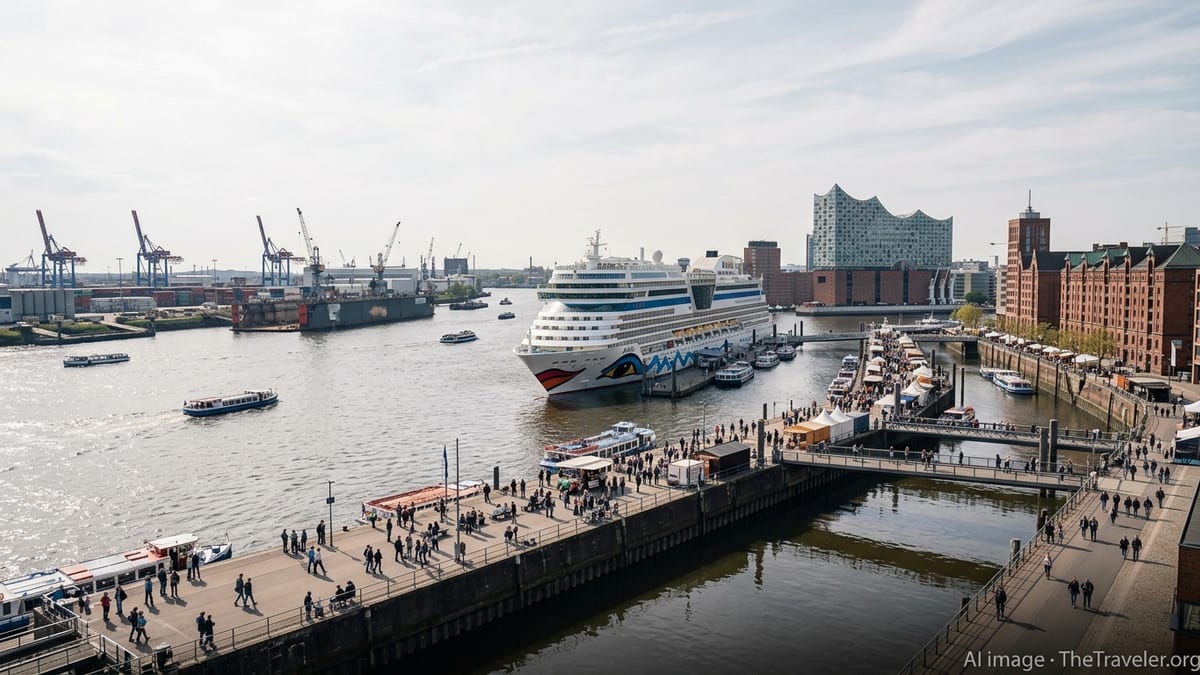
Port Anniversary Underscores Hamburg’s Cruise Momentum
The 837th anniversary of the Port of Hamburg, celebrated during the annual Hafengeburtstag festivities, is reinforcing the city’s identity as one of Europe’s leading cruise gateways. Public information on the event notes that the celebration routinely draws hundreds of thousands of visitors to the Elbe waterfront, with large cruise ships forming a key visual and economic centerpiece of the program.
AIDA Cruises has become a regular presence at the port festival over the past decade, using the occasion to showcase vessels that operate from Hamburg throughout the year. Earlier editions of the Hafengeburtstag have included milestone moments for the brand, such as the christening of AIDAprima during the port’s anniversary celebrations, embedding AIDA closely in Hamburg’s maritime calendar.
The latest edition of the anniversary weekend again places cruise tourism alongside tall ships, working harbor craft, and cultural events, underlining how cruise calls are now woven into Hamburg’s broader tourism narrative. For many international visitors, a cruise embarkation or port call has become their primary gateway into the city’s attractions, from the historic Speicherstadt to the modern HafenCity waterfront.
Cruise Tourism’s Expanding Economic Footprint
Recent data from Hamburg’s economic and port authorities show that cruise tourism has evolved into a significant pillar of the regional visitor economy. Studies based on pre‑pandemic activity estimate that cruise operations in Hamburg support several thousand jobs in services such as ground handling, logistics, ship supply, retail, hospitality, and cultural offerings, while contributing hundreds of millions of euros in value added to the metropolitan region.
Passenger volumes illustrate this momentum. Cruise terminal operator figures indicate that Hamburg has set successive records in recent years, with more than 1.3 million passengers handled and more than 260 ship calls in a strong recent season. Industry analyses position Hamburg as Germany’s leading cruise port, with its three main terminals and central riverfront location enabling both turnaround and transit calls that feed spending into the city center.
Local business organizations and tourism analysts point to a ripple effect that extends well beyond the terminals. Direct spending by cruise guests on accommodation, dining, shopping, and excursions is complemented by indirect demand for transport, technical services, and provisioning. Publicly available studies comparing the cruise industry’s economic role to that of Hamburg Airport underline how maritime tourism has become a comparable driver of turnover and employment for the city.
AIDA Cruises at the Intersection of Growth and Sustainability
AIDA Cruises, one of Germany’s most prominent cruise brands, sits at the intersection of this growth and the push for cleaner operations. Company and industry sustainability reports describe a multi‑year program that includes investments in liquefied natural gas capable vessels, bio‑LNG trials, shore power connections, and efficiency technologies designed to cut emissions both at sea and while alongside.
In Hamburg specifically, AIDA has been closely linked to pilot projects for alternative power supplies in port. The brand was involved in early shore power initiatives at the Hamburg Cruise Center Altona and in the development of an LNG hybrid barge concept that provides lower‑emission electricity to ships at berth. These projects have been highlighted in environmental awards and sector reports as pioneering steps in reducing air pollution in dense urban port areas.
More recent updates from cruise industry publications note that AIDA has expanded its use of certified bio‑LNG, including bunkering operations in Hamburg, and has significantly increased the number of shore power connections across its fleet. The company’s roadmap toward emission‑neutral operations, published in its AIDA Cares documentation, positions Hamburg as a core hub where new technologies and processes are tested and scaled.
Managing Environmental Impacts in a Busy Port City
The environmental debate around cruise tourism remains a central theme as Hamburg’s port marks its 837th anniversary. Academic studies and policy papers on maritime emissions draw attention to the contribution of cruise and container shipping to air pollutants such as nitrogen oxides and particulate matter in port cities, prompting calls for stricter regulation and cleaner fuels.
In response, Hamburg’s port authority and city government have progressively strengthened their framework for sustainable cruise development. Public planning documents reference expanded shore power infrastructure at multiple cruise terminals, emissions requirements for ships at the berth, and coordination between port operators and cruise lines to prioritize lower‑emission technologies. AIDA’s adoption of LNG and shore power in Hamburg is frequently cited in these materials as one example of how industry and port strategies can align.
Experts contributing to regional maritime economy publications argue that the long‑term viability of cruise tourism in the city depends on reducing its environmental footprint while maintaining economic benefits. Measures such as cleaner fuels, more efficient itineraries, and closer integration with public transport are highlighted as key tools to limit congestion and emissions associated with passenger movements during peak arrival days.
Balancing Visitor Growth With Local Benefits
As Hamburg celebrates its maritime heritage, the discussion is increasingly focused on how to ensure that growing visitor numbers translate into tangible benefits for residents and local businesses. Tourism and economic studies across Europe have shown that cruise passengers often spend less per day onshore than overnight visitors, prompting ports and destinations to design strategies that encourage longer, higher‑value stays.
In Hamburg, this is reflected in efforts to strengthen links between cruise terminals and surrounding districts. City and tourism planners promote shore excursions that highlight less‑visited neighborhoods, cultural institutions, and regional attractions, aiming to distribute cruise‑related spending more evenly and avoid pressure on a narrow set of central sights. Initiatives encouraging cruise guests to arrive by rail and extend their stay before or after a voyage are also emerging as tools to increase economic impact while reducing transport‑related emissions.
Against this backdrop, AIDA Cruises’ role at Hamburg’s 837th port anniversary illustrates a broader transition in European cruise hubs. The brand’s visibility at the festival, combined with its investments in lower‑emission technologies, mirrors a wider industry shift in which economic growth is expected to move in parallel with progressively stricter sustainability benchmarks.