

More news on this day
AIDAdiva has returned to Hamburg after a 133 day world cruise, marking the longest voyage in AIDA Cruises’ history and underscoring the growing appeal of extended, globe spanning itineraries from German homeports.
Get the latest news straight to your inbox!
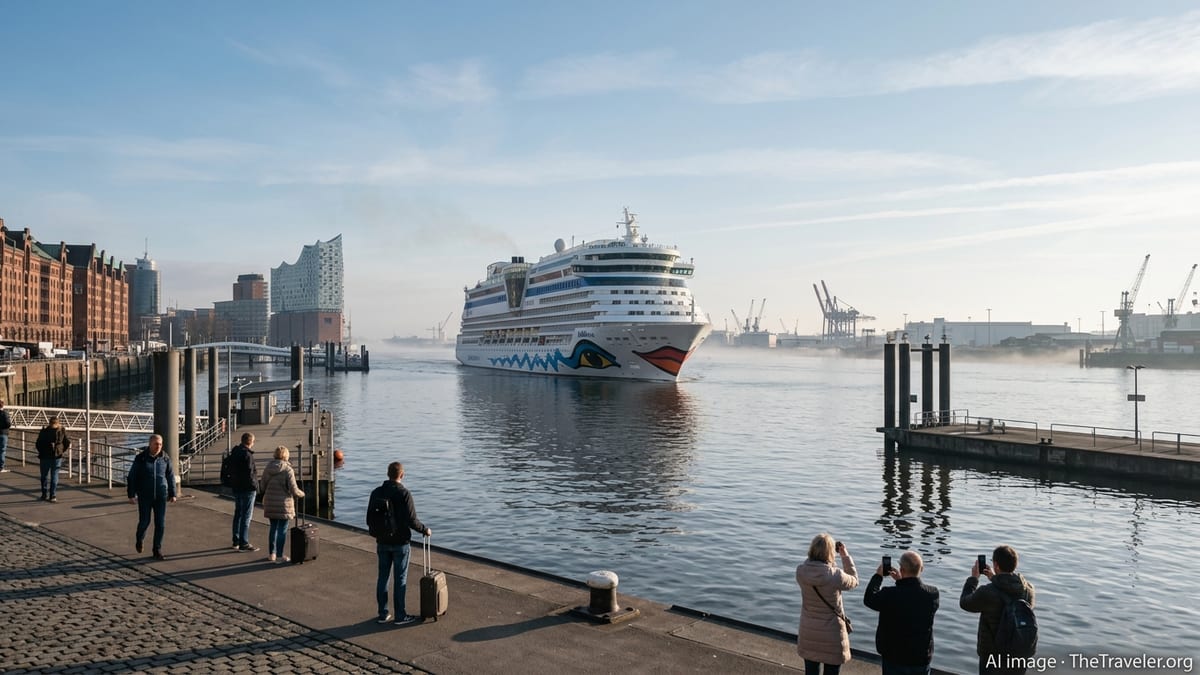
Milestone Return Caps AIDA’s Longest World Voyage
The 69,000 gross ton AIDAdiva completed her XXL world cruise in late March 2026, closing a loop that began in Hamburg in November 2025 and took guests once around the globe. Publicly available itinerary data shows that the ship was at sea for 133 days, making this sailing the longest world cruise yet operated by AIDA Cruises and a new benchmark for the German brand’s long haul offerings.
Information from cruise specialists indicates that the voyage was positioned as a flagship product in AIDA’s winter 2025 to 2026 program, reflecting a strategy to extend sailing durations while keeping Hamburg as a key turnaround port. The round trip format allowed guests to embark and disembark in the same city, a convenience that has become increasingly important for travelers from Germany and neighboring markets.
The return of AIDAdiva to the Elbe is also symbolically significant for the Sphinx class vessel, which entered service in 2007 and underwent a comprehensive refurbishment in 2025. The world cruise debut following that modernization has been widely presented as a showcase of the company’s fleet renewal initiative.
Global Route Spanned Five Continents and Iconic Gateways
Route details published by cruise platforms outline a wide ranging itinerary that traced a westbound arc from Hamburg across the Atlantic, through the Americas and Pacific, into Asia, the Indian Ocean and back to Europe. The sailing included calls in North America, East Asia, Southeast Asia, the Indian subcontinent, the Middle East and Atlantic islands before culminating in northern Europe.
In North America, port schedules list calls at classic eastern seaboard cities such as Boston and New York alongside southern gateways including Charleston and Miami. The itinerary continued into the Caribbean and Central America with stops like Cozumel, Belize and Puerto Limón, followed by a Panama Canal transit that linked the Atlantic and Pacific segments of the voyage.
West coast calls such as San Diego, Los Angeles and San Francisco connected the ship to the Pacific Rim, before AIDAdiva crossed to Hawaii and onward to Asia. Later stages of the journey included visits to ports in Japan, South Korea, Taiwan, Hong Kong and Vietnam, as well as Singapore, Malaysia, Thailand, Sri Lanka and the Maldives, providing an extensive cross section of cultures and climates in a single continuous sailing.
On the homeward stretch, the ship crossed the Indian Ocean and proceeded through the Red Sea and Suez Canal region, with published itineraries noting stops in ports such as Salalah and Aqaba, before heading toward the Mediterranean and Atlantic. Calls in Malta, southern Spain and Portugal preceded the final leg to northern Europe and back to Hamburg.
Record Length Highlights Changing Demand for Extended Cruises
Travel trade analysis describes the 133 day voyage as both a commercial and branding milestone for AIDA Cruises. Previous world cruises operated by the line were notably shorter, so the expansion to more than four months reflects an evolving market for long duration sailings among German speaking guests who can invest several months at sea.
Pricing and booking information released when the itinerary opened for sale positioned the trip as a premium product, with packages aimed at experienced cruisers and long stay travelers. Observers note that this segment often values a single, continuous itinerary over multiple shorter voyages, especially when the route returns to the original departure port without requiring long haul flights.
The scale of the AIDAdiva voyage also illustrates how cruise lines are using established mid sized ships to test new concepts. At around 2,000 passengers, AIDAdiva is smaller than many contemporary mega ships, which can make port logistics more flexible while still delivering the onboard amenities and entertainment programs expected on a world cruise.
Industry commentary suggests that successful execution of the 2025 to 2026 world cruise could encourage further experimentation with extended routes, including variations that emphasize specific regions or seasons, such as longer stays in Asia Pacific or additional crossings of the southern oceans.
Refurbished Sphinx Class Ship Showcases AIDA Evolution Program
AIDAdiva’s world cruise took place after a major technical and hotel refurbishment carried out in 2025 as part of the company’s broader AIDA Evolution program for its Sphinx class ships. Public information about the upgrade indicates that guest areas, restaurants and bars were refreshed, while technical systems were modernized to align with newer vessels in the fleet.
This modernization meant that the world cruise doubled as a high profile demonstration of the ship’s updated interiors and service concepts. For guests on board, the combination of a familiar Sphinx class layout with refreshed décor, expanded digital services and adjusted dining concepts created what marketing materials described as a contemporary, resort style atmosphere for a long stay at sea.
From an operational perspective, deploying a recently upgraded ship on the line’s longest itinerary allowed AIDA Cruises to showcase energy efficiency improvements and updated environmental technologies to a wide audience across multiple regions. Port calls in destinations with sensitive ecosystems, such as certain Pacific islands and the Indian Ocean, further highlighted the importance of technical upgrades that support stricter environmental expectations.
The decision to schedule the refurbishment ahead of the world cruise also positions AIDAdiva for future deployment on other complex itineraries, including additional long duration sailings announced for later in the decade, where reliability and guest comfort over extended periods are critical.
Hamburg Strengthens Its Role as a World Cruise Gateway
AIDAdiva’s return reinforces Hamburg’s position as a key North European hub for very long voyages. Port calls data and cruise calendars show that the Hanseatic city has steadily expanded its role beyond seasonal departure point to a homeport for world cruises and grand voyages that circle multiple continents.
Hamburg’s cruise terminals, including the facility at Steinwerder used by AIDAdiva, offer direct access for passengers from across Germany as well as neighboring countries via rail and air connections. This infrastructure, combined with the city’s maritime heritage, makes it an attractive start and end point for travelers embarking on long round the world journeys.
Local and regional tourism stakeholders are expected to benefit from increased hotel stays, restaurant visits and sightseeing linked to the turnaround of large ships on extended itineraries. The arrival and departure of a globe circling cruise often generate additional attention in the city, with enthusiasts gathering along the Elbe to view the ship as it navigates in and out of port.
With AIDA Cruises already promoting future world cruises from Hamburg, including additional sailings by AIDAdiva later in the decade, the successful completion of the 133 day voyage in March 2026 signals that the city is likely to remain a major European gateway for travelers seeking months long adventures at sea.