

More news on this day
AIDA Cruises’ decision to cancel its 2025–2026 Middle East season is emerging as a bellwether for the wider cruise industry, as operators scale back or rethink regional deployments in response to persistent security risks and softening demand across key Red Sea and Gulf routes.
Get the latest news straight to your inbox!
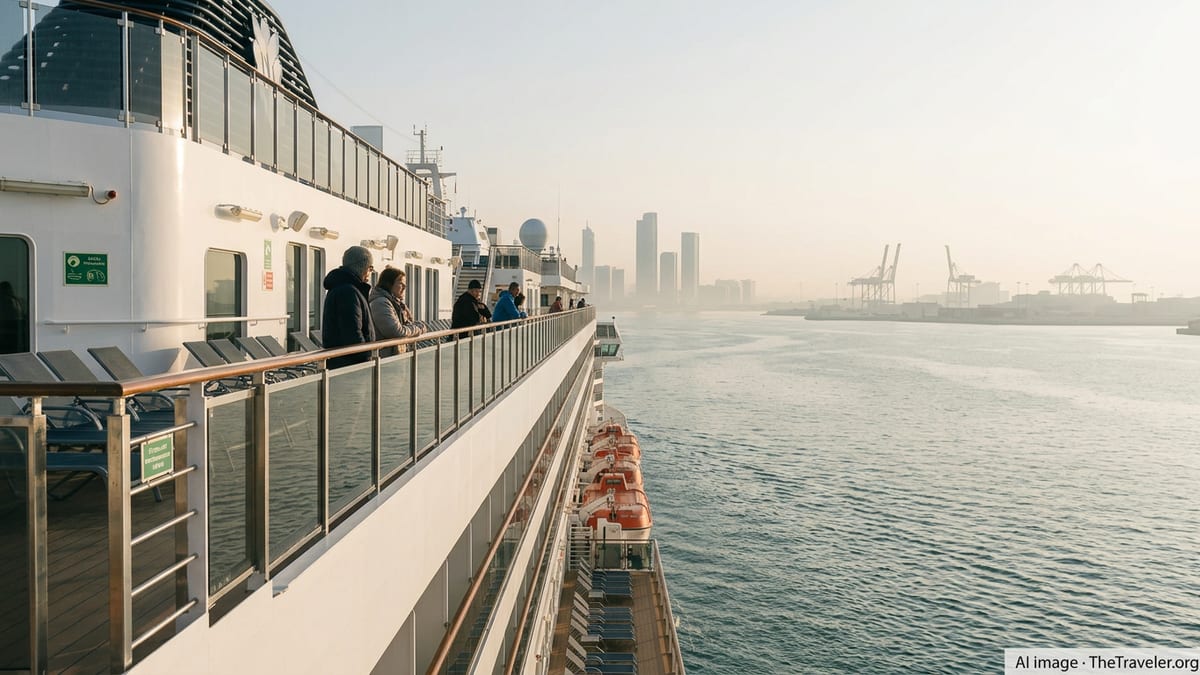
AIDA Pulls AIDAprima From Gulf, Repositions to Europe
AIDA Cruises has confirmed that it will withdraw from the Middle East for the 2025–2026 winter season, canceling all planned voyages for AIDAprima from Dubai and Abu Dhabi. Publicly available information indicates that the program would have covered itineraries between October 2025 and March 2026, visiting ports including Oman, Bahrain, and other Gulf destinations.
The German brand is instead redeploying AIDAprima to Northern Europe and the Atlantic Islands. Cruise schedule disclosures show that the ship is set to operate from homeports such as Kiel and Hamburg, serving routes in the North and Baltic Seas, as well as the Canary Islands. Reports describe the move as a strategic pivot designed to give the line more operational certainty and to concentrate capacity closer to its core German-speaking markets.
Company statements cited an environment in the Middle East that cannot be reliably assessed in the foreseeable future. The cancellation marks the first time since AIDA’s initial Gulf program in the winter of 2006–2007 that the line will not operate a seasonal deployment in the region, underscoring the significance of the shift for both the brand and regional cruise tourism stakeholders.
Travel trade coverage indicates that bookings for the alternative AIDAprima sailings are opening in phases, allowing the line to re-accommodate affected guests while also tapping into solid demand for European winter cruising. The redeployment effectively transforms what had been a sunny, warm-weather program into a mixed portfolio of Northern Europe city breaks and Atlantic island itineraries.
Security Concerns in the Red Sea and Gulf Drive Itinerary Changes
AIDA’s withdrawal comes against the backdrop of a prolonged security crisis in the Red Sea and adjacent waters. Since late 2023, attacks on commercial vessels attributed to Yemen-based Houthi forces have created sustained uncertainty for shipping and cruise operators. Published analyses of maritime security note that these incidents have periodically disrupted traffic along one of the world’s most important sea lanes, raising insurance costs and complicating voyage planning.
Cruise-focused outlets have documented a steady stream of itinerary adjustments across multiple brands as a result. Several operators have avoided the Red Sea entirely, rerouting repositioning cruises around the southern tip of Africa or converting long-haul voyages into regional sailings. In many cases, ships originally slated to transit via Suez between Europe and Asia have instead adopted alternative routes or had sailings canceled outright.
Although many Gulf itineraries technically operate at some distance from the most affected areas, the regional nature of the crisis has had broader repercussions. Industry coverage suggests that cruise lines are weighing not only direct security risks along specific corridors but also the operational complexity of last-minute diversions, potential airlift challenges for guests, and evolving government guidance on travel to nearby countries.
This layered risk environment has encouraged operators to favor itineraries where alternative ports and routes are more readily available. In practice, that has contributed to a relative de-emphasis on Red Sea and Eastern Mediterranean calls in favor of more flexible regions such as the Canary Islands, Western Mediterranean, Caribbean, and Northern Europe.
A Growing List of Cruise Lines Scaling Back in the Region
AIDA is far from alone in rethinking its Middle East footprint. Over the past two years, multiple major brands have curtailed Red Sea and nearby deployments, citing similar concerns. Reports on deployment changes highlight examples such as MSC Cruises suspending or canceling Red Sea winter programs, including sailings that would have homeported in Jeddah or operated itineraries close to Israel, when tensions escalated.
Other European lines have followed suit. Published coverage notes that Marella Cruises canceled its Asia and Middle East program for the period from November 2024 through April 2025, pointing to the conflict in the Red Sea area. Celestyal Cruises, traditionally active in the Eastern Mediterranean, has also trimmed select repositioning cruises that would have transited the Red Sea, focusing instead on more predictable Aegean and Mediterranean operations.
Even brands not traditionally associated with the Middle East have been touched by the turbulence. Industry news has documented cases in which transcontinental voyages by major North American cruise lines were rerouted to avoid Suez, with some departures canceled and others restructured around African coastal itineraries. In each case, companies have framed the decisions in terms of guest and crew safety, coupled with the need for greater operational clarity.
These cumulative adjustments have significantly reduced the number of scheduled cruise calls in Red Sea and Eastern Mediterranean ports over the coming seasons. Destination ports that had invested heavily in cruise infrastructure, including terminals and shore excursion offerings, are now facing gaps in expected arrivals, while lines reallocate tonnage to markets perceived as more stable.
Impact on Gulf Destinations and Source Markets
The Arabian Gulf had been regarded as one of the cruise industry’s most promising growth regions before the latest wave of instability. Trade fair presentations and tourism board materials from recent years have highlighted strong investment in ports such as Dubai, Abu Dhabi, and Doha, along with new terminals and streamlined visa processes aimed at attracting international cruise guests.
Yet AIDA’s withdrawal, combined with other lines’ adjustments, raises questions about the pace of that growth. While some Gulf sailings are still proceeding, the loss of a full winter season from a brand with a substantial European customer base represents a noticeable setback. Regional tourism authorities now face the dual challenge of reassuring potential visitors and preserving relationships with cruise operators that may be rebalancing their global portfolios.
For European source markets, the redeployment of ships away from the Middle East appears to be reinforcing existing travel patterns. Public surveys and booking trend reports have shown resilient demand for itineraries in the Canary Islands, Western Mediterranean, and Northern Europe, especially when political or security concerns weigh on more distant or complex routes. AIDA’s decision to send AIDAprima to ports such as Hamburg and Kiel aligns with this broader preference for destinations that feel closer to home and easier to access by air or rail.
At the same time, the shift may impact travelers who had specifically sought out Middle East itineraries for winter sun and cultural exploration. Travel advisors quoted in trade coverage describe a pattern in which many of these guests rebook to alternative warm-weather routes, such as the Caribbean or Atlantic islands, rather than abandoning cruise travel altogether.
What AIDA’s Move Signals for Future Cruise Deployment
AIDA’s cancellation of its Middle East season highlights a broader recalibration in how cruise lines assess and price geopolitical risk. Rather than treating regional volatility as a short-term disruption, more operators appear to be incorporating extended instability into their long-range deployment planning. The decision to remove an entire winter season over a year in advance indicates a cautious stance that prioritizes predictability over opportunistic growth.
Analysts following the sector suggest that this approach could accelerate existing trends toward regional diversification. With ships increasingly redeployed to areas offering year-round demand and robust infrastructure, capacity in certain emerging markets may plateau or even contract until conditions stabilize. In this context, the Middle East is shifting from a high-growth frontier to a region where cruise participation is likely to remain uneven and closely tied to geopolitical developments.
For travelers, the near-term effect is a more limited range of options for Red Sea and Gulf itineraries, coupled with expanded choice in Europe, the Caribbean, and other established regions. As cruise lines continue to refine their schedules for 2025 and 2026, publicly available deployment updates indicate that many are maintaining flexibility, with alternative routings and backup port plans prepared in case conditions worsen or improve.
AIDA’s move may therefore prove to be both a signal and a test case. If regional tensions ease and demand rebounds, the line and its competitors could return with revised itineraries and enhanced safety protocols. If instability persists, the current wave of cancellations and redeployments could mark the beginning of a more structural realignment in how the cruise industry engages with the Middle East, reshaping winter cruising patterns for years to come.