

More news on this day
Algiers is stepping into a bigger role on the global aviation map as Air Algérie accelerates fleet renewal, route expansion and infrastructure upgrades that aim to recast the Algerian capital as a major gateway between Africa, Europe and Asia.
Get the latest news straight to your inbox!
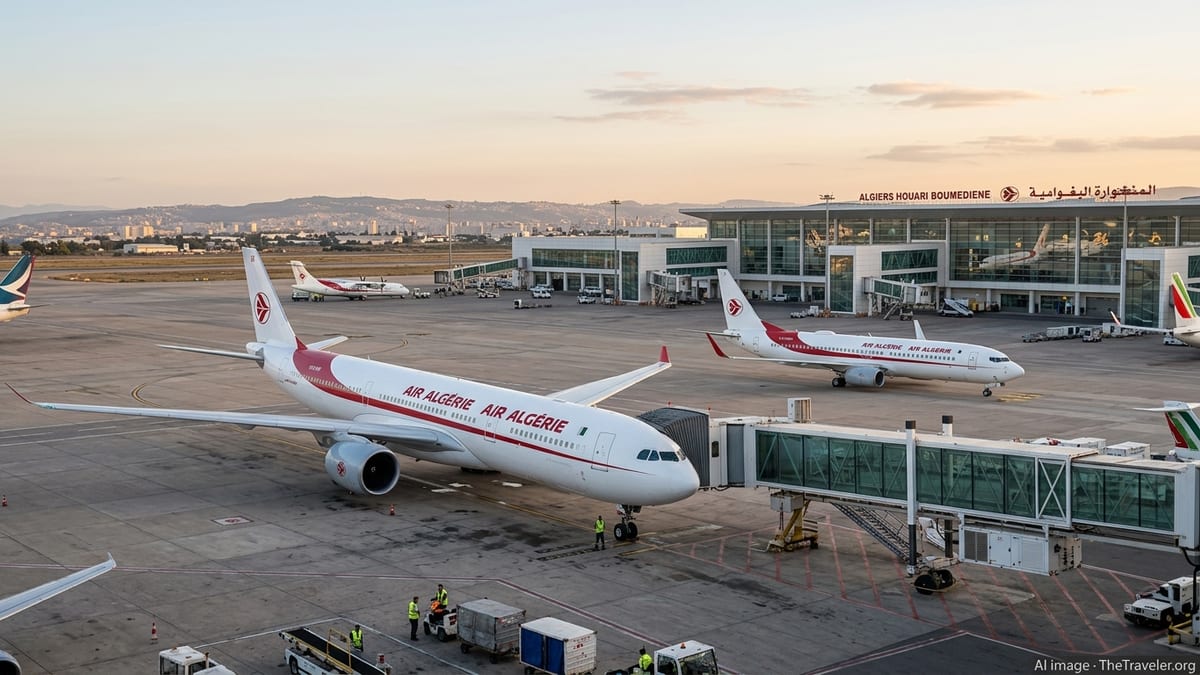
Fleet Overhaul Positions National Carrier for Long-Haul Growth
Air Algérie is reshaping its fleet to compete more aggressively in long-haul and high-density regional markets, a move that underpins ambitions for Algiers Houari Boumediene Airport to function as a full-scale hub. Publicly available information shows that the airline has committed to a mix of new-generation widebody and narrowbody aircraft designed to lower fuel burn and open new routes.
The carrier has ordered Airbus A330-900neo and A350-1000 aircraft to refresh its long-haul capabilities, alongside Boeing 737 Max 9 jets for medium-haul operations. Industry data indicates that deliveries of the 737 Max 9 are scheduled to begin from 2027, with further orders under study as Algeria seeks to expand capacity on both regional and intercontinental sectors.
On the regional side, Air Algérie has also turned to turboprops to strengthen domestic and short African routes. A 2025 agreement for 16 ATR 72-600 aircraft is framed as a way to serve thinner markets and provide more frequent links from secondary cities into Algiers, feeding longer-haul services. This layered fleet structure is central to the hub strategy, enabling the carrier to align aircraft size with demand while maintaining banked connections.
In the near term, the airline continues to bridge capacity gaps with leased aircraft and tactical seasonal deployments. Winter wet leases of Airbus A320s and additional single-aisle capacity during peak months are being used to sustain growth until the new generation of owned aircraft enters service later in the decade.
Algiers Airport Upgrades Target African and Euro-Mediterranean Traffic
Houari Boumediene Airport is being reshaped to support a larger role as a transfer point, with authorities prioritizing both airside and landside enhancements. According to published coverage, expansion plans target a doubling of the airport’s capacity from around 10 million passengers in 2024 to roughly 20 million by 2027, with improvements focused on terminal throughput, aircraft stands and baggage handling.
Recent infrastructure work at the airport has already improved processing speeds and on-time performance for connecting flights. Industry analyses report that enhancements completed through 2024 have boosted handling capabilities, an important step for an airport that is marketing itself as a reliable alternative to competing hubs in Casablanca and Cairo for Africa–Europe and Africa–Middle East flows.
Ground access is also a central part of the transformation. The extension of the Algiers Metro toward the airport, together with existing rail links, is designed to shorten travel times from the city center and integrate the terminal more effectively into the wider transport network. Plans outlined by local infrastructure agencies foresee the metro connection being received around early 2026, supporting a smoother experience for both origin and transfer passengers using Algiers as a staging point.
These upgrades come as regional rivals invest heavily in their own gateways. Analysts note that Algeria’s strategy seeks to capitalize on Algiers’ geographic position on the Southern Mediterranean, close to major European cities yet directly aligned with air corridors to West and Central Africa, offering time savings on many north–south itineraries.
New Routes and Schedules Build Hub-and-Spoke Connectivity
Air Algérie is quietly but steadily reshaping its network around Algiers as the primary hub, supported by Oran and Constantine as secondary bases. Operational reports for 2025 show Algiers continuing to concentrate the majority of the airline’s arrivals and departures, allowing for banked waves of flights that minimize connection times for transit travelers.
In Europe, France remains the core international market, with capacity growth anchored in both diaspora and leisure demand. Airline schedule data for the 2025–2026 season points to more than 50 routes between Algeria and France, including new or reinstated services from Algiers to Strasbourg and Nantes. Seasonal plans also introduce a summer connection between Algiers and Manchester in the United Kingdom, tapping into a large catchment of northern England travelers seeking North African and Mediterranean destinations.
The African network is undergoing a pronounced expansion. Coverage from aviation analysts indicates that Air Algérie has moved to double its African routes, adding frequencies and new points across West and Central Africa. This growth is framed as a way to capture flows that currently route through Gulf or European hubs and to position Algiers as a practical transfer point for passengers traveling between African cities and destinations in Europe or Asia.
Operational statistics underscore the shift. In August 2025 the airline operated more than 6,000 arriving flights, nearly 14 percent higher than the previous year, with much of the additional activity concentrated on regional and continental sectors. These patterns reinforce Algiers’ emerging role as a connecting platform rather than simply an origin–destination airport.
Domestic and Regional Feed Strengthened by New ATR Subsidiary
A key pillar of Algeria’s hub strategy lies not in the long-haul jets but in smaller aircraft feeding traffic into Algiers. According to industry publications, a new domestic airline owned by Air Algérie is being developed around a fleet of ATR turboprops, with the goal of knitting together underserved interior regions and neighboring countries.
The order for 16 ATR 72-600s, announced in 2025, is intended to enable high-frequency services on short and thin routes where jet operations would be uneconomical. This will allow travelers from secondary Algerian cities and nearby African markets to connect through Algiers onto Air Algérie’s mainline network, enlarging the catchment area for long-haul services without requiring major infrastructure outlays at smaller airports.
Regional analysts describe this approach as consistent with broader trends in African aviation, where national carriers are pairing modern narrowbody fleets with turboprop subsidiaries to build scale. For Algiers, the domestic and regional feed provided by ATR aircraft is expected to be crucial in sustaining year-round load factors on intercontinental flights, particularly outside the busy summer season driven by diaspora traffic.
The turboprop strategy also aligns with Algeria’s broader connectivity goals, supporting economic development in remote areas while channeling additional passenger flows and cargo through the capital. This dual focus on national cohesion and hub competitiveness is emerging as a defining feature of the country’s aviation policy.
Competitive Landscape Pressures Algiers to Differentiate
Algiers is entering a crowded field of African and Middle Eastern hubs, many of which leverage larger fleets and long-established global brands. Airports in Morocco, Egypt and the Gulf states are all expanding capacity, negotiating alliances and courting transfer traffic between continents. This reality places pressure on Air Algérie and its home hub to differentiate on routing efficiency, pricing and traveler experience.
Analyst commentary suggests that Algeria is seeking to position Algiers as a cost-competitive, geographically efficient alternative for passengers flying between secondary African cities and Europe or parts of Asia. The city’s location can reduce total flight time on certain routings, while the airline’s defensive pricing on emerging African services has introduced more economical options for travelers who might otherwise connect through Western Europe.
At the same time, reliability and service standards remain closely watched. External reviews point to gradual improvements in on-time performance on African routes over the past year, helped by the airport upgrades and more disciplined scheduling. As the new generation of aircraft enters service and ground access improves, expectations are rising that Algiers will be able to offer a more seamless transfer product in line with its ambitions.
For now, the capital is in the midst of a transition rather than an arrival. Aircraft orders, infrastructure projects and network additions launched since 2023 are set to unfold over the next several years, with milestones through 2027. If these initiatives stay on track, Algiers appears poised to consolidate its role as one of Africa’s key gateways to the skies, reshaping travel patterns between the continent and the wider world.