

More news on this day
Air Algerie is embarking on one of North Africa’s most ambitious airline overhauls, combining major new aircraft from Boeing and Airbus with a sweeping network and service revamp to lift annual traffic to nearly ten million passengers in 2026.
Get the latest news straight to your inbox!
Record Orders from Boeing, Airbus and ATR Reshape the Fleet
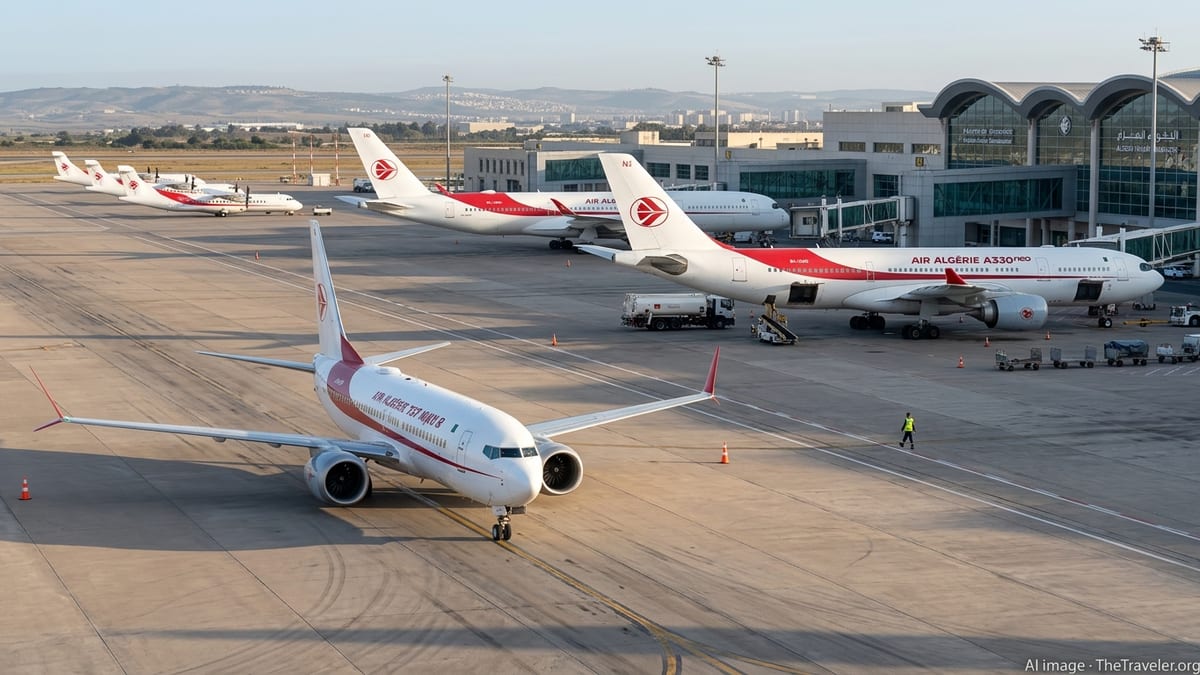
Publicly available information shows that Air Algerie has moved from incremental upgrades to an assertive, multi-manufacturer fleet strategy. Since 2023 the carrier has lined up a mix of Boeing 737 MAX narrowbodies and Airbus A330neo and A350 widebodies, underpinned by financing from Algeria’s National Investment Fund to secure 15 new jets for intercontinental and regional services. Additional reports indicate that the airline has later expanded its Airbus widebody commitments, reinforcing long haul capacity aimed at Europe, the Middle East, Asia and North America.
Alongside the Boeing and Airbus deals, the airline has triggered what industry coverage describes as the largest ATR purchase in African aviation, with 16 ATR 72-600 turboprops due for delivery from 2026. These aircraft are earmarked primarily for a new domestic-focused operation and thinner regional routes, extending connectivity to interior and southern regions that have historically been underserved by jet services.
In parallel, fleet renewal is already visible on the ground. Updates from regional aviation bodies note the arrival of new Airbus A320-family jets and early A330neo deliveries as part of a phased replacement of older widebodies. Taken together, the confirmed orders and initial handovers suggest that by the late 2020s, Air Algerie will operate a substantially younger and more fuel-efficient fleet, with a growing share of seats provided by latest-generation Boeing and Airbus types.
French-language industry summaries compiled this month highlight another key step: in March 2026 the carrier announced an additional order for ten Boeing 737 MAX 8 aircraft, on top of eight previously signaled MAX 9s. Combined with the widebody commitments and the ATR turboprop program, this pushes the long-term expansion objective to roughly 60 new aircraft, a scale that positions Air Algerie well beyond simple replacement and firmly into growth mode.
Traffic Surge and the Ten-Million-Passenger Target
Recent figures presented at an internal customer-experience summit and relayed by local business media suggest Air Algerie carried around 8.8 million passengers in 2025, an increase of about 11 percent compared with 2024. That performance marked a turning point after the post-pandemic recovery years, putting the airline within striking distance of the symbolic ten-million-passenger threshold.
To bridge the remaining gap in 2026, the carrier is pairing added aircraft capacity with more aggressive network planning. Reports indicate that new and reinstated routes to Guangzhou and Kuala Lumpur in Asia and to several sub-Saharan African cities are being phased in as widebody deliveries ramp up. Higher frequencies on core Europe and Middle East city pairs are also planned, taking advantage of Algiers as a hub linking African, European and Gulf markets.
Growth will not rely solely on international traffic. The new domestic offshoot, supported by the incoming ATR fleet, is designed to unlock latent demand across Algeria’s vast interior and Saharan regions, connecting secondary cities to Algiers and coastal centers with more regular and reliable schedules. Publicly available projections suggest that stronger domestic flows, combined with expanded transfer traffic through the Algiers hub, could provide much of the incremental volume needed to lift annual passenger numbers close to ten million in 2026.
Industry analysts following the North African market note that this traffic ambition, while bold, broadly tracks wider regional trends, as African and Middle Eastern carriers invest in capacity to capture rising intra-African and South-South travel. Air Algerie’s ability to synchronize aircraft deliveries, route launches and service improvements over the next 18 months will be critical to turning the numerical target into a sustainable traffic base.
New Governance Model and Subsidiaries to Support Expansion
The fleet build-up is unfolding alongside a structural shake-up of the company itself. Business press coverage from late 2025 and early 2026 describes a transition toward a holding-company model intended to separate core airline operations from specialized subsidiaries while improving transparency and financial discipline.
Existing units such as Air Algerie Cargo, Amadeus Algeria and Air Catering are being joined by new entities dedicated to ground operations and training. A separate domestic airline subsidiary has been created to focus on internal routes, leveraging the ATR turboprop order and allowing the mainline brand to concentrate on medium and long haul markets.
Government support has been stepped up in parallel. Budget documents and local reporting show increased subsidies for 2026 tied specifically to fleet expansion and network development, as Algeria seeks to reinforce its role as an aviation gateway between Africa, Europe and the Middle East. This backing, combined with sovereign financing for aircraft acquisitions, gives Air Algerie a capital platform that many regional peers lack.
Observers note that the holding structure, if fully implemented, could also facilitate future partnerships or equity tie-ups at the subsidiary level, for example in ground handling or training. For now, however, the emphasis remains on consolidating operations under the new framework so that the rapid fleet and network growth does not outpace the airline’s managerial and operational capabilities.
Route Map Upgrades and Customer Experience Overhaul
Air Algerie’s leadership has signaled that adding new aircraft will be matched by an overhaul of the customer journey. Accounts of recent internal strategy gatherings emphasize a focus on “reinventing the customer experience,” with initiatives that include refreshed cabins on incoming aircraft, simplified fare structures and accelerated deployment of digital tools for booking and disruption management.
The introduction of new-generation Boeing and Airbus jets is expected to bring quieter cabins, improved onboard connectivity and more efficient layouts. Widebody A330neo and future A350 deployments on long haul services should allow the airline to standardize products on key intercontinental routes, while the 737 MAX family is set to modernize the backbone of regional and short haul operations.
On the ground, the Algiers hub is being reconfigured to better support transfer traffic, with local media outlining efforts to streamline security, baggage handling and minimum connection times. Digital check-in, mobile boarding passes and enhanced disruption communications are being expanded across the network, aiming to close the gap with more established global carriers.
Market watchers caution that service upgrades will be vital if Air Algerie is to convert increased capacity into higher yields rather than pure volume. With travelers across Africa and the Mediterranean increasingly able to choose between national carriers, Gulf super-connectors and emerging low-cost operators, consistency and reliability may prove as important as headline route announcements or fleet statistics.
Regional Competitive Impact and Strategic Stakes
Air Algerie’s expansion drive comes as airlines across the broader Middle East and Africa invest heavily in next-generation fleets. Gulf carriers are ordering long haul jets in large numbers and regional competitors are refreshing narrowbody fleets to secure market share. Within this context, Air Algerie’s combination of Boeing and Airbus orders, reinforced by ATR turboprops, represents a bid to ensure that Algeria’s flag carrier is not left behind in a reshaped aviation landscape.
By 2026, if the planned deliveries and route launches remain broadly on schedule, the airline could operate one of the youngest mixed fleets in North Africa, with distinct brands for domestic, regional and intercontinental services. That would strengthen Algeria’s position as a connecting hub and support broader economic aims related to tourism, trade and investment.
At the same time, the scale of the investment raises the stakes. Rising fuel costs, currency pressures or delays in aircraft programs could test the robustness of the business plan. Industry experience elsewhere in the region shows that rapid fleet growth without matching improvements in efficiency and governance can weigh on profitability.
For now, however, the trajectory is clear. With a pipeline of Boeing, Airbus and ATR aircraft, a new governance framework and a stated goal of carrying nearly ten million passengers in 2026, Air Algerie is positioning itself for a decisive leap from recovery to expansion, potentially altering competitive dynamics across African and Mediterranean skies.