

More news on this day
Severe storms sweeping across the Gulf region have pushed Air Arabia to extend its weather-related disruption alerts to include Sharjah, compounding widespread delays and cancellations already affecting the low-cost carrier’s network and leaving many travelers stranded across the United Arab Emirates and beyond.
Get the latest news straight to your inbox!
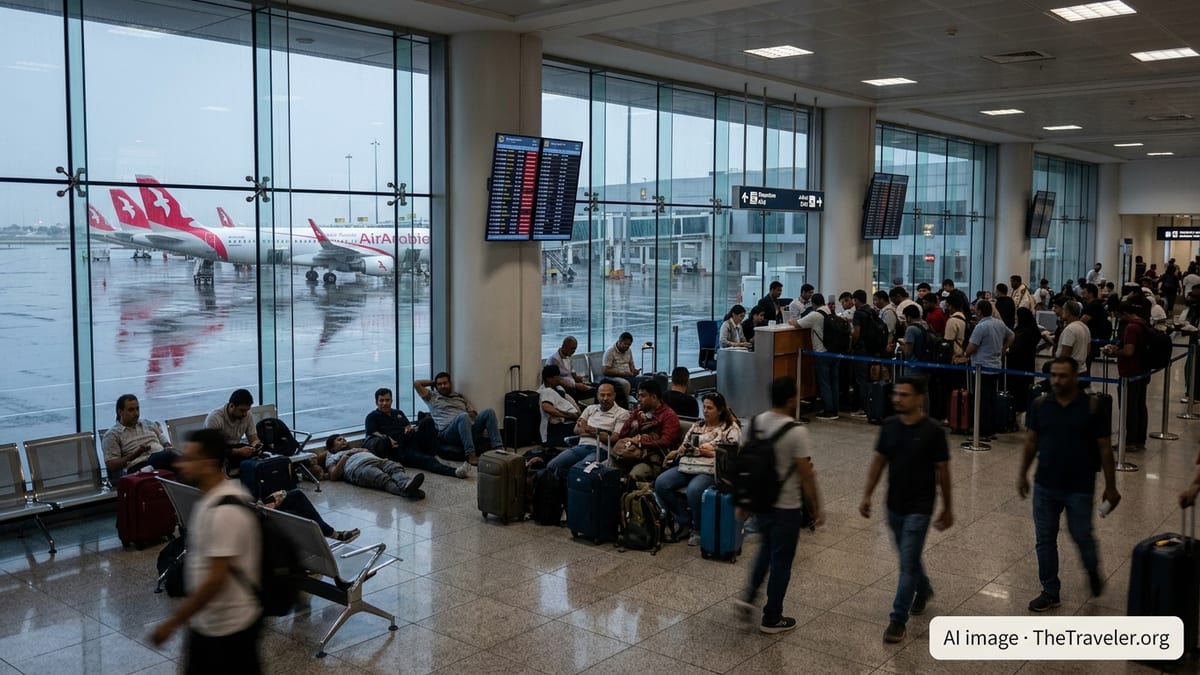
Sharjah Brought Under Expanded Weather Advisory
Recent deadly storms linked to an intense regional weather system have prompted a broad re-evaluation of flight safety and scheduling across United Arab Emirates airspace. Publicly available aviation updates indicate that Air Arabia, which is based at Sharjah International Airport, has widened its disruption notices to explicitly cover operations at Sharjah alongside other already affected airports in the country.
According to published coverage on Gulf aviation conditions, exceptional operating procedures have been in place at major UAE hubs, with Dubai, Abu Dhabi and Sharjah airports all handling a reduced number of commercial flights. The combination of storm activity, saturation of air-traffic control capacity and wider regional airspace constraints has left airlines with fewer usable slots, forcing schedule cuts and rolling timetable changes.
Travel advisories circulating among industry stakeholders describe how severe storms, heavy rainfall and associated flooding can halt airport operations or sharply limit takeoffs and landings. In this environment, Sharjah’s inclusion in Air Arabia’s weather communications reflects both localized conditions and the wider constraints on the country’s interconnected airspace system.
Reports from travelers suggest that, on some days, long stretches of time pass with almost no visible movements in or out of key UAE airports. While flight tracking gaps can also result from temporary data restrictions, they have become a visual shorthand for the scale of aviation disruption the storms and associated regional tensions have triggered.
Passengers Face Cancellations, Long Delays and Uncertainty
For passengers booked on Air Arabia, the practical impact of Sharjah’s addition to the weather advisory has been a fresh wave of cancellations and protracted delays. Publicly available customer accounts describe flights that were initially shown as operating normally before being cancelled at short notice, sometimes after passengers had already checked in and cleared security.
In several cases shared on travel forums and social platforms, travelers reported waiting for hours in departure halls before learning that their flights would not depart, and then facing further uncertainty about rebooking options. Some described seeing successive replacement flights also cancelled, with each change extending their stay in the airport or forcing them to seek temporary accommodation in Sharjah or nearby emirates.
These disruptions have created complex onward-journey problems, especially for those using Sharjah as a low-cost connection point between South Asia, the Middle East and Europe or Southeast Asia. Missed onward flights on separate tickets, expiring visas and additional accommodation and food costs have all featured prominently in first-hand accounts of the current disruption cycle.
Several travelers have reported considering alternative exit routes via Oman or Saudi Arabia after repeated cancellations at Sharjah, reflecting the way regional weather and airspace shocks can rapidly reshape traditional transit flows through the UAE.
Regional Storms and Airspace Constraints Compound the Chaos
The latest turbulence for Air Arabia and its customers comes against a backdrop of volatile weather and heightened geopolitical tension across parts of West Asia. Meteorological analyses of recent seasons show that the Gulf has faced episodes of unusually severe rainfall and flooding, with events in April 2024 standing out as some of the heaviest downpours recorded in the United Arab Emirates in decades.
Those storms inundated major cities including Dubai and Sharjah, caused deadly flash floods and severely disrupted ground transport and airport operations. Reports from that period detail hundreds of cancelled flights, diversions to neighboring airports and days-long backlogs as carriers struggled to reposition aircraft and crew once conditions improved.
While current disruptions stem from a different confluence of factors, the historical context underscores how vulnerable tightly scheduled low-cost networks can be when extreme weather and airspace restrictions collide. Customer advisories from airlines and logistics firms in early March 2026 describe a patchwork of closures and suspensions across multiple Gulf and Levant countries, with UAE airspace periodically operating in an “exceptional” mode and neighboring states implementing night closures or selective suspensions.
For carriers such as Air Arabia, which rely heavily on quick turnarounds at Sharjah and other regional bases, the combination of storms, constrained airspace corridors and shifting security considerations has translated into limited operational flexibility. Aircraft and crew can quickly end up in the wrong place relative to the timetable, magnifying the effect of each new disruption on passengers.
Air Arabia’s Operational Response and Passenger Guidance
Public travel notices referencing Air Arabia indicate that the airline has, at various points during the current turbulence, temporarily suspended flights to and from UAE airports for set periods, then gradually restarted a limited schedule as conditions allowed. One widely circulated advisory noted a complete suspension of Air Arabia services linked to Dubai-area disruptions until a specified afternoon time, followed by a phased resumption of selected routes.
In practice, the inclusion of Sharjah in the carrier’s weather and disruption messaging signals that travelers using the airline’s primary hub should anticipate continued short-notice changes. Industry guidance emphasizes the importance of monitoring airline apps and official channels frequently on the day of travel, as departure times and even operating dates may shift several times before a flight eventually departs.
Published advisories from travel management companies and freight forwarders point out that aircraft already in the air may be diverted to alternate airports if weather conditions or temporary airspace closures make it unsafe or impractical to land at the intended destination. This can add further layers of complexity for passengers whose itineraries were already disrupted at the point of departure.
Against this backdrop, Air Arabia customers passing through Sharjah are increasingly building in extra time, preparing contingency plans and, in some cases, weighing the cost of booking fully flexible tickets on alternate carriers or routing through less affected hubs, even if this means higher fares in the short term.
What Travelers Transiting Sharjah Should Expect Next
With storms and regional airspace constraints still affecting flight planning across the Gulf, aviation analysts expect intermittent turbulence for UAE carriers to persist in the near term. While airport operations at Sharjah, Dubai and Abu Dhabi have shown an ability to rebound quickly once conditions stabilize, clearing accumulated backlogs can take several days.
Reports indicate that, as of mid-March 2026, a limited but growing number of Air Arabia flights are again operating from Sharjah, with some travelers successfully boarding outbound services to South Asian destinations. However, anecdotal evidence from recent days also points to continued last-minute schedule changes, suggesting that the network has yet to return to a fully predictable rhythm.
For now, passengers planning to travel with Air Arabia through Sharjah are being urged by publicly available advisories and travel industry updates to treat schedules as provisional, to keep essential items in carry-on luggage in case of separation from checked bags, and to ensure they have access to funds or insurance support if extended delays require overnight stays.
As the Gulf region adapts to increasingly volatile weather patterns and a more complex airspace environment, Sharjah’s role within Air Arabia’s weather advisory framework is likely to remain under close watch from both the carrier and the millions of travelers who rely on its low-cost network each year.