

More news on this day
Air Arabia has issued a series of safety-focused travel advisories as adverse weather and wider regional airspace disruptions continue to affect flight operations in the United Arab Emirates, prompting passengers to adjust travel plans and closely monitor real-time updates.
Get the latest news straight to your inbox!
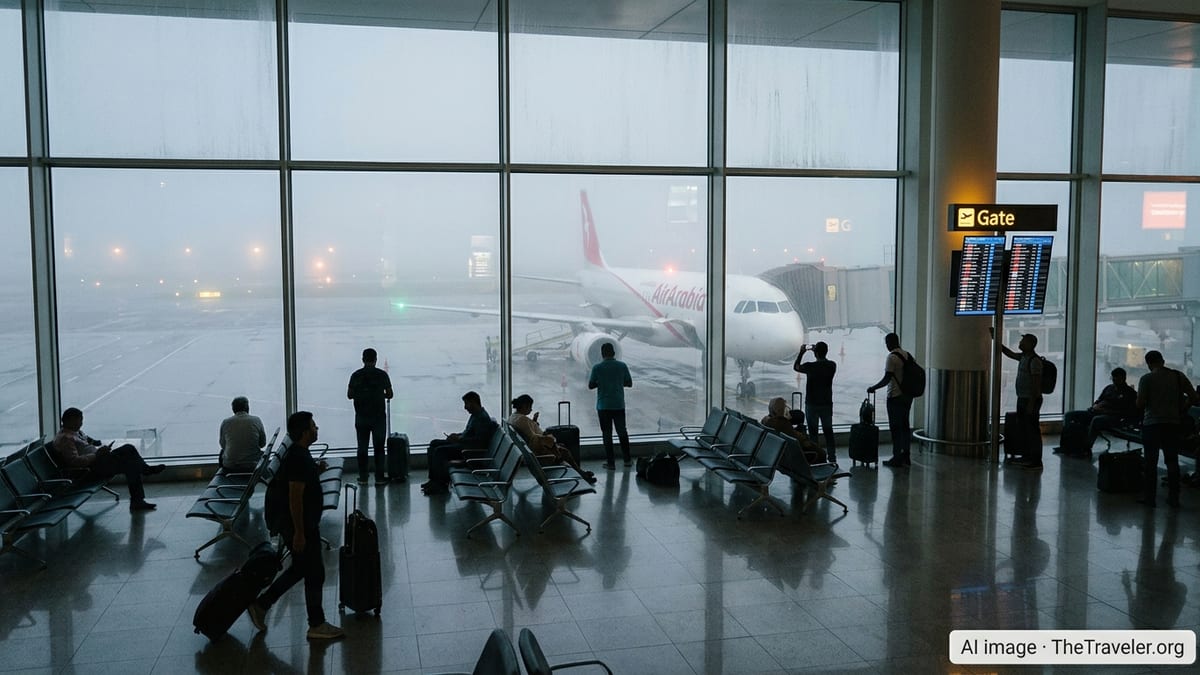
Adverse Weather and Regional Disruptions Affecting UAE Flights
Recent periods of dense fog, heavy rain and unstable atmospheric conditions across the United Arab Emirates have led to repeated flight delays, cancellations and diversions at key airports including Sharjah International Airport, the main hub for Air Arabia. Publicly available information from local media and aviation trackers indicates that visibility-related disruptions have periodically halted operations or reduced capacity at Sharjah, Ras Al Khaimah and other northern emirates airports in recent weeks.
These weather challenges have coincided with a separate wave of regional airspace restrictions linked to heightened geopolitical tensions, which have triggered temporary suspensions of flights on certain routes and tighter safety margins for carriers operating to and from the UAE. Coverage in regional business outlets shows that Air Arabia, alongside other UAE airlines, has adjusted schedules and in some cases paused services for defined periods in response to evolving airspace conditions and risk assessments.
The combined impact of local weather and regional constraints has been a more volatile operating environment for airlines and passengers alike, with schedules often subject to short-notice changes. Industry analyses note that carriers have generally prioritised conservative decision-making on flight paths and timings in order to maintain compliance with international safety protocols and national regulatory guidance.
Travel industry advisories emphasise that these disruptions may continue intermittently as weather patterns shift and regional airspace measures are updated, making proactive planning and close attention to airline communications essential for travellers using UAE airports.
Air Arabia’s Operational Safety Priorities in Challenging Conditions
Air Arabia presents itself as operating under a safety-first framework that places strict limits on flight operations in conditions of reduced visibility, heavy precipitation or strong winds. Publicly available airline communications and standard industry practice indicate that operations in fog, thunderstorms or sand-laden air are governed by defined minima for runway visibility, wind shear risk and cloud ceiling, with captains and operations control centres required to defer, divert or cancel flights if conditions fall below these thresholds.
In episodes of dense fog over Sharjah and the wider northern emirates, reports show that Air Arabia flights have been delayed, held in holding patterns or redirected to alternative airports such as Fujairah when safe landing criteria could not be met. Similar patterns have been reported during periods of intense rainfall and unstable weather, when surface water on runways and rapidly changing wind direction heighten risk factors and necessitate conservative decision-making.
Alongside weather-related actions, Air Arabia has also participated in broader safety responses to partial airspace closures in the wider region by suspending or rerouting flights on affected corridors. Regional news coverage describes temporary halts to departures and arrivals at Sharjah International Airport during specific windows when airspace restrictions were introduced, with operations resuming gradually as authorities authorised limited corridors and exceptional flights to clear passenger backlogs.
Aviation analysts point out that these operational decisions, though disruptive to travel plans, are consistent with global civil aviation standards that require operators to prioritise safety margins over schedule integrity whenever meteorological or geopolitical conditions introduce elevated risk.
Key Travel Advisories Issued to Passengers
In response to the recent weather instability and related operational challenges, Air Arabia has used its digital channels to publish a series of travel advisories directed at customers flying to and from the UAE. Regional news reports on these advisories highlight common themes that include warnings of possible delays during periods of heavy rain, instructions to verify flight status before heading to the airport, and reminders that schedules may change at short notice as conditions evolve.
One widely reported advisory issued during a spell of unstable weather in the UAE urged passengers to closely monitor their flight status via the airline’s official website or mobile application, particularly over the subsequent 24 hours when heavy rain and thunderstorms were forecast to persist. Similar alerts have been circulated during dense fog episodes, with passengers reminded that early-morning and late-night services are especially vulnerable to visibility-related disruption.
Separate notices have addressed the impact of regional airspace restrictions on Air Arabia’s broader network, outlining temporary suspensions on selected routes and advising passengers not to travel to the airport unless their flight had been explicitly confirmed as operating. Public guidance from travel risk consultancies has echoed this advice, recommending that travellers rely on direct airline notifications, rather than third-party schedules, to determine whether their flight will depart as planned.
These advisories typically stress that passengers affected by changes may be eligible for rebooking or alternative travel arrangements under the airline’s disruption policies, and encourage the use of self-service tools and official customer service channels to manage bookings.
Practical Guidance for Air Arabia Customers in the UAE
For travellers planning to fly with Air Arabia from Sharjah or other UAE airports during periods of adverse weather, practical preparation can significantly reduce the stress associated with last-minute schedule changes. Travel experts recommend that passengers complete online check-in as early as possible, enable notifications in the airline’s mobile application, and verify departure times repeatedly in the 24 hours leading up to a flight when challenging conditions are forecast.
Given the possibility of traffic congestion and longer queues at airport check-in and security during disruption periods, travellers are also advised to allow additional time for their journey to the airport. Reports from recent weather events in the UAE suggest that arriving earlier than usual can help mitigate the impact of longer processing times, especially when multiple airlines are simultaneously adjusting schedules or consolidating flights.
Passengers with tight onward connections or essential commitments at their destination are encouraged to consider more flexible itineraries, including longer connection windows and fully changeable fares where available. Travel risk advisories published in March 2026 underline that even when main hubs such as Sharjah are operational, knock-on effects from regional airspace constraints can lead to rolling delays and aircraft rotation challenges that may not be visible in standard timetable views.
In addition, travellers are urged to regularly review their government’s travel advice for the wider region and to ensure that contact details in their Air Arabia booking are accurate and up to date. This increases the likelihood of receiving timely SMS or email alerts regarding gate changes, departure time revisions or eligibility for rebooking options.
Broader Implications for UAE Aviation and Passenger Expectations
The recent sequence of weather disruptions and regional airspace restrictions has underscored the sensitivity of the UAE’s high-volume aviation system to external shocks, as well as the growing importance of clear passenger communication. Analysts covering Gulf aviation note that low-cost carriers such as Air Arabia, with dense networks and high aircraft utilisation, may face particular challenges when prolonged adverse conditions force multiple rotations to be rescheduled or cancelled within a short period.
Industry commentary suggests that travellers flying in and out of the UAE can expect weather-related advisories to become a more regular feature of the travel landscape, especially during seasons associated with fog, thunderstorms and occasional dust or sandstorms. This has prompted airlines to invest further in digital tools that push real-time updates, as well as to refine disruption management policies that balance operational resilience with customer service considerations.
For Air Arabia, the current environment highlights the need to align its low-cost operating model with robust safety and communication protocols capable of handling both meteorological and geopolitical volatility. Publicly available corporate materials indicate that the airline continues to emphasise strict adherence to regulatory standards and risk-based route planning, while seeking to maintain affordable fares and frequent services across its network.
For passengers, these developments translate into a greater responsibility to stay informed, build flexibility into itineraries and treat weather and regional advisories as integral components of trip planning, rather than last-minute obstacles. As the UAE’s aviation sector navigates a complex period, clear, consistent and timely guidance from airlines such as Air Arabia is likely to remain a critical factor in maintaining traveller confidence.