

More news on this day
Air Arabia is set to expand its United Kingdom network in March 2026 with the launch of nonstop flights between Sharjah and London Gatwick, adding new low-cost capacity on one of the Gulf’s most competitive long-haul corridors.
Get the latest news straight to your inbox!
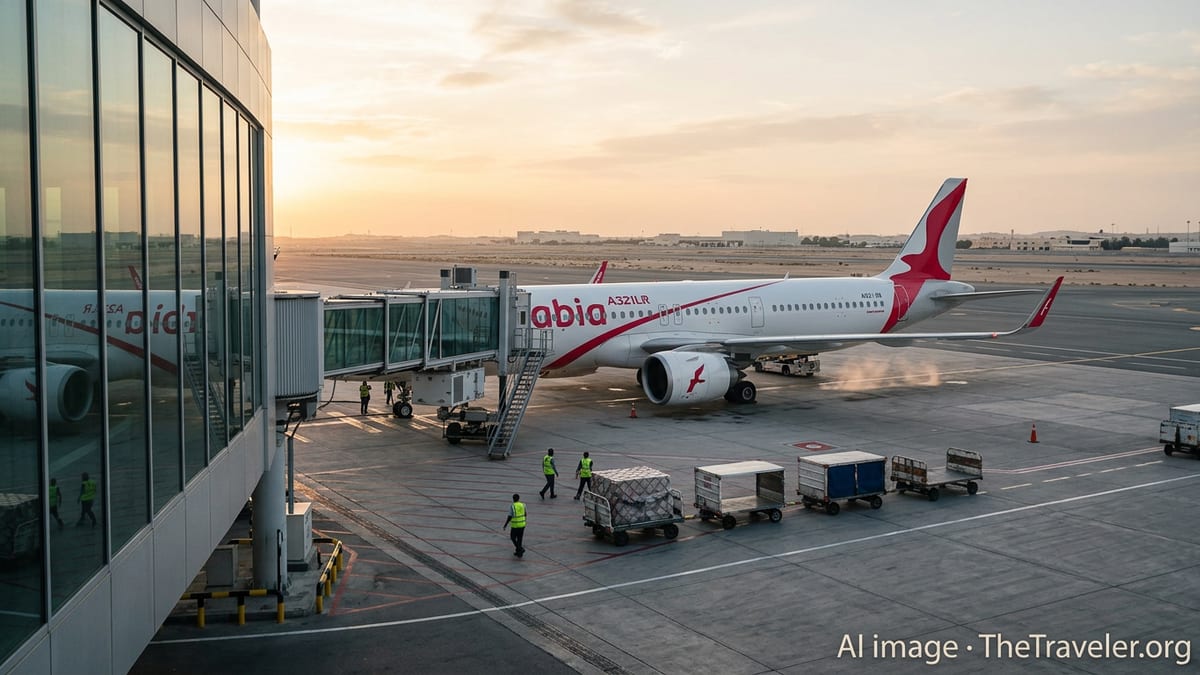
Twice Daily Sharjah–Gatwick Service Planned from Late March
Industry schedules data and aviation trade coverage indicate that Air Arabia intends to begin serving London Gatwick from its Sharjah hub from late March 2026, aligning the launch with the start of the Northern Hemisphere summer season. The service is planned as a nonstop connection, positioning the carrier to tap leisure, visiting‑friends‑and‑relatives, and small business travel between the United Arab Emirates and the south of England.
Reports show the route is set to operate twice daily, significantly increasing the airline’s presence in the UK market beyond its existing London offerings. A twice‑daily pattern would allow Air Arabia to offer both daytime and overnight options in each direction, improving connectivity for passengers traveling onward from Sharjah across the carrier’s network in the Middle East, South Asia, North Africa, and Central Asia.
The choice of a late March start allows the new route to build traction ahead of the busy spring and summer holiday periods, when demand for Gulf–UK travel typically peaks. Travel industry observers note that advance loading into global distribution systems and online booking platforms is likely to begin well before the first flight, giving tour operators and travel agents time to package the service.
The new operation will also give London‑based passengers an additional point of access into the UAE beyond Dubai and Abu Dhabi, which are currently served by multiple full‑service and low‑cost carriers. Sharjah’s growing profile as a gateway for price‑sensitive travelers is expected to be a key selling point.
Gatwick Win Underscores Airport’s Middle East Growth Strategy
The addition of Air Arabia’s Sharjah flights further strengthens London Gatwick’s position as a hub for services to the Middle East. Recent route development reports highlight that Gatwick is targeting record traffic levels in 2026, supported in part by new and expanded links to Gulf and wider Middle Eastern destinations.
By welcoming Air Arabia, Gatwick gains direct connectivity to a third UAE airport, complementing existing services to Dubai and, through other carriers, to emerging Gulf hubs. This diversification reduces reliance on a single operator or gateway and offers travelers more choice in terms of schedules, fares, and connection possibilities.
For the airport, additional Middle East capacity is strategically important. Gulf carriers and regional low‑cost airlines tend to generate strong year‑round demand, helped by robust visiting‑friends‑and‑relatives flows and growing two‑way tourism. Analysts point out that such routes help smooth seasonal peaks and troughs in European leisure demand, providing more stable utilization of runway and terminal infrastructure.
The move also reinforces Gatwick’s role as a base for value‑focused long‑haul and mid‑haul operations. With Air Arabia joining a roster of carriers that already use the airport for competitively priced services to Africa, Asia, and the Americas, the new route is expected to slot naturally into Gatwick’s broader growth narrative.
Narrowbody A321LR Aircraft to Serve Long Narrow‑Haul Market
According to network planning and fleet deployment reports, Air Arabia plans to operate the Sharjah–London Gatwick service with Airbus A321LR aircraft. The long‑range narrowbody type is increasingly popular among low‑cost and hybrid airlines on so‑called long narrow‑haul routes, where demand supports frequent service but not necessarily the capacity of larger widebody jets.
The A321LR allows carriers such as Air Arabia to offer nonstop flights of up to about eight hours while maintaining a single‑aisle configuration and relatively low operating costs. This makes it well suited to the roughly six‑to‑seven‑hour sector between Sharjah and London, where efficiency and high seat density can underpin competitive fares.
Travel industry commentary notes that passengers can expect a standard all‑economy or predominantly economy layout, with unbundled pricing for ancillaries such as checked baggage, seat selection, and onboard meals. This aligns with Air Arabia’s existing model on other medium‑haul routes from Sharjah, where customers trade some frills for lower base fares.
From an operational perspective, using the A321LR on both daily frequencies should help Air Arabia optimize aircraft utilization while managing exposure to fuel and airport charges. The type’s commonality with the broader A320 family in the airline’s fleet may also support more efficient maintenance and crew scheduling.
Sharjah’s Profile Rises as a Budget Gateway to the UK
The planned launch of flights to London Gatwick is expected to further elevate Sharjah International Airport’s role as a budget‑friendly alternative to Dubai for UK‑bound travelers. Publicly available traffic and tourism data show Sharjah steadily increasing its share of outbound passengers from the northern Emirates, particularly among price‑sensitive segments.
For residents in Sharjah, Ajman, Umm Al Quwain, and parts of Dubai’s northern suburbs, the airport can be significantly closer and less congested than Dubai International. With new nonstop access to Gatwick, these passengers gain a direct link to south London and the broader South East England region, which is home to sizable expatriate communities from the Middle East and South Asia.
On the inbound side, the route is likely to appeal to UK travelers seeking access not only to Sharjah’s cultural attractions and family‑oriented resorts, but also to the wider UAE via road connections. Industry observers point out that many low‑cost carriers successfully market secondary airports as gateways to larger conurbations, and the Sharjah–Gatwick pairing fits this pattern.
Tourism stakeholders in both markets are expected to monitor booking trends closely once seats go on sale. Package holiday providers, in particular, may look to incorporate the new service into itineraries that combine city breaks in London with longer stays in the UAE’s beach and desert destinations.
Competitive UK–UAE Market Poised for Further Change
The entry of Air Arabia on the Sharjah–London Gatwick route comes at a time of continued change in the wider UK–UAE market. Network announcements and schedule adjustments from other Gulf carriers have highlighted an ongoing rebalancing of capacity between London Heathrow and Gatwick, as airlines respond to slot constraints, demand patterns, and evolving fleet plans.
Gulf airlines have historically concentrated their London services at Heathrow, but rising costs and limited room for expansion have made Gatwick increasingly attractive, especially for low‑cost and leisure‑focused operators. Industry analysis suggests that Gatwick’s catchment area, combined with comparatively lower airport charges, can support sustainable point‑to‑point and connecting traffic to the Gulf.
For passengers, Air Arabia’s arrival is expected to translate into more fare options and potentially sharper competition on routes between the UK and the UAE. As capacity grows and more carriers vie for similar customer segments, travel search platforms and online agencies are likely to feature a broader range of price points, schedules, and product types.
While the precise start date and schedule remain subject to standard regulatory approvals and final timetable filings, the planned March 2026 launch underscores how quickly the UK–Middle East market is evolving. Observers note that further announcements from both full‑service and low‑cost airlines are likely in the run‑up to the 2026 summer season, as carriers position themselves for a new phase of demand growth.