

More news on this day
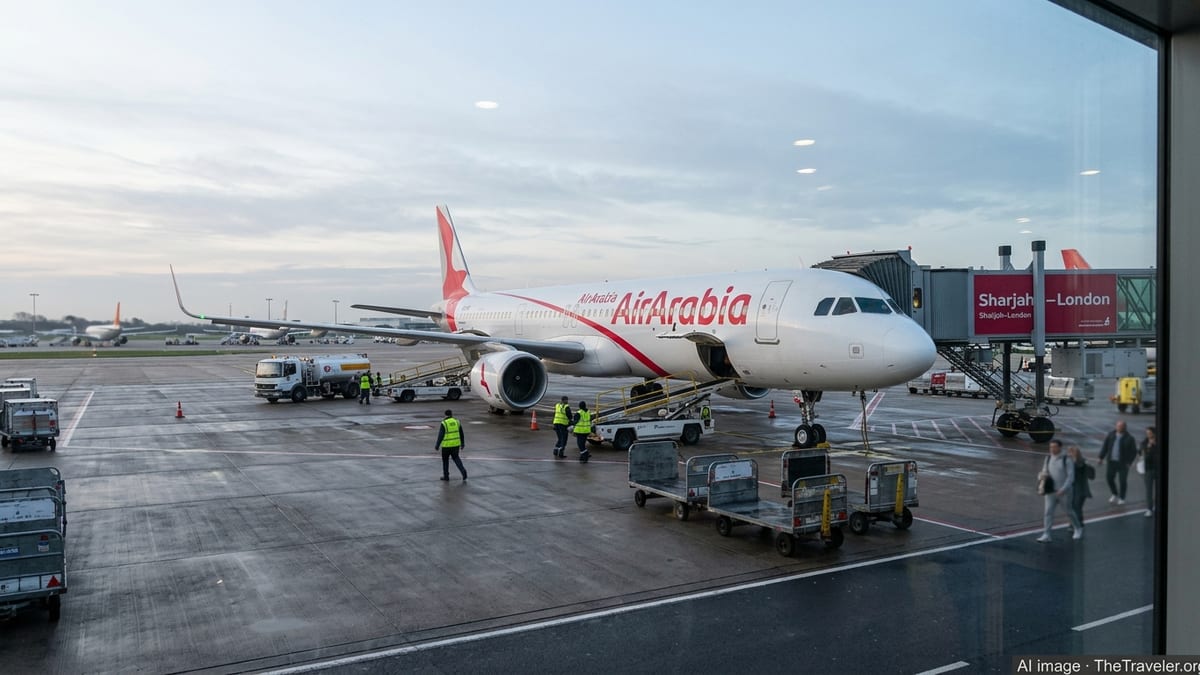
Air Arabia’s decision to launch double daily Sharjah–London Gatwick flights from March 29, 2026 is set to inject new low-cost competition into one of the Gulf’s busiest long-haul corridors, challenging full-service rivals and potentially resetting price expectations for UK–UAE travel.
Get the latest news straight to your inbox!
New Low-Cost Link on a Crowded UK–UAE Corridor
The new route will connect Air Arabia’s Sharjah hub with London Gatwick twice a day, using Airbus A321neo LR aircraft configured for high-density, single-class operations. Publicly available information shows that the airline will become the only carrier offering a direct Sharjah–Gatwick service, adding a fresh gateway alongside existing London links from Dubai and Abu Dhabi.
The flights are scheduled to begin on March 29, 2026, with one daytime and one overnight rotation in each direction. Schedules published in industry reports indicate early-morning and afternoon departures from Sharjah, and morning and evening departures from Gatwick, designed to appeal to both leisure and visiting friends-and-relatives travelers as well as small business passengers looking for lower fares.
Reports indicate that introductory return fares are being marketed from around the 999 dirham level for Sharjah–London tickets, a price point that undercuts many full-service competitors on the broader UAE–London market. While such lead-in fares are limited and subject to availability, they underscore Air Arabia’s strategy of using price to stimulate new demand on a traditionally premium-heavy city pair.
According to published coverage, the move will also give London-based travelers direct access to Sharjah’s growing network across South Asia, the Caucasus, Central Asia and North Africa, using Sharjah as a lower-cost alternative transit hub to nearby Dubai.
Long-Range Narrowbodies Power a Low-Cost Long-Haul Push
Air Arabia’s choice of the Airbus A321neo LR places the Sharjah–London route squarely within the emerging trend of low-cost and hybrid carriers using long-range single-aisle aircraft on sectors approaching six hours. Aviation industry analysis describes the Sharjah–Gatwick distance at roughly 5,500 kilometers, making it one of the longest routes in the airline’s network and near the upper range of the A321neo LR’s capabilities.
The aircraft type is configured to balance range and seat density, enabling lower unit costs than many widebody operators on the same city pair. Public data on Air Arabia’s fleet strategy highlights the airline’s focus on a single narrowbody family to keep maintenance and training costs down, a core principle of the low-cost model.
Industry observers note that the route structure embodies an important evolution of low-cost, long-haul operations. Instead of deploying large twin-aisle jets, Air Arabia is using a more flexible narrowbody platform, allowing it to test demand with double daily frequencies while keeping operating economics lean. This approach mirrors developments in Europe and North America, where long-range single-aisle aircraft are increasingly deployed on thinner transcontinental and transatlantic routes.
Reports from airline and airport briefings suggest that the use of long-range narrowbodies also allows Air Arabia to schedule flights at times attractive to cost-conscious travelers, without the higher risk associated with filling widebody capacity on every departure.
Competitive Shock for Established UK–UAE Carriers
The UK–UAE market is already one of the most heavily served long-haul corridors out of London, with multiple daily widebody flights to Dubai and Abu Dhabi. According to recent schedule data cited in aviation commentary, there are expected to be around 150 weekly departures between the UAE and London’s main airports by April 2026, dominated by major full-service airlines.
Air Arabia’s entry from Sharjah introduces a structurally different product into this landscape. As a point-to-point low-cost carrier with paid ancillaries and a single-class cabin, it targets travelers more sensitive to total trip cost than to full-service frills. Analysts suggest this could pressure yields on overlapping traffic flows, particularly among price-driven passengers who are willing to trade premium services and central London access for cheaper fares and flights from Gatwick.
Gatwick itself has been working to deepen its Middle East connectivity, and publicly available information from the airport operator positions the new Sharjah flights as a way to diversify its Gulf offering beyond traditional hubs. The pairing could appeal to Southeast England residents who prefer Gatwick over Heathrow, and to UAE-based leisure travelers heading to London and southern England.
Travel industry coverage also points to potential knock-on effects in regional UK markets. With a budget competitor now linking the UAE to London at scale, tour operators and online agencies may repackage itineraries that combine low-cost long-haul segments with separate domestic or European connections, further widening Air Arabia’s reach.
What Passengers Can Expect Onboard and On the Ground
According to Air Arabia’s published materials, the Sharjah–London flights will offer the carrier’s standard buy-on-board catering under the SkyCafe brand, along with complimentary access to its streaming platform SkyTime using passengers’ own devices. The A321neo LR cabins are expected to feature slimline seating, with paid options for extra-legroom rows and preferred seat selection.
Checked baggage, seat assignments and onboard meals are generally sold as ancillaries or bundled into higher-fare options, in line with the airline’s low-cost model. Travel trade reports suggest this unbundled structure could be especially attractive to backpackers, students and visiting friends-and-relatives traffic who prioritize base fare over inclusions, while still allowing higher-spend passengers to customize their experience.
On the ground, Sharjah International Airport has been positioning itself as a more compact alternative to Dubai for point-to-point and connecting travelers. Public information describes shorter walking distances and simpler terminal layouts, which may appeal to budget passengers willing to trade some of Dubai’s extensive amenities for a more straightforward airport experience.
At Gatwick, the new flights will plug into an ecosystem of low-cost and leisure carriers already using the airport as a base. This environment, combined with rail and coach links into central London and beyond, is likely to support Air Arabia’s efforts to attract cost-conscious travelers who are comfortable piecing together their own connections or ground transport rather than relying on a traditional full-service itinerary.
Implications for the Future of Low-Cost Long-Haul
The Sharjah–London Gatwick announcement is being viewed in specialist aviation media as another data point in the ongoing experiment around low-cost long-haul viability. Previous attempts on other continents saw mixed results, particularly where high fuel prices, complex transfer operations and fleet constraints challenged profitability.
Analysts observing the UK–UAE market point out that Air Arabia’s model differs from some earlier efforts by focusing on a large, year-round demand pool with strong visiting friends-and-relatives traffic, as well as leveraging a single-type narrowbody fleet. By using long-range A321neo LR aircraft and a no-frills product, the airline aims to keep costs tightly managed on a route where premium carriers have traditionally set the tone.
For travelers, the most immediate impact is likely to be increased choice and, at least during promotional periods, sharper fares between the UAE and London. Over time, the route’s performance may help determine how far low-cost, single-aisle long-haul flying can be pushed in the Gulf region and beyond.
If the double daily Sharjah–London service proves sustainable, observers suggest it could encourage further experimentation with long-range narrowbodies on other secondary Gulf–Europe city pairs, adding a new layer of competition for established global network airlines and reshaping price expectations on some of the world’s busiest long-haul corridors.