

More news on this day
Kazakhstan’s flag carrier Air Astana is set to launch a new direct service between Almaty and Shanghai at the end of March 2026, a move expected to significantly deepen travel, trade and aviation links between Central Asia and China’s economic powerhouse.
Get the latest news straight to your inbox!
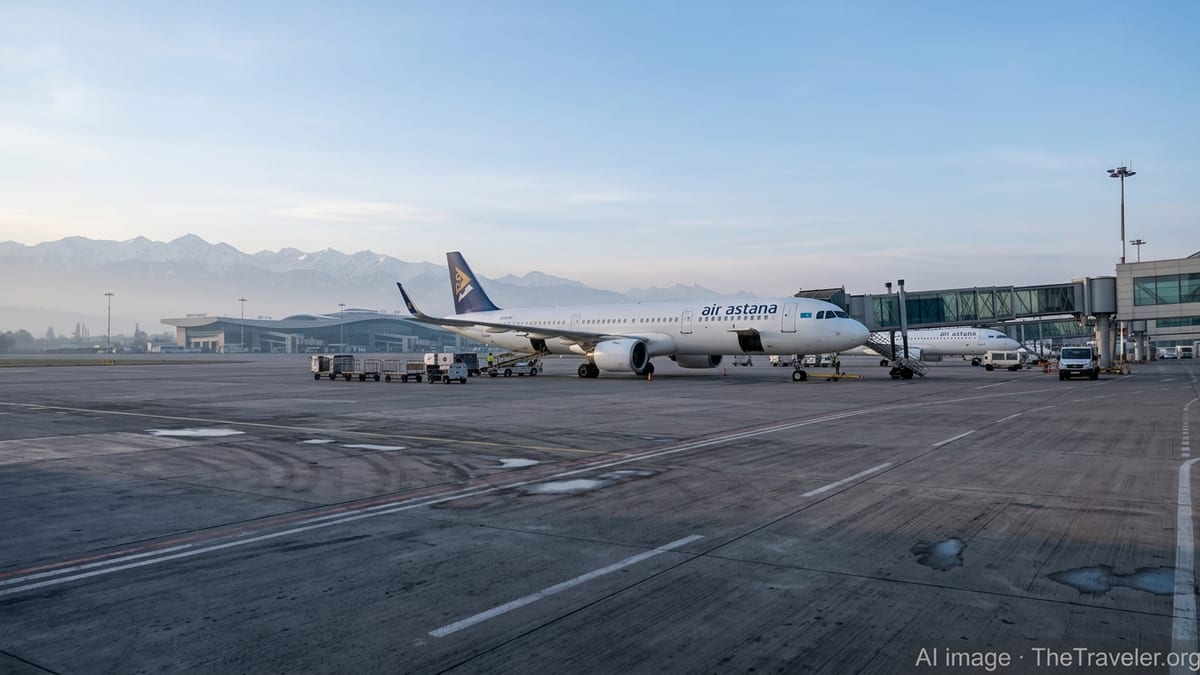
New Route Connects Central Asia’s Hub with China’s Financial Capital
According to publicly available information from Air Astana and recent industry coverage, the Almaty–Shanghai route is scheduled to begin operations on March 29, 2026, subject to final regulatory approvals. The flights will link Almaty International Airport with Shanghai Pudong International Airport, adding a high-demand business and leisure city pair to the airline’s growing Asia network.
Reports indicate that the service will initially operate three times per week. Flight KC281 is planned to depart Almaty in the evening and arrive in Shanghai early the following morning, while the return flight KC282 is scheduled to leave Shanghai shortly after dawn and land back in Almaty by mid-morning. The timetable is designed to support both same-day business connections in Shanghai and onward long-haul itineraries.
The route will be operated by Air Astana’s Airbus A321LR aircraft, a latest-generation narrowbody that offers extended range and improved fuel efficiency. Published data show that the flight time between Almaty and Shanghai is expected to be around six hours and fifteen minutes, placing Shanghai within a single overnight hop from Central Asia’s largest city.
Industry analyses note that Almaty already serves as a major aviation gateway for Kazakhstan and the wider region, with growing connectivity to Europe, the Middle East and East Asia. The addition of Shanghai strengthens this role, positioning Almaty as a more competitive transfer point for passengers moving between China, Central Asia and destinations further west.
Expansion of Air Astana’s China Network and Regional Strategy
The Almaty–Shanghai launch further enlarges Air Astana’s footprint in the Chinese market. Publicly available route information shows that the airline already serves Beijing, Guangzhou, Sanya and Urumqi, offering a mix of business and leisure destinations. Shanghai, as China’s financial and commercial hub, is viewed by analysts as a logical next step in the carrier’s China strategy.
Recent corporate disclosures emphasize that Air Astana is pursuing a broader Asia-focused growth plan, with new and enhanced services to major markets including China, India and Japan. The introduction of an additional long-range A321LR-operated route is consistent with this approach, as the type allows the airline to develop medium-haul services with lower operating costs than widebody aircraft.
Sector commentary also links the Shanghai launch to Kazakhstan’s wider aviation and transport policy, which has prioritized expanding international air services and positioning the country as a bridge between East and West. The Civil Aviation Committee and associated agencies have reported steady growth in the number of routes and weekly frequencies between Kazakhstan and China in recent years, with the new Almaty–Shanghai flights expected to raise that total further.
Observers note that competition in the Shanghai–Almaty corridor is gradually intensifying. China Eastern Airlines introduced Shanghai–Almaty services in 2025, and Air Astana’s entry will add capacity, choice of schedules and additional connectivity via its Almaty hub. This evolving landscape reflects growing demand for travel between the two markets, as well as the strategic importance of Shanghai in regional aviation networks.
Boost for Business Travel, Trade and Investment Flows
Economic commentators suggest that direct Almaty–Shanghai flights could provide a tangible boost to trade and investment between Kazakhstan and China. Shanghai is home to a dense concentration of multinational firms, financial institutions, logistics companies and technology enterprises, many of which are active or exploring opportunities along Central Asia’s transport and energy corridors.
By reducing travel times and simplifying itineraries, the new service is expected to make it easier for Kazakh and Chinese companies to organize meetings, site visits and deal-making trips. It also offers a more convenient option for Chinese investors, engineers and project managers working on infrastructure, energy and manufacturing projects across Kazakhstan and neighboring states.
Publicly available data on Kazakhstan–China economic relations show that bilateral trade has expanded in sectors such as oil and gas, minerals, agriculture and consumer goods. Analysts argue that improved air connectivity tends to support this growth by facilitating faster decision-making, improving supply-chain coordination and enabling more frequent high-level exchanges.
Shanghai’s role as a maritime and logistics hub adds another dimension. Freight forwarders and logistics firms may benefit from tighter integration between air and sea networks, particularly for time-sensitive goods and high-value cargo moving between Central Asia, eastern China and global markets via Shanghai’s ports and distribution centers.
Tourism and Cultural Exchange Along a Growing Corridor
Tourism boards and travel market observers expect the Almaty–Shanghai flights to stimulate two-way leisure travel. Shanghai remains one of Asia’s most visited cities, attracting travelers with its skyline, shopping districts, cultural institutions and historic waterfront. Direct flights from Almaty lower the barrier for Kazakh and regional tourists considering short city breaks or longer itineraries that connect onward within China or across East Asia.
At the same time, Kazakhstan is promoting Almaty and surrounding regions as nature and adventure destinations, with mountain resorts, hiking trails and winter sports facilities within easy reach of the city. Direct access from Shanghai could appeal to Chinese travelers seeking new outdoor experiences, particularly as Central Asia gains visibility through regional tourism campaigns.
Travel industry reports point out that the broader Central Asia–China corridor has seen a steady build-up of air routes over the past few years, including both full-service and low-cost carriers. This growth has contributed to rising visitor numbers, more diverse tour offerings and greater cultural exchange, from educational programs to arts and sports events.
For Air Astana, the Shanghai route can also enhance its role as a connector for transit passengers. With coordinated schedules, travelers from China can use Almaty as a transfer hub to reach destinations in the Caucasus, the Middle East or Europe served by the airline, potentially adding a new stream of sixth-freedom traffic through Kazakhstan.
Implications for Central Asian Aviation Competitiveness
Aviation analysts view the Almaty–Shanghai launch as part of a broader push by Central Asian carriers and airports to secure a place in the evolving Eurasian air network. As travel flows shift and diversify across Asia, the Middle East and Europe, hubs like Almaty are seeking to capture transfer traffic and build sustainable point-to-point demand.
The use of fuel-efficient Airbus A321LR aircraft on the route reflects industry-wide efforts to manage costs and environmental impact while expanding networks. Public information on Air Astana’s fleet plan indicates a continued focus on modern, narrowbody jets for medium-haul growth, a strategy intended to balance capacity with demand on emerging routes such as Almaty–Shanghai.
Regional policy documents and market studies highlight that improved air connectivity is increasingly seen as a competitive differentiator for Central Asian economies. By adding a direct link to Shanghai, Kazakhstan strengthens its value proposition as a transport and logistics hub, complementing its rail and road corridors that form part of wider Eurasian trade routes.
While the long-term performance of the route will depend on factors such as demand, pricing and broader economic conditions, observers note that the decision to proceed with the Almaty–Shanghai service underscores confidence in the potential of Central Asia–China travel and trade. The new flights mark another step in the gradual integration of the region into Asia’s fast-developing aviation landscape.