

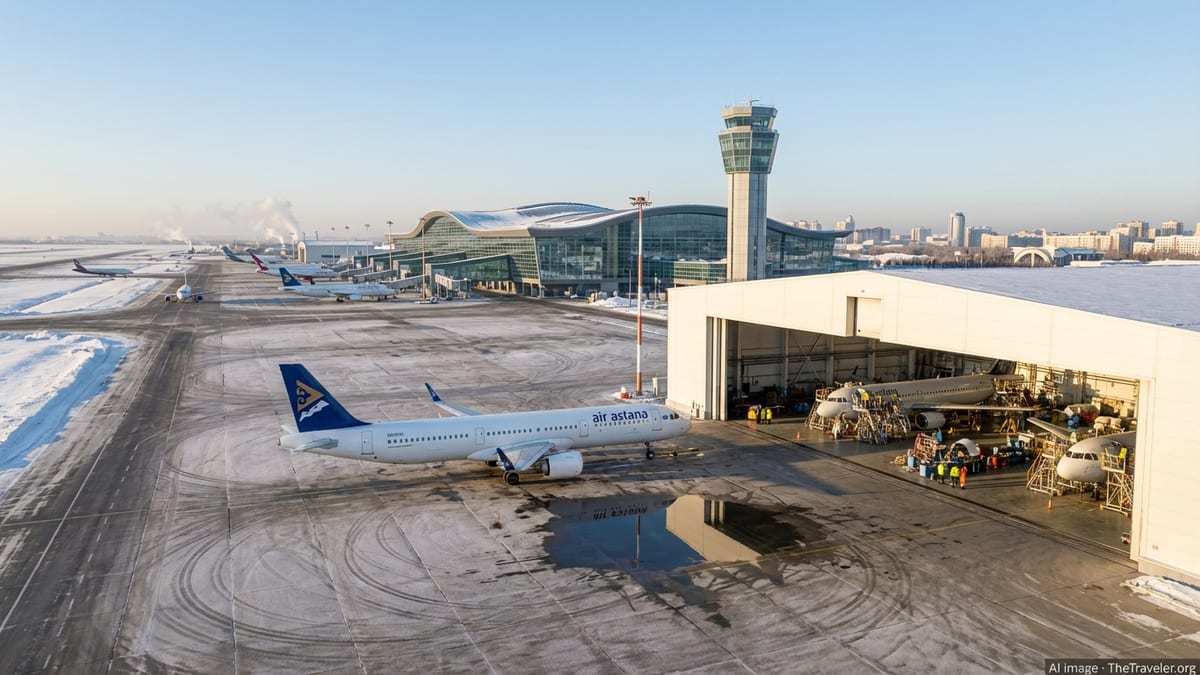
Air Astana has quietly crossed a landmark 50th in-house C-check at its Astana engineering hub, a technical milestone that is rapidly transforming Kazakhstan’s capital from transit crossroads into a serious aviation power with ambitions to rival established maintenance and repair centers across Europe and the Middle East.
From First C-Check to a Fleet-Wide Milestone
Just a few years ago, heavy maintenance on Air Astana’s Airbus A320 family meant ferrying aircraft to third-party facilities in Europe, Russia or China. That picture has changed dramatically. Since securing European Union Aviation Safety Agency certification in 2019 to perform C1 and C2 checks on its own Airbus fleet at bases in Almaty and Astana, the carrier has steadily built up a self-reliant maintenance ecosystem that now supports both Air Astana and its low-cost arm FlyArystan.
The completion of a 50th C-check represents more than an internal metric for the engineering department. It signals that Kazakhstan’s flag carrier has moved from cautious early steps into mature, high-volume heavy maintenance. Each C-check involves hundreds of scheduled tasks, detailed structural inspections and system tests that collectively determine whether an aircraft is fit to fly for years to come. Reaching dozens of such events in-house demonstrates that processes, tooling and human capital have scaled up in tandem.
Industry data and the airline’s own disclosures show how quickly that scaling has occurred. The first independent C-check in 2019 was followed by the first 2C-check in 2022, the first six-year C-check in 2023 and, in 2024, the first 12-year inspection on an Airbus A321. By late 2025, Air Astana’s facilities in the capital were capable of handling dual C-checks on A320 family aircraft and, as of this year, can support up to three heavy checks at once, a capacity that would have been unthinkable when the Astana technical center opened in 2017.
Astana’s Technical Center Emerges as Regional Heavyweight
At the heart of this transformation is the Aviation Technical Centre at Astana’s Nursultan Nazarbayev International Airport. Conceived less than a decade ago as an ambitious piece of industrial infrastructure, the hangar complex has evolved into one of Central Asia’s most advanced hubs for commercial aircraft maintenance. It was designed to cope with the severe winters of Kazakhstan’s steppe climate, providing a controlled environment where complex structural work can continue uninterrupted even when temperatures outside plunge well below freezing.
The wide-span main hangar can accommodate a widebody such as a Boeing 767 or 787 alongside a narrow-body Airbus A320 family jet, giving engineers the flexibility to sequence different fleet types and maintenance tasks. Inside, the layout is tailored to the rhythm of heavy checks: aircraft positioned for maximum access, workshops for composite repairs and avionics, non-destructive testing labs and a large integrated spares warehouse that reduces waiting time for critical components. For a C-check that may keep an aircraft out of commercial service for several weeks, shaving even a day or two from the schedule can translate into significant gains in availability and revenue.
Astana’s technical campus is also, in effect, a training ground. The airline has invested in technician development programs aligned with international standards, ensuring that a growing pool of local engineers hold EASA Part 66 licenses and type ratings for the Airbus A320 family. As the engineering teams have moved from basic C1 and C2 events into deeper six- and twelve-year checks, they have accumulated experience with the most demanding inspections on the narrow-body workhorses at the core of Air Astana’s and FlyArystan’s fleets.
Why C-Checks Matter: Safety, Savings and Sovereignty
C-checks are among the most intensive scheduled maintenance events in an airliner’s life cycle. Performed roughly every three to six years, depending on aircraft utilization and manufacturer guidance, they involve stripping back major components, opening up the fuselage and wings for hidden corrosion, and closely examining structural joints, landing gear and critical systems. For the aircraft’s owner or operator, it is the moment when the true condition of the asset is revealed and when upgrades and modifications can be introduced with minimal additional downtime.
By bringing these checks home to Astana and Almaty, Air Astana has effectively taken control of one of the largest cost items on its maintenance ledger. Company figures indicate that in-house C-check capability is already saving several million dollars annually, while reducing ground time by as much as a fifth compared to sending aircraft abroad. Those savings matter in a market where margins are tight and competition for transfer traffic is growing across Eurasia.
There is also a strategic dimension. Heavy maintenance has long been a lever of industrial sovereignty in aviation. States that depend entirely on foreign facilities for critical checks can find themselves exposed to capacity bottlenecks or geopolitical shocks. Kazakhstan’s decision to cultivate a domestic heavy maintenance capability gives it greater resilience and aligns with national plans to build up advanced, exportable technical services. Each C-check completed within its borders keeps high-value work and skilled employment in the country.
Astana’s Bid to Become Central Asia’s MRO Hub
With 50 C-checks completed, Air Astana is no longer thinking solely in terms of its own fleet needs. The carrier and its shareholders have made clear that they see a commercial opportunity in marketing Astana as a maintenance, repair and overhaul hub for the wider region. The A320 family, which forms the backbone of the group’s operations with dozens of aircraft in service, is also the narrow-body workhorse of many airlines across Eurasia. Offering competitive, EASA-standard heavy checks in Kazakhstan could appeal to operators seeking alternatives to saturated European or Gulf MRO centers.
The blueprint is becoming visible. Air Astana has steadily expanded capacity at its Advanced Technical Centre so that three C-checks can run in parallel, with further hangar projects planned in both Astana and Almaty later this decade. The airline’s 2023 annual reporting highlighted the intention to begin offering C-check slots to third-party customers, a move that would shift the engineering arm from cost center to profit generator. Conferences and industry events held in Astana are now routinely showcasing Kazakhstan’s MRO ambitions to global lessors, maintenance specialists and regional carriers.
For Astana itself, this is a critical part of its strategy to be more than just a stopover on long-haul routes between Europe and Asia. As more airlines deploy aircraft to the capital, incentives to perform turnarounds and maintenance there increase. Successful marketing of C-check services could see new operators basing aircraft in Astana or scheduling extended stays for checks, bringing additional hotel, catering and logistics business to the city’s wider economy.
Engineering Excellence Under Global Scrutiny
As Air Astana’s technical operations grow in scale and visibility, they do so under the scrutiny that comes with international regulatory oversight and a stock exchange listing. The airline’s maintenance programs are audited against EASA standards, and the carrier operates in an era where any technical incident, however minor, can quickly attract online attention. In this context, the reliability of C-check work performed in Astana becomes inseparable from the airline’s brand promise.
The recent example of a minor structural defect discovered on one of the airline’s aircraft underscores why robust inspection regimes matter. Air Astana highlighted that the hairline crack, identified in a non-critical area, posed no threat to safety and was rectified in line with manufacturer guidance. Nonetheless, the incident showed that even small findings are now dissected in public. For the engineers in Astana, it is a reminder that every inspection report and torque wrench reading feeds into a wider narrative about Kazakhstan’s aviation standards.
So far, that narrative has been positive. International safety bodies removed Kazakh carriers from restrictive lists several years ago, and Air Astana has worked intensively to improve its safety record and processes. The progression from basic C-checks to complex twelve-year inspections on modern Airbus types would not have been possible without multiple layers of regulatory approval and recurrent oversight. Each completed check in Astana is signed off not only by licensed engineers but also by a system of quality assurance designed to match the best European practices.
Economic and Workforce Impacts in Kazakhstan’s Capital
The economic impact of Air Astana’s C-check milestone extends far beyond the boundaries of the hangar. Heavy maintenance is labor intensive: the first six-year check completed in Astana required nearly 8,000 man-hours from teams of engineers and mechanics. As the number of checks grows, so does the demand for specialists in structures, avionics, non-destructive testing, planning and logistics. That, in turn, is prompting investment in technical education and vocational training in and around the capital.
Partnerships between Air Astana, local colleges and international training organizations are producing a new generation of Kazakh aviation professionals, many of them based in Astana. These technicians are building careers that would have been difficult to imagine at such scale a decade ago, when most heavy work on local aircraft was exported abroad. Their skills are transferable and internationally recognized, opening the possibility that Kazakhstan could one day export expertise as well as services.
The city benefits in subtler ways too. A fully occupied maintenance center requires a supply chain of component vendors, tooling specialists, calibration labs and IT support. Foreign experts who come to supervise specialized work or share best practice add to the city’s international profile. For a capital that has long positioned itself as a showcase of modern Kazakhstan, the sight of advanced composite repairs and digital maintenance planning systems at its airport fits neatly alongside the skyline of new architecture and business towers.
Astana’s Growing Role in Eurasian Air Connectivity
The rise of Astana as a heavy maintenance hub coincides with its growing role as a passenger and cargo gateway. Runway upgrades and airside infrastructure projects in recent years have aimed to support higher traffic volumes and improve operational resilience, even if temporary works have at times required schedule adjustments. Air Astana and other operators have had to manage around daytime runway closures for periods to allow modernization, a reminder that the physical foundations of a hub must keep pace with its ambitions.
As those upgrades come online, the synergy between operations and maintenance strengthens. Airlines are more likely to route aircraft through Astana if they can combine revenue flights with scheduled checks or quick-turn rectification work. For passengers, this can translate into more route options and potentially more competitive fares, as carriers optimize rotations around a well-equipped base. For Kazakhstan, it cements the capital’s status as a node in the wider Eurasian aviation network, not merely as a political or administrative center.
Astana’s geographic position between major European, Russian, Chinese and Middle Eastern markets has always offered theoretical advantages for aviation. The expansion of in-house C-check capability, capped by the recent 50th milestone, is one of the clearest signs yet that those advantages are being converted into tangible infrastructure and expertise. As more aircraft rotate through the gleaming white hangars of the Aviation Technical Centre for deep maintenance, Kazakhstan’s capital is steadily earning its place on the shortlist of serious aviation cities.