

More news on this day
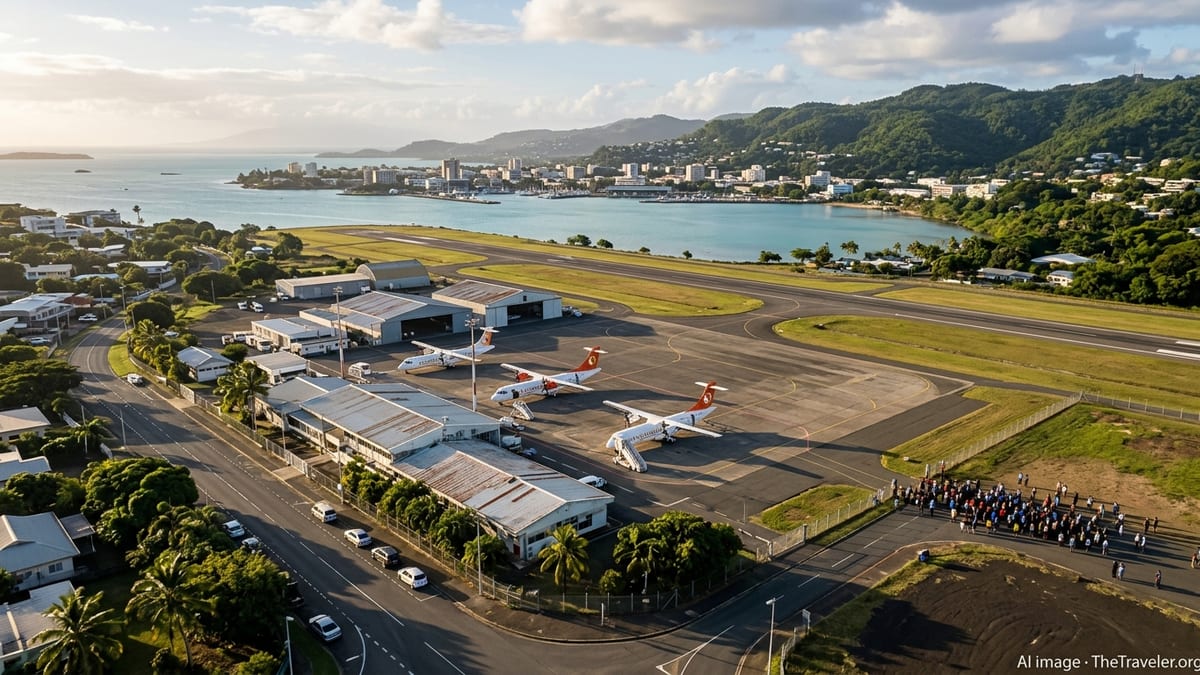
New Caledonia’s domestic airline Air Calédonie has filed for bankruptcy in Nouméa as long-running protests over its relocation from city-center Magenta Airport to La Tontouta International Airport culminate in airfield blockades and the grounding of most flights, intensifying travel disruption across the French Pacific territory.
Get the latest news straight to your inbox!
Bankruptcy Filing Caps Years of Mounting Strain
Publicly available information from regional aviation and business outlets indicates that Air Calédonie’s bankruptcy follows several years of financial pressure, heightened by the COVID-19 downturn, the violent unrest that swept New Caledonia in 2024, and a contested restructuring plan centered on moving operations out of Nouméa’s Magenta Airport. Analysts had already described the carrier as fragile, noting reduced schedules, workforce cuts, and the sale of at least one ATR aircraft as management sought to stabilize the balance sheet.
Reports from local economic bulletins and territorial audit documents describe a domestic network heavily dependent on public subsidies, especially on low-traffic island routes. An audit released in late 2025 criticized the high per-passenger cost of maintaining territorial air continuity, while acknowledging that a transfer of operations to La Tontouta was part of a broader recovery strategy aimed at lowering operating expenses.
The recent surge in protests and the subsequent grounding of flights removed what little revenue cushion remained. Aviation industry coverage in recent days has detailed how prolonged blockades at airfields and on access roads effectively shut down the airline’s core activity, undermining cash flow to the point where court-supervised bankruptcy protection was presented as the only option to keep the company from outright collapse.
Under the bankruptcy process, Air Calédonie is expected to operate on a drastically reduced basis, if at all, while administrators and public stakeholders assess options ranging from a state-backed rescue to a restructuring of routes and staffing. For travelers inside New Caledonia, however, the immediate effect is the sudden disappearance of the primary link between Nouméa and the outer islands.
Protests Over Airport Relocation Boil Over
The immediate trigger for the latest unrest lies in the politically and socially sensitive decision to transfer Air Calédonie’s domestic operations from Magenta, the convenient in-town airfield in Nouméa, to La Tontouta, the international airport located roughly 47 kilometers from the city. Territorial authorities had set early March 2026 as the formal switchover date, with aviation news outlets noting that the move was designed to reduce infrastructure costs and consolidate operations.
Opposition to the plan, particularly strong on the Loyalty Islands and other outer communities, has been building for months. Commentators in local media have reported widespread concerns that relocating flights to La Tontouta would make travel more expensive and cumbersome for residents who rely on quick connections to the capital for health care, education, and administrative services. The fear of renewed roadblocks along the main highway between Nouméa and La Tontouta, a route repeatedly disrupted during the 2024 crisis, added to anxieties.
In late February and early March, that simmering discontent translated into direct action. Aviation reports and regional news coverage describe protesters blocking access to runways and airport facilities, forcing the cancellation of most Air Calédonie services just as the transfer to La Tontouta was due to begin. Some of the carrier’s aircraft were repositioned for limited operations elsewhere in the Pacific, but domestic movement within New Caledonia largely came to a standstill.
The blockade has taken on a symbolic dimension that goes beyond aviation policy. For many residents, particularly in pro-independence and island communities, the airport decision is viewed as part of a broader pattern in which economic and strategic priorities in Nouméa overshadow local needs and concerns, echoing tensions that fueled the 2024 unrest over electoral reform.
Travel Chaos for Islands and a Capital Still Recovering
The grounding of Air Calédonie’s flights has immediate, concrete consequences for New Caledonia’s scattered population. Domestic services from Nouméa traditionally connect Grande Terre with islands such as Lifou, Maré, Ouvéa, and the Isle of Pines, routes that are difficult to replace quickly by sea. Past episodes of protest that shut down runways on Lifou and Maré have already highlighted how quickly communities can become isolated when air links fail.
In Nouméa itself, the disruption arrives as the capital is still recovering from the 2024 unrest, when La Tontouta International Airport was closed to commercial traffic for weeks and key road corridors were repeatedly blocked. International connectivity has only gradually improved, with foreign carriers resuming some services and the long-haul operator Aircalin adding capacity in stages as curfews were lifted and demand recovered.
The bankruptcy of Air Calédonie risks undermining that fragile progress. While La Tontouta continues to handle limited international traffic, the loss of a reliable domestic feeder network complicates itineraries for tourists heading to the islands and for residents needing to connect through Nouméa to reach Australia, New Zealand, or other Pacific destinations. Travel advisories issued by foreign governments in recent years have already urged caution because of intermittent roadblocks and social tension, and the current turmoil is likely to keep risk assessments elevated.
Within New Caledonia, local commentators warn that suspended flights may further strain public services. Medical evacuations, the transport of teachers and civil servants, and the delivery of time-sensitive goods have long relied on the speed of small turboprop aircraft. Shipping lines and charter operators can plug some gaps, but capacity is limited and the cost per passenger is typically higher and less predictable than scheduled air transport.
Economic Shock for a Territory in Political Transition
Economists in Nouméa and in mainland France have repeatedly described the aviation sector as a strategic pillar for New Caledonia’s diversified but fragile economy, which also includes nickel mining, public administration, and tourism. Territorial chambers of commerce and trade groups have emphasized that air links are crucial not just for visitors but for the internal circulation of workers, goods, and services that keeps the archipelago functioning as a single market.
The failure of Air Calédonie comes at a particularly delicate political moment. The territory is moving toward a new constitutional framework following the Bougival Accord, intended to replace the Nouméa Accord and redefine relations between New Caledonia and the French state. Public debate over autonomy, identity, and economic development has intensified, and the fate of key infrastructure, including airlines and airports, sits at the heart of those discussions.
Observers note that the combination of lingering damage from the 2024 crisis, ongoing debates over nickel sector restructuring, and now the collapse of the main domestic carrier could weigh heavily on investor confidence. Businesses that rely on just-in-time deliveries or frequent inter-island travel may delay projects or scale back operations, while tourism operators face renewed uncertainty just as some cruise lines and international airlines were reconsidering calls at Nouméa.
For island communities, the economic impact may be especially harsh. Local markets that depend on visitors from the capital, guesthouses and small tour operators, and producers of perishable goods risk losing crucial revenue streams. In previous periods of prolonged disruption, reports from social and economic agencies have documented rising unemployment and increased reliance on public assistance in precisely those areas now threatened by a renewed breakdown in connectivity.
Uncertain Path Ahead for Air Links and Travelers
Attention now turns to what shape New Caledonia’s air transport system might take if Air Calédonie cannot emerge from bankruptcy as a viable operator. Policy documents and industry commentary over the past year have explored possibilities ranging from a leaner, restructured airline to deeper cooperation or consolidation with other regional carriers, as well as more targeted subsidies tied to specific “territorial continuity” obligations.
Any solution is likely to require difficult trade-offs. Concentrating operations at La Tontouta could lower costs and better integrate domestic and international flights, but may entrench opposition from island communities that see the move as marginalizing their access. Maintaining dual hubs at Magenta and La Tontouta would preserve convenience but at a financial cost that past audits have questioned as unsustainable without significantly higher public funding.
For travelers, the immediate advice from tour operators and travel planners is to expect disruption, build in longer connection times, and monitor local news outlets closely for information on reopened routes or replacement services. Overland transfers between Nouméa and La Tontouta remain vulnerable to protest-related roadblocks, making flexibility and contingency planning essential for anyone with time-sensitive itineraries.
As New Caledonia navigates this latest crisis, Air Calédonie’s bankruptcy has become a focal point for wider debates about equity, governance, and the cost of maintaining cohesion across a widely dispersed Pacific territory. How leaders resolve the tension between economic efficiency and territorial accessibility will shape not only the recovery of air travel, but also the broader trajectory of New Caledonia’s political and social future.