

More news on this day
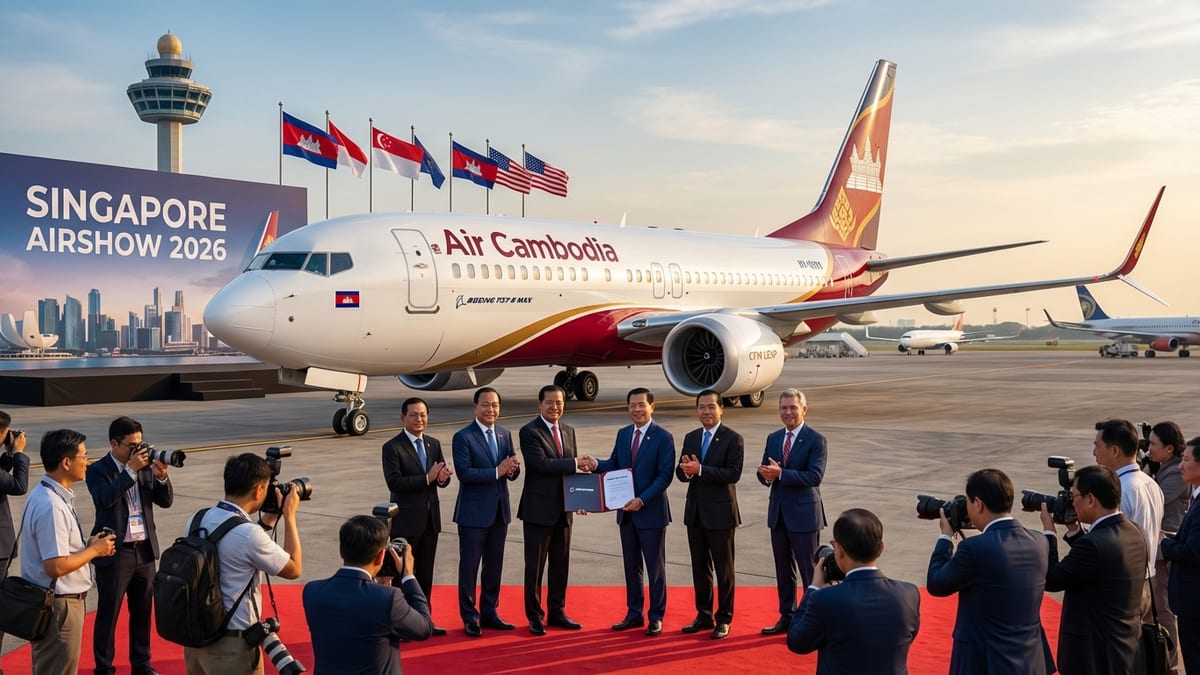
The spotlight of Asia’s aviation industry has swung firmly toward Cambodia and Singapore this week as Air Cambodia unveiled a landmark order for up to 20 Boeing 737 MAX jets at the Singapore Airshow.
The deal, valued at around 3 billion US dollars at list prices, marks the first time a Cambodian airline has purchased Boeing aircraft and underscores how Southeast Asia’s fast-growing markets are reshaping the regional aviation landscape.
More News
- TSA Rolls Out $45 ConfirmID Fee for Travelers Without REAL ID at Security
- Flying Blue Launches February 25% Promo Rewards on Transatlantic and Regional Routes
- United Fast-Tracks Starlink Wi‑Fi Across Fleet, Free for MileagePlus Members
A Landmark Deal Sealed at the Singapore Airshow
Announced on February 3 at the Singapore Airshow 2026, the agreement covers a firm order for 10 Boeing 737-8 aircraft with options and purchase rights for 10 more. The transaction had been finalized in December 2025 but appeared on Boeing’s order books as an unidentified customer until this week, when Air Cambodia’s leadership and Boeing executives jointly presented the deal to the public in Singapore.
The order instantly became the largest single-aisle aircraft purchase ever made by a Cambodian carrier. For Boeing, it was one of the headline commercial announcements of this year’s show, reinforcing the manufacturer’s strategic focus on Asia’s rapidly expanding aviation markets. The 737 MAX jets will be the first Boeing aircraft operated by a Cambodian airline, a symbolic step that broadens the competitive mix in a market long dominated by Airbus single-aisles and regional turboprops.
Senior officials from Cambodia, Boeing and the United States government were present at the signing ceremony, reflecting the deal’s broader trade and diplomatic significance. The US Department of Commerce highlighted the agreement as a major export success, projecting that it will support thousands of aerospace jobs in the United States while helping Cambodia deepen its air connectivity and economic integration across Asia.
Air Cambodia’s Transformation into a Modern Flag Carrier
The Boeing order caps a period of rapid transformation for Air Cambodia, the country’s national flag carrier, which has been rebuilding its fleet, network and brand following its rebranding from Cambodia Angkor Air. The airline officially adopted the Air Cambodia name in 2025 after a government-approved restructuring and has since positioned itself as a full-service national carrier with ambitions beyond its traditional regional footprint.
In January 2026, the airline unveiled a refreshed brand identity and new livery at a ceremony at Techo International Airport in Phnom Penh, signaling a renewed focus on national identity and service quality. With a growing network that spans key markets in China, India, Vietnam, Thailand, Hong Kong and Japan, Air Cambodia is targeting higher aircraft utilization, stronger international partnerships and a larger role in supporting the country’s tourism and trade strategy.
Until now, Air Cambodia’s fleet has consisted mainly of Airbus narrowbodies and ATR 72-600 turbopops used on domestic and short-haul regional routes. The introduction of the 737 MAX signals a shift to a dual-supplier approach and paves the way for a modernized, more efficient narrowbody fleet that can handle higher-demand routes and longer sectors more competitively.
What the Boeing 737 MAX Brings to Cambodia’s Skies
The 737-8 variant chosen by Air Cambodia is designed to seat up to around 178 passengers in a two-class layout and offers a range of about 3,500 nautical miles. For Cambodia, that range opens up nonstop access from Phnom Penh or Siem Reap to a wide swath of Asia, including North Asia and South Asia, while also bolstering capacity on shorter, high-density routes in Southeast Asia.
A key motivation for the purchase is fuel efficiency. Boeing and Air Cambodia executives have emphasized that the 737 MAX family delivers roughly 20 percent lower fuel consumption and emissions compared with the previous generation of single-aisle aircraft that many regional carriers still operate. For a cost-sensitive and increasingly environmentally conscious market, that combination of lower operating costs and reduced carbon footprint is an attractive proposition.
The aircraft will feature Boeing’s latest cabin design, aimed at improving passenger comfort with larger overhead bins, modern lighting and quieter engines. For Air Cambodia, these upgrades offer an opportunity to enhance the onboard experience and align more closely with the expectations of regional and long-haul transfer passengers, particularly as it targets higher-yield traffic and potential interline or codeshare partnerships.
Cambodia’s Aviation Ambitions in a Rebounding Tourism Economy
The order comes as Cambodia seeks to leverage aviation as a pillar of its broader economic growth and tourism recovery strategy. The country’s economy has averaged robust growth over the past decade, and policymakers see expanded air connectivity as essential to sustaining that trajectory. Tourism, which suffered deeply during the pandemic, has been climbing back but remains highly sensitive to air access and competition from neighboring destinations.
New-generation aircraft with longer range and better economics give Air Cambodia more flexibility to open or deepen routes to key feeder markets, particularly in China and India, where outbound leisure and business travel continue to grow. Additional capacity could also support new links to secondary cities across Asia, aligning with Cambodia’s goal to disperse visitor flows beyond traditional hubs such as Angkor Wat and Phnom Penh and to encourage investment in emerging urban centers.
At the same time, the investment carries a clear signal domestically. By committing to a modern, fuel-efficient fleet, Cambodia’s national carrier is demonstrating confidence in long-term travel demand and in the country’s ability to compete more directly with regional heavyweights based in Thailand, Vietnam and Singapore. It also underscores growing cooperation between the Cambodian state, foreign investors and international partners in building out aviation infrastructure and services.
Singapore’s Role as Asia’s Aviation Showcase and Deal Hub
The location of the announcement is no coincidence. The Singapore Airshow has become one of Asia’s most important stages for commercial aviation deals, drawing airlines, manufacturers, financiers and government delegations from across the region. For emerging carriers such as Air Cambodia, unveiling a strategic fleet order in Singapore offers maximum visibility among potential partners and suppliers.
Singapore itself is a central node in Asia’s aviation system, with Changi Airport serving as a benchmark for airport management, connectivity and passenger experience. The city-state also plays a growing role in aircraft leasing, maintenance, training and finance, and acts as a bridge for international investors looking to tap Southeast Asia’s fast-growing markets. By choosing the Singapore Airshow to present its Boeing order, Air Cambodia is aligning its ambitions with the region’s leading aviation ecosystem.
For Boeing, announcing the deal in Singapore highlights the company’s long-term bet on Asia as a driver of narrowbody demand over the next two decades. Industry forecasts consistently project that airlines in Southeast Asia will need thousands of new single-aisle aircraft to support economic growth and rising middle-class travel. Securing a new customer in Cambodia at this venue reinforces Boeing’s message that its 737 MAX family is central to meeting that demand.
Safety, Strategy and the 737 MAX’s Renewed Prospects in Asia
The Air Cambodia order also signals the continued rehabilitation of the 737 MAX brand in Asia following the model’s extended global grounding earlier in the decade. Since the aircraft returned to service after extensive recertification and software updates, regulators across Asia have gradually cleared the type, and major carriers in markets such as Singapore, Malaysia and Indonesia have resumed or initiated MAX operations.
By joining that cohort, Air Cambodia is aligning itself with a growing consensus among regulators and operators that the aircraft meets current safety standards. For passengers, the decision may prompt renewed attention to aircraft type and safety records, but airlines and manufacturers are working to communicate the changes implemented since the grounding, including revised pilot training and software safeguards.
Strategically, diversifying its fleet to include both Airbus and Boeing narrowbodies could give Air Cambodia more bargaining power, greater flexibility in sourcing aircraft and engines, and access to a wider pool of leasing and financing options. The deal also benefits engine maker CFM International, whose LEAP engines power all Boeing 737 MAX variants and are expected to play a role in the airline’s fuel-efficiency gains.
Implications for Connectivity Across Southeast Asia and Beyond
The expansion of Air Cambodia’s fleet with next-generation narrowbodies is likely to have ripple effects across Southeast Asia’s route networks. With more capable aircraft, the airline can better connect Cambodian airports with regional hubs such as Singapore, Bangkok and Hanoi while also targeting point-to-point routes that bypass traditional gateways. This could mean more direct links for travelers heading to Cambodia’s cultural sites or coastal destinations, and smoother connections for business travelers transiting through Phnom Penh.
For Singapore, enhanced connectivity with Cambodia supports its broader role as a regional transfer hub and investment center. Additional capacity on Cambodia–Singapore routes can feed Changi Airport’s extensive long-haul network, while also supporting Singaporean businesses operating in Cambodia’s tourism, construction, manufacturing and digital sectors. The interplay between a rising Cambodian flag carrier and Singapore’s mature aviation ecosystem illustrates how regional integration is increasingly expressed through airline fleet decisions and route strategies.
More broadly, the deal contributes to an emerging pattern in which secondary and midsize carriers across Asia commission modern narrowbody fleets to tap growing demand beyond the region’s mega-hubs. This trend is likely to reshape traveler options over the next decade, delivering more nonstop routes, better frequencies and, potentially, more competitive fares as new capacity comes online.
FAQ
Q1: What exactly did Air Cambodia order from Boeing?
Air Cambodia has ordered a total of up to 20 Boeing 737 MAX jets, specifically the 737-8 variant. The agreement includes 10 firm orders and options or purchase rights for an additional 10 aircraft, giving the airline flexibility to scale its fleet as demand grows.
Q2: When and where was the order announced?
The order was unveiled publicly on February 3, 2026, at the Singapore Airshow. While the commercial terms were finalized in December 2025 and recorded on Boeing’s order books, Air Cambodia was previously listed only as an unidentified customer.
Q3: Why is this deal significant for Cambodia’s aviation sector?
This is the largest single-aisle aircraft order ever placed by a Cambodian carrier and the first time a Cambodian airline has purchased Boeing jets. It marks a major step in modernizing the country’s national airline, improving fuel efficiency and expanding the range and capacity of routes served from Cambodian airports.
Q4: How does the Boeing 737 MAX benefit Air Cambodia’s passengers?
The 737-8 offers a more modern cabin with improved lighting, larger overhead bins and quieter engines. Its efficiency and range allow Air Cambodia to operate longer routes nonstop and to offer more competitive schedules and potentially better fares, while also reducing fuel burn and emissions per passenger.
Q5: What routes might Air Cambodia serve with the new aircraft?
While specific routes have not yet been announced, the range of the 737-8 allows nonstop flights from Cambodia to a wide variety of destinations across Southeast Asia, North Asia and parts of South Asia. High-demand markets in China, India, Japan and key ASEAN capitals are likely candidates for deployment.
Q6: How does this order relate to Cambodia’s tourism and economic goals?
Improved air connectivity is central to Cambodia’s strategy to boost tourism, attract investment and support trade. By adding more efficient, longer-range jets, Air Cambodia can open new routes, increase frequencies and strengthen links to source markets, supporting job creation in hospitality, services and infrastructure.
Q7: Why was the announcement made in Singapore rather than Cambodia?
The Singapore Airshow is one of Asia’s premier aerospace events and a preferred venue for major commercial aircraft announcements. Presenting the deal there maximizes visibility among airlines, investors and suppliers and situates Air Cambodia’s growth story within the wider context of Asia’s aviation momentum.
Q8: Is the 737 MAX widely used elsewhere in Asia now?
Yes. Following its global grounding earlier in the decade, the 737 MAX has since been recertified and returned to service with numerous airlines across Asia. Carriers in markets such as Singapore, Malaysia, Indonesia and India now operate the type, and new orders continue to be placed as demand recovers.
Q9: How will this deal affect competition with other regional airlines?
By upgrading to fuel-efficient single-aisle jets, Air Cambodia can compete more effectively on both cost and passenger experience against regional rivals based in Thailand, Vietnam and elsewhere. The added capacity and range may also allow it to launch routes that were previously uneconomical with older aircraft.
Q10: When will travelers start flying on Air Cambodia’s 737 MAX aircraft?
Delivery dates have not been publicly disclosed, but industry expectations suggest that the first aircraft could arrive in the latter part of this decade, depending on Boeing’s production slots and Air Cambodia’s fleet plan. Once deliveries begin, the airline is expected to introduce the jets gradually on key regional routes.