

More news on this day
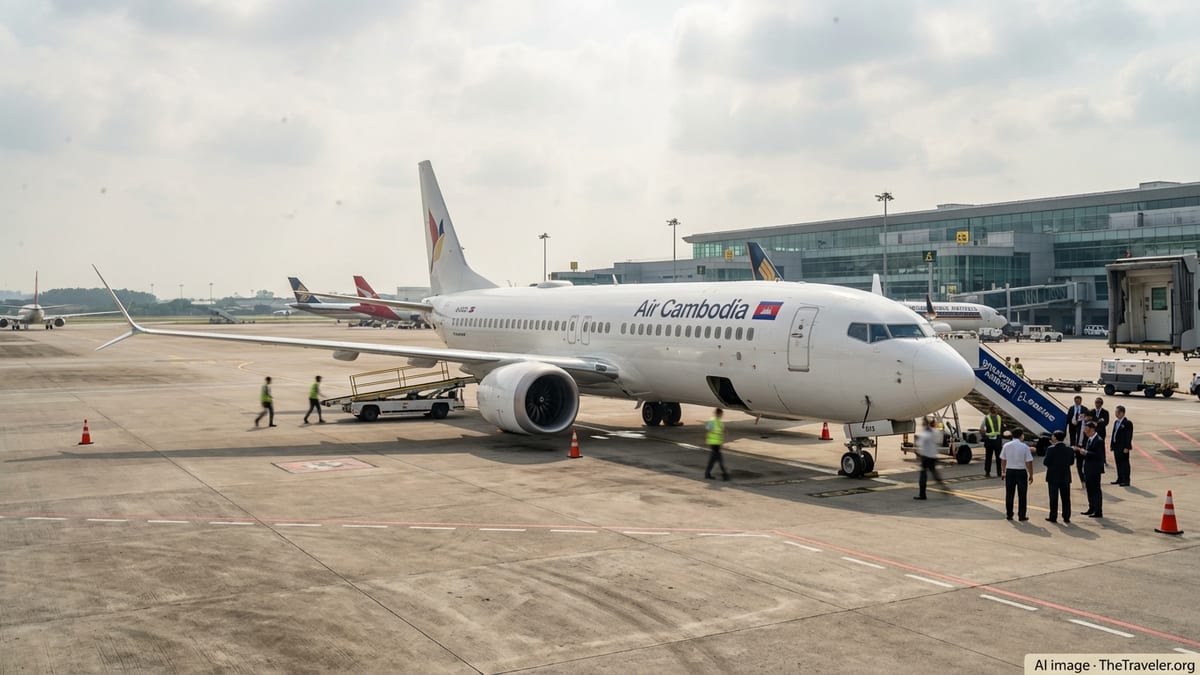
Air Cambodia has placed its biggest narrowbody aircraft order to date, signing for up to 20 Boeing 737 MAX jets in a deal that underscores the airline’s ambitions to become a stronger regional player across Asia.
Announced on February 3 at the Singapore Airshow, the agreement marks the carrier’s first purchase from Boeing and the first time a Cambodian airline will operate the US manufacturer’s latest generation single aisle aircraft.
More News
- Caribbean Travel to U.S. Upended by New Visa Freezes and Expanded Bans
- Mexico Restores E-Visas for Brazilians, Paving the Way for Borderless Tourism
- Philippine Airlines Joins Regional Carriers Powering Southeast Asia’s Tourism Boom
Landmark Boeing Deal Unveiled at Singapore Airshow
The order, revealed on the opening day of the 2026 Singapore Airshow, consists of 10 firm 737-8 aircraft with the opportunity for 10 additional jets. The firm portion of the deal was finalized in December 2025 but had until now appeared on Boeing’s books as an order from an unidentified customer. By formally attaching Air Cambodia’s name to the agreement at one of the region’s most prominent aviation showcases, both airline and manufacturer signaled a long term partnership and a vote of confidence in the Southeast Asian market.
Boeing officials described Air Cambodia as the company’s newest 737 MAX customer and emphasized the strategic nature of entering the Cambodian market. For Boeing, the contract delivers another foothold in a region where low cost and full service carriers alike are racing to add fuel efficient single aisle capacity. For the airline, it represents a high profile fleet modernization move timed to coincide with a broader recovery in Asia Pacific travel.
The announcement ceremony drew senior executives and government representatives from both sides, underscoring the order’s national significance. Cambodian authorities have long viewed aviation as a pillar of tourism development, particularly for destinations such as Angkor Wat, and the deal is being framed domestically as part of a broader effort to upgrade the country’s connectivity and aviation infrastructure.
Inside the Order: 10 Firm 737-8s and Options for 10 More
At the heart of the agreement is the 737-8, the workhorse member of the 737 MAX family. Air Cambodia has committed to 10 of the type, with options that could bring the total to 20 aircraft if fully exercised. The structure gives the airline near term certainty on core fleet additions, while preserving flexibility to scale up depending on demand and financial conditions.
The 737-8 typically seats up to 178 passengers in a two class layout and offers a range of about 3,500 nautical miles, giving Air Cambodia the ability to cover dense regional routes as well as longer thin markets within Asia. The airline plans to deploy the type on high demand services linking Cambodia to key commercial and tourism centers across Southeast Asia, North Asia and parts of South Asia.
Industry analysts note that the order size is significant relative to Air Cambodia’s current narrowbody and regional fleet, which numbers only six aircraft. Bringing in up to 20 MAX jets will more than triple overall capacity if all options are taken, shifting the carrier from a modest operator into a more substantive regional player. The staged nature of deliveries will allow the airline to phase in the aircraft gradually, align them with route launches and retire older units over time.
Fleet Renewal and Ambitious Network Expansion
Air Cambodia currently relies on a mix of Airbus A320 family jets and ATR 72 turboprops to operate domestic services and short haul routes to neighboring markets. The addition of the 737-8 is intended both to refresh that fleet and to power new city pairs that were previously beyond the airline’s reach in terms of range, economics or available capacity.
The airline’s leadership has pointed to new direct services to North and Southeast Asian markets as a priority. Nonstop links to cities in Japan, northern China and India are expected to be early beneficiaries of the new aircraft, alongside additional frequencies to existing destinations such as Ho Chi Minh City, Bangkok and Hong Kong. With the 737-8’s range performance, Air Cambodia can contemplate longer stage lengths without the payload compromises that can challenge older models in hot and humid operating environments.
Tourism flows are central to the strategy. Cambodia has been working to rebuild visitor numbers following the pandemic period, and improved air access is seen as critical for attracting higher spending travelers and diversifying source markets beyond the region’s core. The new jets will make it easier for the airline to launch point to point flights from secondary Asian cities directly to Cambodian destinations, bypassing traditional hubs and reducing total journey times.
Efficiency, Sustainability and the 737 MAX Proposition
A key selling point of the 737 MAX family is its promise of lower fuel burn and emissions compared with earlier generation single aisle aircraft. Boeing and Air Cambodia are highlighting a reduction in fuel use and emissions of around 20 percent versus the models the new aircraft will replace. In an era of rising environmental scrutiny and volatile jet fuel costs, that efficiency gain is central to the airline’s business case.
The 737-8 achieves those savings through a combination of redesigned CFM LEAP engines, aerodynamic improvements and lighter materials. For Air Cambodia, the lower operating costs support more competitive fares and help make thinner routes viable year round. The aircraft’s cabin is also configured to support higher passenger comfort, including larger pivoting overhead bins and modern LED lighting, features that the airline is expected to leverage in its marketing as it positions itself as a full service regional carrier.
Regulators and travelers remain sensitive to the 737 MAX label after the type’s global grounding earlier in the decade, but most markets have now seen the aircraft return to service and accumulate millions of flight hours. By joining a growing list of operators in Asia that have adopted the latest generation 737, Air Cambodia is signaling its confidence in the model’s safety record and in the scrutiny it has undergone during its recertification and subsequent operations.
Boeing’s Wider Bet on Southeast Asia’s Growth
The Air Cambodia deal fits neatly into Boeing’s broader view of Southeast Asia as one of the world’s most dynamic aviation growth regions. The manufacturer’s long term market outlook projects nearly 5,000 new aircraft deliveries to carriers in the subregion over the next two decades, with single aisle jets like the 737 MAX expected to account for more than 80 percent of that total.
As incomes rise, low cost carriers expand and tourism flows deepen between major and secondary cities, airlines across Southeast Asia are seeking economical narrowbody aircraft that can operate both dense trunk routes and point to point services. Boeing has secured large MAX commitments from airlines in Indonesia, Vietnam and Thailand in recent years, and the Air Cambodia contract extends that footprint into a smaller but strategically important market.
The order also comes at a time when competition between Boeing and Airbus in Asia is intensifying. The Airbus A320neo family has had considerable success in the region, particularly with budget carriers. By winning a new flag carrier customer in Cambodia for the 737-8, Boeing gains a reference operator whose future growth, if successful, could influence fleet decisions by other airlines in the Mekong subregion.
Implications for Cambodia’s Aviation and Tourism Sectors
Cambodia’s aviation sector has evolved over the past decade from a narrow focus on inbound leisure traffic toward a more diversified mix that includes business travel, visiting friends and relatives, and emerging cargo demand. The introduction of modern narrowbodies like the 737 MAX is expected to accelerate that transition by improving connectivity and schedule reliability, particularly during peak tourism seasons.
Government officials have consistently framed air connectivity as a development tool, linking improved access to job creation in hospitality, services and airport operations. The Air Cambodia order will likely feed into training initiatives for pilots, cabin crew and maintenance personnel, as well as drive investment in ground infrastructure capable of handling more frequent and higher capacity jet operations at Phnom Penh, Siem Reap and Sihanoukville.
The timing of the order aligns with broader infrastructure projects, including upgrades at the country’s main international airports and efforts to streamline border and visa procedures for visitors. With more efficient aircraft and expanded route options, policymakers hope to position Cambodia as both a destination in its own right and a convenient regional gateway, particularly for travelers looking to combine multiple stops in mainland Southeast Asia.
Delivery Timelines and Integration into the Existing Fleet
While detailed delivery schedules have not been disclosed publicly, the firm 737-8 aircraft are expected to begin arriving later in the decade, with the balance of options potentially stretching into the early 2030s if exercised. This extended window allows Air Cambodia to stage its fleet growth in line with market conditions and to manage the transition from its current Airbus focused narrowbody operation.
Introducing a new aircraft type and manufacturer will require investments in training, tooling and support. The airline will need to develop MAX specific pilot training programs, cabin crew procedures and maintenance capabilities, often in partnership with Boeing and local aviation authorities. In return, access to the 737-8’s range and capacity opens up commercial opportunities that the current fleet cannot fully exploit.
For passengers, the shift will be visible through refreshed cabin interiors, new route announcements and potentially revised schedules as the airline optimizes aircraft deployment. For Air Cambodia’s workforce, the arrival of a new fleet type is likely to bring both challenges and opportunities, including progression pathways onto a modern jet family that is widely used across the region.
FAQ
Q1: How many Boeing 737 MAX aircraft has Air Cambodia ordered?
Air Cambodia has placed a firm order for 10 Boeing 737-8 aircraft with the opportunity to add 10 more, bringing the total potential order to 20 jets.
Q2: Which version of the 737 MAX will Air Cambodia operate?
The airline’s order covers the 737-8, a core member of the 737 MAX family designed for short and medium haul routes with a typical two class capacity of up to 178 passengers.
Q3: When was the order announced?
The agreement was officially announced on February 3, 2026, during the Singapore Airshow, although the firm portion of the order was finalized in December 2025.
Q4: Why is this order significant for Cambodia?
This is the first time a Cambodian airline has ordered and will operate Boeing 737 MAX aircraft, marking a major step in modernizing the country’s aviation sector and expanding its regional reach.
Q5: What routes will the new 737-8s likely serve?
Air Cambodia plans to use the aircraft on high demand regional routes, including services within Southeast Asia and new or expanded links to markets in northern Asia and India.
Q6: How will the 737 MAX benefit passengers?
Passengers can expect more nonstop route options, newer cabin interiors with modern lighting and storage, and the potential for more competitive fares due to the aircraft’s lower operating costs.
Q7: How does the 737-8 compare to Air Cambodia’s current fleet?
The 737-8 offers greater fuel efficiency, longer range and higher seating capacity than many of the airline’s existing narrowbody jets, enabling both network growth and fleet renewal.
Q8: Is the 737 MAX considered safe to operate?
The 737 MAX returned to service after extensive design changes, regulatory reviews and operational checks, and is now flown by airlines around the world. Air Cambodia’s decision reflects confidence in the aircraft’s current safety and performance record.
Q9: What does the deal mean for Boeing in Southeast Asia?
The order strengthens Boeing’s presence in Southeast Asia’s fast growing single aisle market and gives the manufacturer a new flag carrier customer in a country where it previously had no major commercial jet operator.
Q10: Will this order create jobs in Cambodia?
The expansion of Air Cambodia’s fleet is expected to support new jobs in areas such as flight operations, maintenance, airport services and tourism, as the airline adds capacity and launches additional routes.