

More news on this day
Air Canada is broadening its ground-to-air network in southern Ontario, unveiling new luxury motorcoach routes that connect more community airports directly with its global hub at Toronto Pearson International Airport and giving travelers a seamless, ticketed alternative to driving the busy Highway 401 corridor.
Get the latest news straight to your inbox!
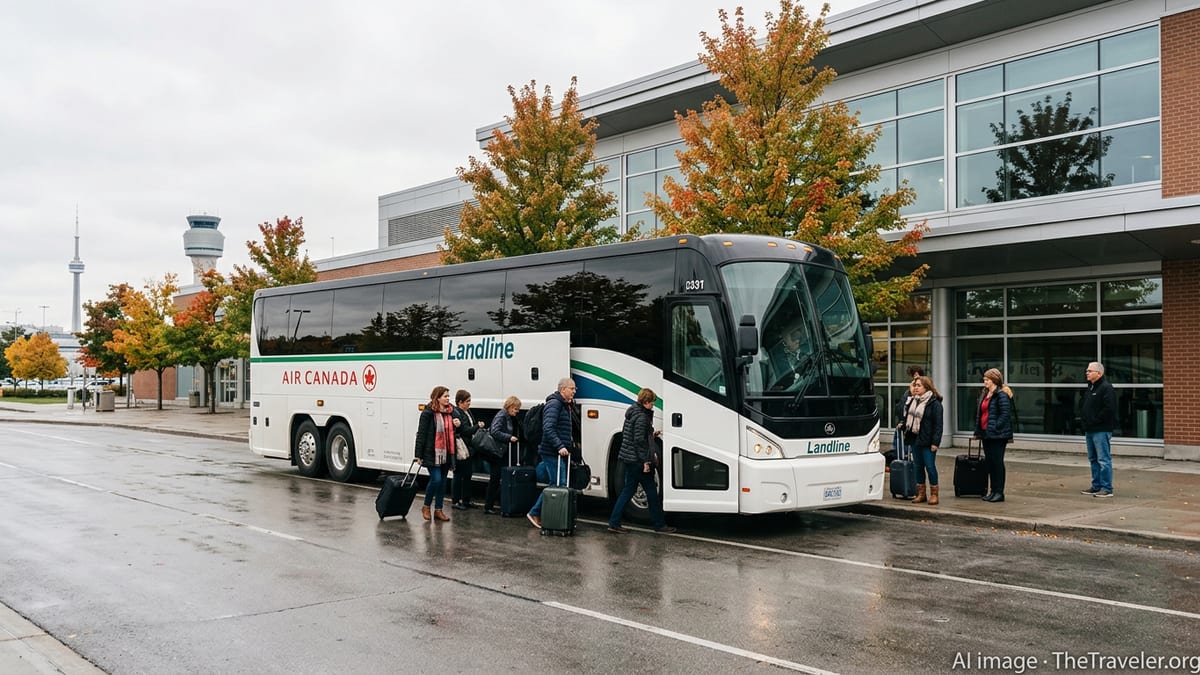
New Motorcoach Routes Extend Pearson’s Reach
The latest phase of Air Canada’s partnership with The Landline Company brings additional Ontario communities into the carrier’s Toronto Pearson network through branded luxury motorcoaches operating as if they were short-haul flights. Under the arrangement, travelers start their journey at regional airports and ride nonstop to Pearson’s Terminal 1, where they connect onto Air Canada’s domestic and international services using a single ticket.
The expanded network builds on initial services linking Hamilton and the Region of Waterloo with Toronto Pearson, which launched in 2024, and now incorporates Kingston and other growing markets that lack frequent regional jet service. The goal is to restore reliable connectivity for smaller cities while avoiding the cost and complexity of operating short regional flights that have become harder to sustain economically.
By marketing the coaches as part of its scheduled network and assigning them flight numbers, Air Canada is effectively stretching the catchment area of its Toronto hub deeper into southern and eastern Ontario. For communities that lost direct air links during the pandemic and its aftermath, the new routes are being framed as a way to regain access to the carrier’s global schedule without adding new aircraft.
For Toronto Pearson, Canada’s busiest airport and Air Canada’s primary global hub, the strategy supports continued growth by funneling more passengers from secondary markets onto long-haul services. It also allows the airline to compete more aggressively with United States and European carriers that have built similar ground-to-air networks at their major hubs.
How the Landline Service Works for Travelers
Unlike traditional airport shuttles, the Landline coaches are fully integrated into Air Canada’s reservations and check in systems. Customers booking online select their hometown airport as the origin, choose a destination anywhere on the Air Canada network, and receive a single fare that includes both the motorcoach and the onward flight. The coach segment appears in the itinerary just like a short connecting flight.
On departure, passengers check in at their local airport terminal, present identification, and drop their luggage, which is tagged through to the final destination. They then board a Landline coach that is configured with wide, reclining seats, power outlets, Wi Fi, and washrooms, and travel directly to Pearson’s Terminal 1. Upon arrival, they proceed into the terminal and continue to security screening and their connecting gate, while checked bags are transferred behind the scenes.
The return works in reverse, with travelers following signs at Pearson to a dedicated Air Canada counter on the ground transportation level before boarding coaches back to their community airports. Because the service is treated as part of the airline itinerary, minimum connection times and protections are similar to air to air transfers. If a long haul arrival is delayed, affected customers can be rebooked on a later coach or flight, rather than being left to negotiate with an independent bus operator.
Importantly for price sensitive travelers, the coach link is embedded in Air Canada’s fare structure rather than sold as a separate add on. The airline positions it as a cost comparable alternative to driving and parking at Pearson, or booking a private shuttle, while also providing the reassurance that the entire journey is managed under one booking reference.
Luxury Features Aim to Match Premium Air Experience
Air Canada and Landline are pitching the motorcoach network as a “luxury” extension of the airline experience, a deliberate attempt to distinguish the service from conventional intercity buses. Coaches are configured with fewer seats than standard highway buses to provide extra legroom, larger armrests, and a layout closer to short haul business class than to typical public transit.
Amenities on board mirror those found in premium cabins, including complimentary Wi Fi, individual power and USB outlets, and generous overhead storage. Many coaches also offer leather seating, adjustable headrests, and large panoramic windows. The aim is to create an environment where passengers can work comfortably on laptops, stream entertainment, or simply rest during the drive to Toronto.
Accessibility is another focus: vehicles feature wheelchair lifts and dedicated spaces for mobility devices, allowing passengers who rely on assistive equipment to board at regional airports rather than navigating large, often congested parking and drop off areas at Pearson. Staff are trained to handle checked baggage and assist with transfers in a way that mirrors airport ground handling standards.
The “luxury” branding also aligns the coach product more closely with Air Canada’s premium ground offerings at Toronto Pearson, such as its Signature Suite and café style lounges. While the coach cabins are open to all ticketed passengers on the route, the overall presentation is designed to reinforce the airline’s message that travelers can expect a consistent level of comfort from the moment they leave their hometown airport to the time they board a long haul flight.
Benefits for Ontario Communities and Pearson’s Network
For mid sized cities across southern Ontario, participation in the Landline program helps address a long standing connectivity gap: residents often face a choice between long drives to Pearson or limited schedules on small regional aircraft. By bundling a guaranteed coach transfer into the airline network, communities can promote themselves as being functionally “one stop” from dozens of global destinations, a selling point for local tourism boards, universities, and employers.
Municipal officials in markets such as Kingston and Waterloo Region have highlighted the potential to attract conferences, visiting scholars, and international students by offering simpler, more predictable access to the global hub at Toronto Pearson. For residents, the service promises to reduce the stress and cost of airport trips, especially during peak travel seasons when highway congestion and airport parking availability can be significant concerns.
From Air Canada’s perspective, the coach network provides a flexible way to respond to demand peaks and seasonal changes. Coaches can be added or removed with relatively short lead times, and schedules can be adjusted to align with banked departure waves at Pearson. That agility is particularly valuable as airlines continue to rebalance their networks following the disruptions of the early 2020s.
The initiative also has potential environmental benefits. Consolidating dozens of individual car trips into a single coach journey can lower per passenger emissions for the ground segment of long haul travel. For travelers who are increasingly factoring sustainability into their choices, the ability to avoid driving to a hub airport while still accessing a broad flight network may be an appealing compromise.
What Travelers Should Watch as the Network Grows
As Air Canada adds more Ontario communities to the Landline program, travelers will be watching how reliably the coaches mesh with flight schedules at Toronto Pearson, particularly during winter weather or heavy traffic periods on the region’s highways. Because the services are ticketed as part of a single itinerary, delays on either the road or in the air can ripple through a customer’s entire journey.
Airline representatives say that schedules are being built with buffer time and that operations teams monitor both highway and airport conditions in real time, similar to how they manage aircraft rotations. Early adopters in Waterloo Region and Hamilton have reported that the most successful trips are those aligned with major departure banks at Pearson, giving travelers multiple onward options if a delay occurs.
Another factor to watch is how quickly awareness spreads beyond frequent flyers. While the service is visible in Air Canada’s booking channels, many occasional travelers still default to driving or booking third party shuttles. Travel agents and corporate travel managers are expected to play a role in promoting the coach connections as a standard option for staff and clients based outside the Greater Toronto Area.
With competition increasing among airlines serving Canada’s largest hub, the expanding coach network represents one of Air Canada’s key differentiators in its home market. If the new routes succeed in filling seats on both buses and planes, the model could serve as a template for similar ground to air connections elsewhere in the country where geography and demand patterns mirror those of southern Ontario.