

More news on this day
Air Canada is deepening its bet on ultra long-haul travel, adding a second 17-hour Toronto–Delhi flight to its schedule and strengthening its position in the competitive market for some of the world’s longest nonstop services.
A Second Marathon Flight on a Pivotal Corridor
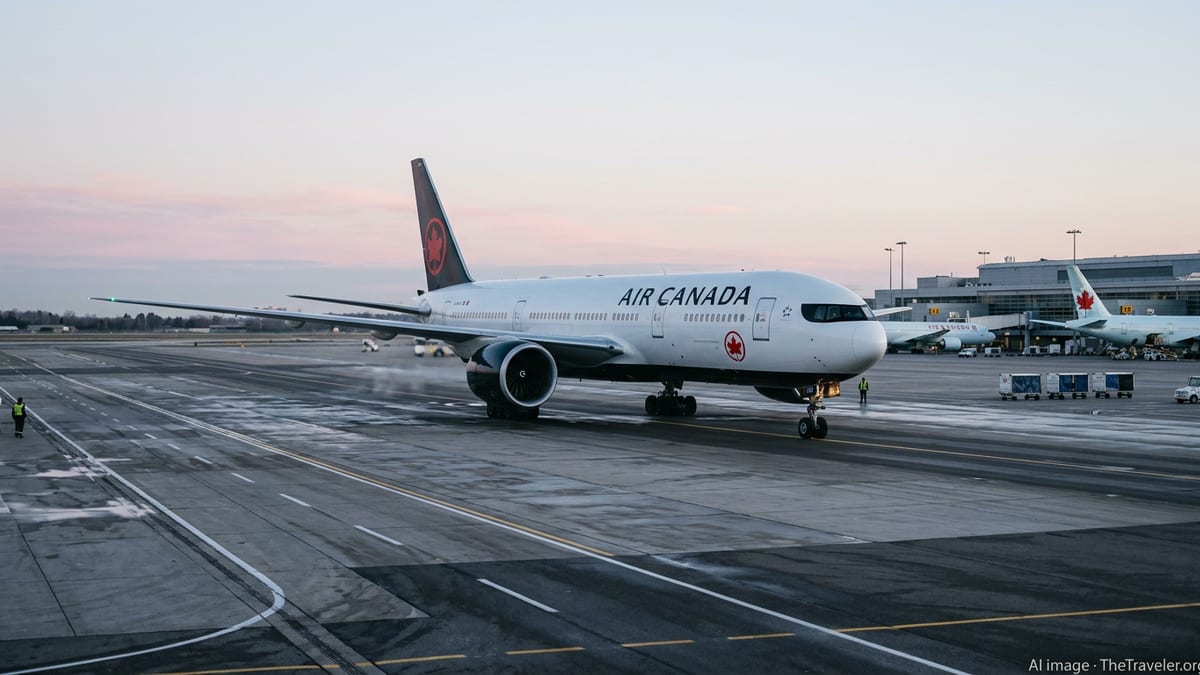
The Canadian flag carrier has introduced a temporary second daily service between Toronto Pearson and New Delhi, turning one of its longest routes into a twice-daily transpolar marathon. The added rotation, operated by Boeing 777-200LR aircraft, is scheduled for a concentrated period and clocked at around 17 hours of flying time, placing it firmly among the world’s ultra long-haul operations.
The move boosts capacity on a corridor that has become strategically important for Air Canada, both commercially and politically. The Toronto–Delhi route connects one of North America’s largest South Asian communities with India’s capital, and demand has remained resilient despite geopolitical tensions, shifting airspace restrictions and volatile fuel costs.
By layering a second 17-hour flight on a market it already serves, Air Canada is signaling confidence that premium and visiting-friends-and-relatives traffic will support sustained ultra long-haul flying. It also provides additional resiliency at a time when many routings between North America and India are being adjusted to avoid closed or congested airspace.
Although framed as a time-limited capacity increase, the added service underscores the airline’s willingness to use long-range widebodies aggressively on key trunk routes, even when scheduling and crew logistics are more complex than on conventional long-haul sectors.
Ultra Long-Haul as a Competitive Strategy
Air Canada’s latest move aligns it with a growing group of global carriers that view ultra long-haul routes as a differentiator rather than a niche. Around the world, airlines are deploying long-range aircraft on city pairs where premium demand and slot constraints justify 16 to 19 hours in the air, from New York to Singapore to nonstop links between the Middle East and North America.
For Air Canada, doubling service on a 17-hour route helps defend market share against both Gulf and European competitors that continue to court India-bound travelers via one-stop itineraries. Nonstop service from Toronto to Delhi eliminates connections and reduces total travel time, an increasingly powerful selling point for time-sensitive business travelers and long-haul leisure passengers wary of missed connections and baggage issues.
The decision also dovetails with the carrier’s broader network strategy. In recent seasons, Air Canada has expanded long-haul flying from its hubs, adding and resuming routes to Asia and Europe while positioning Toronto, Montreal and Vancouver as gateways for transatlantic and transpacific traffic. The second 17-hour flight fits neatly into that framework, allowing the airline to funnel domestic and U.S. transborder passengers through Toronto onto an ultra long-haul service that it controls end-to-end.
Industry analysts note that such flights are high-risk, high-reward propositions. Aircraft must operate with tight reliability margins, crew scheduling is intricate, and even minor disruptions can cascade across an already stretched global network. Yet if performance holds, ultra long-haul flights tend to command a revenue premium over one-stop options, particularly in the most lucrative cabins.
777-200LR at the Heart of Air Canada’s Long-Haul Push
The 17-hour Toronto–Delhi services are entrusted to Air Canada’s Boeing 777-200LR fleet, the long-range variant of Boeing’s twin-engine widebody designed specifically for ultra long-haul missions. The type gives the airline the range and payload needed to operate transpolar routes with seasonal headwinds, while carrying a full complement of passengers and cargo.
Onboard, the aircraft offers a three-cabin configuration built around a lie-flat business class, a growing premium economy section and a high-density economy cabin. This mix reflects the nature of demand on India routes, where there is strong interest at both ends of the price spectrum. Extended flying time places a premium on comfort, and Air Canada has emphasized its inflight entertainment, connectivity and cabin service as key points of differentiation on such long sectors.
The deployment of the 777-200LR on two daily 17-hour flights also underscores how carefully Air Canada must manage its long-haul fleet. With ultra long-haul utilization tying up individual aircraft for nearly a full day per rotation, dispatch reliability and turnaround performance become critical to keeping the schedule intact. Any lengthy delay on one end risks disrupting downline flights across continents.
At the same time, running the 777-200LRs on some of the network’s longest missions helps maximize the value of a relatively small subfleet. As newer long-range narrowbodies such as the Airbus A321XLR enter service in the coming years, freeing up widebodies from thinner routes, Air Canada is expected to keep redeploying its largest jets to sectors where their range and capacity are most needed.
Passenger Demand, Diaspora Ties and Airspace Constraints
The decision to add a second 17-hour flight is rooted in robust demand between Canada and India. Toronto hosts one of the largest Indian diasporas outside Asia, and traffic flows span business travel, family visits, student journeys and tourism in both directions. Even during periods of macroeconomic uncertainty, these segments have shown resilience, giving airlines confidence to sustain long-haul capacity.
Recent disruptions and airspace constraints over parts of the Middle East and surrounding regions have further highlighted the value of nonstop services. Reroutings have added time and complexity for carriers that rely on one-stop hubs between North America and South Asia, at times nudging passengers toward direct options when available. For travelers wary of multi-stop itineraries and operational surprises, a single long sector can be more appealing than two or three shorter ones.
However, ultra long-haul flights pose their own challenges for passengers. Seventeen hours in the air heightens concerns around comfort, jet lag and cabin fatigue. Airlines are responding by refining inflight service flows, improving bedding and seating, and promoting wellness tips tailored to marathon flights. Air Canada is positioning its Toronto–Delhi services as opportunities for uninterrupted rest and work, backed by inflight Wi-Fi and a curated service cadence throughout the journey.
Travel agents and corporate travel managers report strong interest whenever direct options expand on long-haul corridors, even on a temporary basis. The added Toronto–Delhi rotation creates more inventory in premium cabins and additional departure choices, which can be critical for last-minute corporate bookings and complex multi-city itineraries connecting through Canada.
Signaling the Next Phase of Air Canada’s Long-Haul Evolution
While the second 17-hour Toronto–Delhi flight is time-bound, its broader significance lies in how it previews Air Canada’s next phase of long-haul evolution. The carrier is simultaneously investing in fleet renewal, including long-range narrowbodies that will open thinner transatlantic and transcontinental markets, and refining its hubs to handle more complex global flows.
Within this strategy, ultra long-haul services act as flagship routes that showcase the airline’s product and operational capabilities. They can anchor hub banks at key times of day, drawing feeder traffic from across Canada and the United States, and reinforcing the perception of Canada’s largest airline as a serious global player rather than a primarily transatlantic or transborder carrier.
As competitors in North America, Europe, the Middle East and Asia jockey for position on the world’s longest routes, Air Canada’s addition of a second 17-hour flight suggests it intends to be part of that contest. The Toronto–Delhi corridor may not top the charts in distance, but it is emblematic of a wider reshaping of long-haul networks, where strategic nonstop links are prized assets in their own right.
Whether the extra 17-hour rotation ultimately becomes a recurring feature or remains a carefully timed capacity boost, it clearly reflects the airline’s confidence in demand for ultra long-haul travel. For passengers, it translates into more choice on one of the most grueling journeys in commercial aviation, and another sign that the long-haul revolution shows no signs of slowing.