

More news on this day
New York’s LaGuardia Airport faced severe disruption on March 23 after an Air Canada Express regional jet collided with a fire truck on a runway, killing two people and injuring many more in a rare and devastating ground collision that shut one of the United States’ busiest airports for hours.
Get the latest news straight to your inbox!
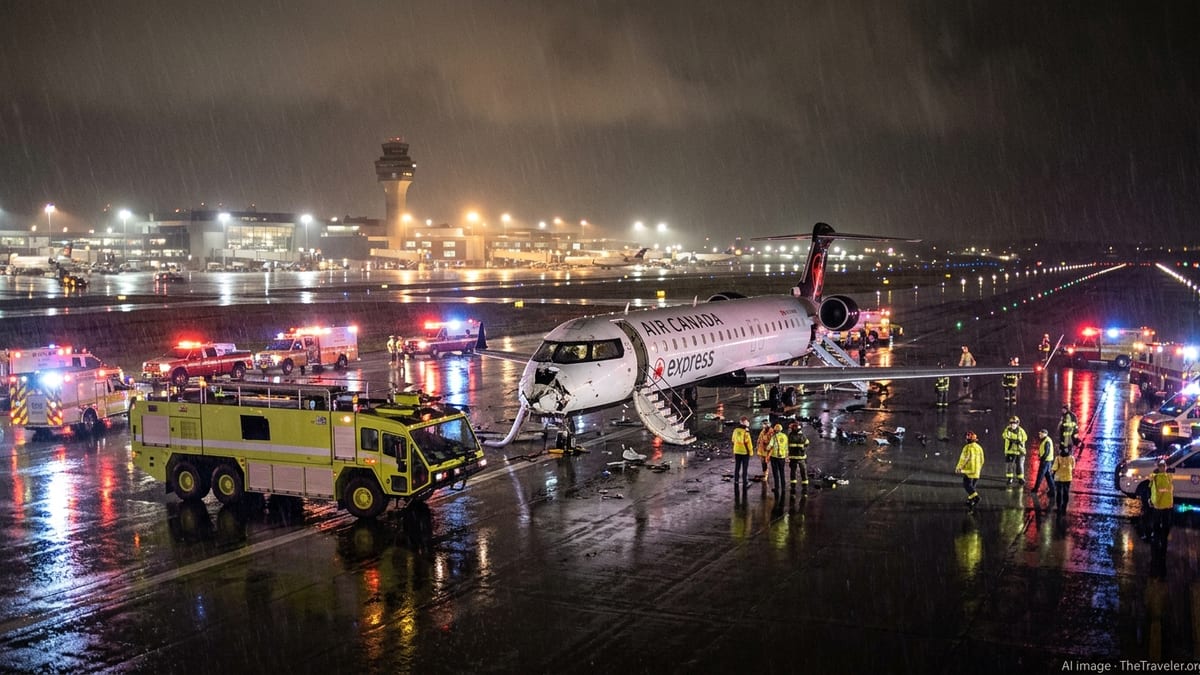
Grim Scene on Runway 4 After Nighttime Collision
Publicly available information describes a violent impact late Sunday night on Runway 4, when an Air Canada Express Bombardier CRJ-900 operating as Flight 8646 from Montreal struck an airport rescue fire truck during its landing roll. Photos circulating in news coverage show the jet’s nose section crushed and twisted, with cockpit windows destroyed and debris scattered across the wet tarmac.
Reports indicate that the two people who died were on board the aircraft, believed to be members of the flight crew, while the occupants of the Port Authority vehicle sustained serious but survivable injuries. Early accounts describe the collision speed as relatively low for an air crash, in the range of 20 to 40 miles per hour, yet sufficient to obliterate the forward fuselage and topple the heavy emergency vehicle onto its side.
Witness images and video reviewed in published coverage show the regional jet coming to rest off the centerline with its nose pitched upward, stair trucks positioned at the forward and rear doors, and firefighters working under intense rain and bright emergency lighting. The fire truck involved, identified in aviation forums as a crash-rescue vehicle responding to a separate incident, appears heavily damaged in images taken after the impact.
Passengers were evacuated via mobile stairways and emergency exits, walking across the rain-soaked runway in the glow of floodlights and emergency strobes. According to reports compiled from multiple outlets, more than 70 people on board were assessed for injuries, with a mix of minor, moderate, and at least one serious case among passengers and crew.
How a Fire Truck and Landing Jet Ended Up on the Same Runway
Initial information from air traffic control recordings and specialist aviation sites suggests a chain of decisions and timing that placed a crash-rescue truck and an incoming jet on the same piece of pavement at the same moment. Recordings circulating online capture a controller clearing the Air Canada Express jet to land on Runway 4 and later granting a fire vehicle permission to cross that same runway to respond to an unrelated United Airlines emergency.
Moments later, a voice believed to be the controller can be heard urgently calling for the fire truck to stop, followed by frantic instructions diverting other inbound aircraft away from the airport. Commentaries in aviation and air traffic control communities frame the sequence as a probable runway incursion scenario, in which misjudged timing, reduced nighttime visibility, and poor weather may have combined to erase the crucial separation between aircraft and ground vehicle.
Reports indicate that visibility at LaGuardia around the time of the accident was reduced by heavy rain and low clouds, conditions that can complicate depth perception and make moving vehicles harder to spot against a background of runway lights, reflections, and glare. While modern airports rely on layered safeguards such as ground radar, lighting systems, and strict radio protocols, the incident underscores that a single clearance given at the wrong moment can still have catastrophic consequences.
Specialist coverage notes echoes of a 2022 collision in Lima, Peru, when a LATAM jet struck a fire truck that had entered the runway during a high-speed takeoff, as well as earlier runway-incursion accidents in North America. Investigators are expected to examine whether similar human-factor pressures, including workload, communication breakdowns, and real-time emergency response demands, played a role at LaGuardia.
Casualty Count, Passenger Experience, and Emergency Response
Figures circulating across major newsrooms and aviation outlets converge on at least two fatalities and roughly 70 injured or affected passengers and personnel. Some reports describe a mass-casualty designation at the airport, a classification that triggers the rapid deployment of ambulances, triage areas, and expanded hospital coordination across New York City’s emergency system.
Accounts from passengers shared with broadcasters and on social media describe a hard jolt shortly after landing, followed by a sharp yaw as the aircraft veered on the runway and came to a stop in heavy rain. The cabin reportedly remained intact behind the first few rows, but the forward galley and cockpit area appear in photos to have absorbed the bulk of the impact. Many travelers were able to walk off the aircraft unaided, though several were transported on stretchers for further evaluation.
Airport-response photos reviewed in published coverage show fire crews surrounding the jet within minutes, spraying foam around the collision area as a precaution and positioning ladders and stairways at multiple exits. Emergency workers can be seen guiding passengers down steps in ponchos and reflective vests as paramedics cluster near staging areas marked by colored tarps often used to sort patients by injury severity.
New York’s hospital network moved quickly to receive patients from LaGuardia, with local media listing a combination of trauma centers and community hospitals taking in those with broken bones, head injuries, and shock. The incident is already being described in local coverage as one of the most serious non-crash events involving a commercial jet at LaGuardia in recent decades.
Airport Closure Triggers Widespread Travel Disruption
The collision forced an immediate halt to flight operations at LaGuardia overnight, triggering cascading delays and cancellations across the Northeast at the start of a busy travel week. Published advisories from aviation tracking services and airline statements report that the airport closure continued into Monday morning to allow investigators to document the scene, recover flight recorders, and remove wreckage blocking Runway 4.
Flights destined for LaGuardia were diverted to neighboring hubs, including John F. Kennedy International and Newark Liberty International, as carriers scrambled to rebook stranded travelers and reposition aircraft. Many passengers en route to New York awoke to text alerts about diversions or cancellations, while those already in LaGuardia’s terminals faced uncertain departure times, long lines at service desks, and overcrowded gate areas.
Air Canada and its regional partner have publicly expressed condolences and confirmed that all passengers and crew were accounted for, while asking affected travelers to monitor airline channels for rebooking options. Travel industry analysts note that even a brief shutdown at a high-density airport like LaGuardia can ripple through schedules for days, especially on popular shuttle routes linking New York with Boston, Washington, and major Canadian cities.
For travelers holding near-term tickets into or out of LaGuardia, consumer advocates are urging close attention to notifications and the use of airline apps to request changes, as call centers experience high volumes. Some carriers have begun to offer limited change-fee waivers and flexible rebooking windows in response to the ongoing disruption.
Early Investigation Focus and What Comes Next for Travelers
The National Transportation Safety Board has announced the deployment of a major investigative team to New York, with a mandate that typically covers cockpit voice and flight data recorders, air traffic control recordings, ground radar data, pilot and controller work histories, and the condition of airport surface movement systems. According to public procedural information, a preliminary report is usually released within weeks, while a full causal analysis often takes a year or more.
Experts quoted in aviation safety coverage expect particular scrutiny on runway incursion prevention at LaGuardia, including how controllers sequence emergency vehicles, how ground crews interpret clearances, and whether any alarms, radar indications, or stop-bar lighting systems were available or active at the time of the collision. Investigators are also likely to examine staffing levels in the control tower, given online discussion pointing to a single controller handling both ground and tower duties during an evolving emergency.
For travelers, the practical horizon is shorter. In the coming days, LaGuardia may operate with constrained runway capacity if sections of pavement or lighting systems require repair, potentially prolonging delays and forcing airlines to thin out schedules. Travel planners advise that anyone with tight connections or time-sensitive meetings build in extra buffers, consider nearby airports as alternatives, and allow additional time to move between terminals and ground transportation hubs.
While commercial air travel remains statistically one of the safest modes of transportation, the collision at LaGuardia is already prompting renewed discussion about how airports manage overlapping crises, such as aircraft emergencies unfolding amid heavy weather and dense traffic. For many travelers passing through New York in the wake of the crash, the images of a shattered cockpit and an overturned fire truck on the LaGuardia runway are likely to linger, even as the industry works to translate the lessons of this catastrophe into new layers of protection.