

Air Canada passengers across Canada and in Austria faced a fresh wave of disruption on Tuesday as 103 delayed departures and 11 flight cancellations rippled through the carrier’s network, snarling operations at major hubs including Vancouver, Calgary, Montreal, Vienna and St. John’s and stranding travelers in peak winter conditions.
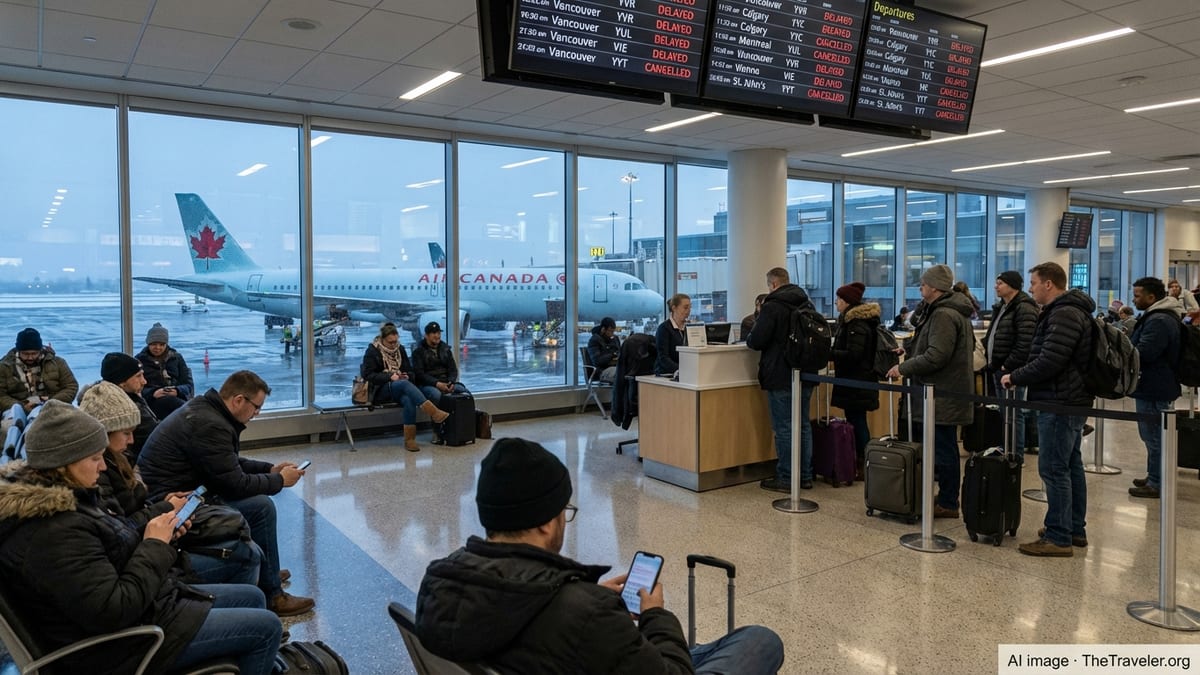
Operational Strain Hits Key Air Canada Hubs
The latest disruption unfolded as a concentrated operational stress test for Air Canada’s network, with the bulk of Tuesday’s delays and cancellations clustered around its busiest domestic and transatlantic gateways. Vancouver, Calgary and Montreal reported some of the highest numbers of delayed departures, while Vienna and St. John’s registered a mix of cancellations and extended waits that left passengers facing long lines at check in, security and customer-service desks.
Although 103 delays and 11 outright cancellations represent a small fraction of Air Canada’s total daily schedule, the impact on affected travelers was significant. Many of the delayed flights were core trunk routes linking major Canadian cities, where even a modest pushback in departure time can cascade into missed connections, aircraft out of position and crews timing out under duty regulations. For Vienna-bound and Vienna-originating passengers, the disruption was felt most acutely on overnight transatlantic services that feed into tightly timed onward connections across Europe.
At Montreal–Trudeau and Vancouver International, passengers reported departure boards heavily peppered with delay notices, often in the range of 45 minutes to several hours. While most flights ultimately departed, the lack of clear early communication about revised timings added to traveler frustration. At smaller but weather-sensitive St. John’s, even a handful of delayed or cancelled flights can effectively paralyze options for rebooking within the same travel day.
Airport operations teams sought to maintain a focus on safety and regulatory compliance as they worked through backlogs. Extended de-icing queues, crew-rest requirements and aircraft maintenance checks all contributed to the slower pace, leaving airlines few quick fixes for returning the system to normal once the disruption was underway.
Weather, Winter Operations and Knock-on Delays
The disruptions came against the backdrop of an already volatile winter season for Canadian aviation, marked by heavy snow, high winds and rapid temperature swings that have repeatedly slowed airport operations. Even when skies appear relatively clear at one airport, weather elsewhere in the network can trigger knock-on effects, particularly for a carrier like Air Canada that relies on hub-and-spoke connectivity through cities such as Vancouver, Calgary and Montreal.
On Tuesday, varying conditions across Western and Atlantic Canada continued to challenge schedule reliability. In Vancouver, intermittent rain and low cloud ceilings forced ground crews to juggle de-icing and safety checks with tight turnaround times, while operations in Calgary and St. John’s remained vulnerable to sudden changes in wind and visibility typical for February. When aircraft arrive late from weather-impacted airports, subsequent departures downline are pushed back, explaining why some delays at otherwise calm airports may appear puzzling to passengers.
In Europe, Vienna’s central role as a connecting hub meant that any disruption affecting inbound North American flights compounded pressure on limited overnight airport resources. A delayed transatlantic arrival can force rapid shuffling of gates, ground handlers and refueling slots early in the morning, complicating efforts to maintain on-time performance for short-haul departures into the rest of the continent. Even modest lateness in the first wave of flights can ripple throughout the day, especially in winter when runway capacity is constrained by de-icing and snow management.
The timing of the latest Air Canada irregularities, following weeks of weather-driven challenges across North America and Europe, further reduced the system’s resilience. Aircraft and crews that had already been running close to the edge of schedule limits had less flexibility for recovery when Tuesday’s set of delays and cancellations took hold.
Transatlantic Routes Link Canada and Austria in the Turbulence
The presence of Vienna among the affected airports underscores how central transatlantic links have become to Air Canada’s strategy. Flights between Canadian hubs and Vienna support both point-to-point demand and a steady flow of connecting passengers bound for Central and Eastern Europe. When a single departure on one of these routes is delayed or cancelled, the disruption is magnified across multiple countries as missed connections and rebookings echo through the schedule.
Several of Tuesday’s delays were concentrated on long-haul services connecting Montreal and Toronto with major European gateways, including Vienna, where aircraft utilization is carefully calibrated. A late-arriving widebody from Canada can jeopardize the rotation needed for its next scheduled departure, forcing operations teams to decide between a same-day delayed departure or a more disruptive cancellation in order to reset the schedule. Either choice can leave passengers with limited immediate alternatives, particularly in February when load factors are high and spare long-haul seats are scarce.
Passengers traveling onward from Vienna to secondary European cities faced some of the greatest uncertainty. While many European carriers can offer re-routing options, coordinating interline rebookings during a period of operational stress is complex. Travellers reported spending long periods in transfer areas while ground agents searched for alternative routings through other hubs, often involving additional stops or overnight stays.
Despite the challenges, the Vienna disruptions remained contained compared with the broad winter-weather meltdowns seen elsewhere in recent years. Most affected Air Canada flights were ultimately operated the same day, albeit hours behind schedule, with cancellations concentrated among a smaller number of services where crew availability or aircraft positioning could not be resolved in time.
Passenger Experiences at Vancouver, Calgary, Montreal and St. John’s
For travelers caught up in the disruption, the experience varied substantially depending on where and when they were traveling. At Vancouver International, where Air Canada maintains a large presence for both domestic and Asia-Pacific services, queues at customer-service desks lengthened quickly once delays started to stack up. Some passengers arriving from Asia or the United States missed tight onward domestic connections and were rebooked onto later departures to Calgary, Montreal or smaller western Canadian cities.
In Calgary, delays on flights both arriving from and departing to coastal and eastern Canadian cities complicated travel plans for business passengers and winter vacationers alike. Some travelers expressed frustration at receiving notifications about revised departure times only shortly before boarding, making it difficult to adjust ground transportation or accommodation plans. Others praised proactive rebooking efforts that moved them to alternative routings before they even reached the airport, limiting their time spent waiting in terminal queues.
Montreal–Trudeau, another key Air Canada hub, saw particularly busy scenes at transfer desks as delayed domestic arrivals from cities like Vancouver and Halifax collided with outbound transatlantic departures. Even short delays of 30 to 45 minutes on inbound flights were enough to push connection times below comfortable margins, prompting gate agents to begin reassigning seats on later services to Europe and the United States.
At St. John’s, where flight frequencies are lower and winter conditions more volatile, a small number of cancellations and extended delays had an outsized impact. Passengers reported that the limited number of later flights made same-day re-accommodation difficult, forcing some to accept overnight hotel stays or waitlists for flights on subsequent days. For residents of Newfoundland and Labrador relying on air links for medical appointments and essential travel, the disruption carried consequences beyond missed holidays.
Air Canada’s Response and Customer Support Measures
Air Canada moved to emphasize its focus on safety and regulatory compliance as its operations team worked to recover the schedule. The carrier reiterated that decisions to delay or cancel flights are made in coordination with airport authorities, air traffic control and weather services, and that crews cannot legally extend duty hours once regulatory limits are reached, even when aircraft and passengers are ready to depart.
For affected customers, the airline deployed its standard suite of disruption-management tools, including rebooking on later Air Canada services and, where available, partner airlines. Many passengers received notifications through email, text message and the Air Canada mobile app, advising them of new departure times or replacement itineraries. However, the uneven timing of those alerts drew criticism from travelers who said they did not receive updates until they were already at the airport.
At major hubs, Air Canada coordinated with airport authorities to distribute food vouchers and hotel accommodation in cases where passengers were stranded overnight for reasons within the airline’s control. The level of support varied depending on whether the disruption was categorized as weather-related or operational. Some passengers reported confusion at service desks about eligibility for vouchers and compensation, highlighting the complexity of rules that differ between domestic, cross-border and international itineraries.
For those traveling to or from Vienna and other European points, consumer-protection regulations added another layer to the airline’s response. Under European rules, certain long delays and cancellations on flights touching EU or EEA territory can entitle passengers to fixed-sum compensation, unless the airline can demonstrate that extraordinary circumstances such as severe weather were the primary cause. As a result, some affected travelers out of Vienna and Montreal began documenting their disruptions with boarding passes and written confirmation in anticipation of potential claims.
Compensation Rights and What Affected Travelers Can Do
The patchwork of passenger rights that applies to a day of disruption like Tuesday’s can be difficult to navigate, especially for travelers whose journeys span multiple countries and regulatory zones. Within Canada, Air Passenger Protection Regulations outline the obligations of airlines in cases of delay and cancellation, including standards for communication, rebooking and, in certain circumstances, compensation and accommodation. These obligations differ depending on the size of the carrier, the cause of the disruption and the length of delay at arrival.
For flights between Canada and Europe, including those linking Montreal or Toronto with Vienna, additional protections can come into play under European rules that cover passengers departing from an EU or EEA airport, or traveling on an EU carrier. While Air Canada itself is not a European airline, certain segments of an itinerary operated in partnership with European carriers may be subject to those regulations, giving passengers another avenue to pursue compensation.
Consumer advocates advise affected passengers to retain boarding passes, booking confirmations and any written communication from the airline detailing the cause and timing of the disruption. These documents can be important in determining whether a delay was primarily due to weather, air traffic control restrictions or issues directly within the airline’s control, such as crew scheduling or technical faults. Third-party claims firms and legal services continue to advertise their assistance in navigating these rules, though they typically charge a percentage of any eventual payout.
For travelers more focused on salvaging their plans than on monetary compensation, flexibility remains the most useful asset. Checking flight status frequently, considering alternative routings through less congested hubs and traveling with minimal checked luggage can all improve the odds of making tight connections during periods of disruption. Many frequent flyers also recommend booking longer layovers in winter months to build in a buffer against the type of rolling delays that hit Air Canada this week.
Impact on Airline Reputation and Future Travel Demand
While a single day featuring 103 delays and 11 cancellations may be viewed by industry insiders as an operational challenge rather than a crisis, repeated episodes of disruption can gradually erode customer confidence. In recent seasons, Canadian travelers have become increasingly vocal about reliability and service quality, particularly on social media platforms where photos of crowded terminals and long customer-service lines spread quickly.
For Air Canada, maintaining trust among frequent domestic and transatlantic passengers is especially important as competition intensifies from low-cost carriers and foreign airlines. The perception that flights through key hubs such as Vancouver, Calgary and Montreal are vulnerable to recurrent winter disruptions may nudge some travelers to seek alternative routings or carriers, even if that means higher fares or longer itineraries. Business travelers and high-yield corporate accounts are particularly sensitive to schedule reliability, making them a crucial audience for any operational-improvement efforts.
Industry analysts note that winter irregularities are, to some extent, an unavoidable feature of operating a large network in Canada’s harsh climate. What matters more is how quickly and transparently airlines recover when problems arise. Clear communication, realistic scheduling buffers in winter months and robust contingency planning for hubs like Vienna and St. John’s can help reduce the severity of future disruptions, even when weather and traffic control conditions remain challenging.
For now, Air Canada faces the task of stabilizing its operations in the days ahead, repositioning aircraft and crews to restore normal rotations and addressing the backlog of passenger-service issues generated by the latest wave of delays and cancellations. Travelers, meanwhile, are left weighing whether the network breadth and loyalty benefits offered by the country’s largest carrier compensate for the risk of getting caught up in another difficult travel day.