

More news on this day
Air Canada has rolled out an expanded goodwill policy offering free rebooking and full refunds for affected passengers as fast-moving Middle East tensions trigger sweeping airspace closures from Dubai to Tel Aviv, snarling global flight networks and stranding travelers worldwide.
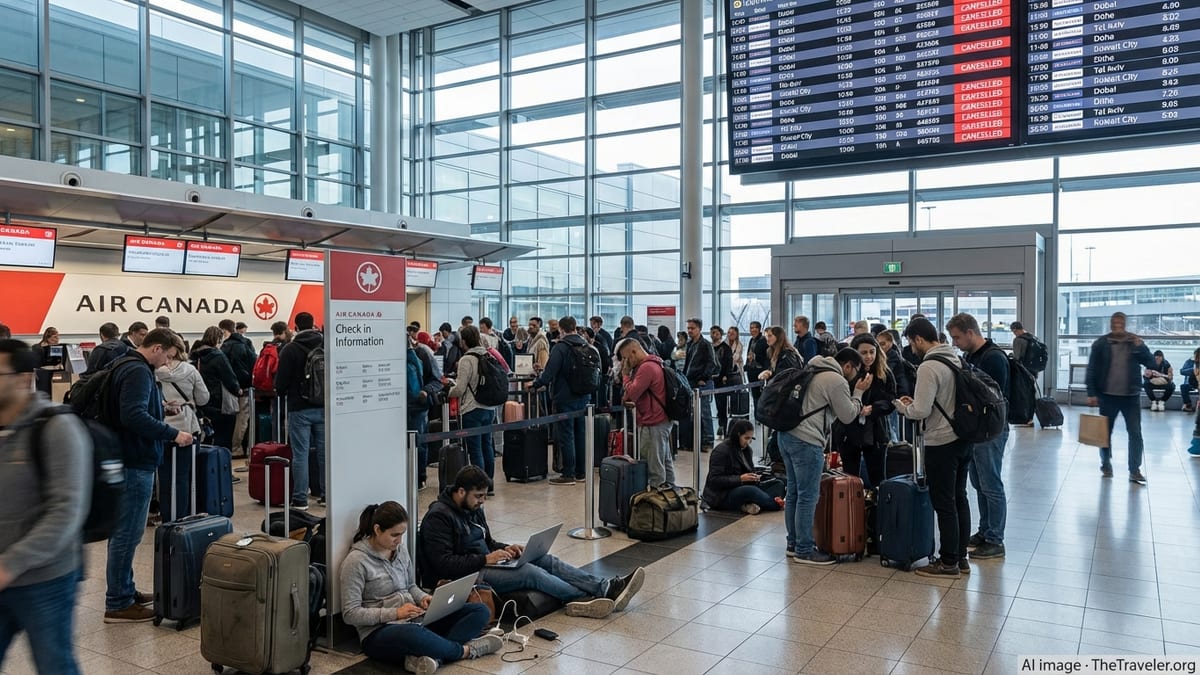
Airspace Closures Ripple Across Key Middle East Hubs
Airspace restrictions across the Middle East intensified over the weekend following coordinated military strikes and retaliatory attacks, forcing authorities in several countries to shut or severely curtail access to their skies. Aviation hubs in the United Arab Emirates, Qatar, Israel and Kuwait have been among the hardest hit, with knock-on effects stretching across Europe, Asia and North America.
Major airports including Dubai, Abu Dhabi, Doha and Tel Aviv have seen waves of cancellations and diversions as safety regulators ordered airlines to avoid conflict zones and as local authorities temporarily suspended normal operations. Kuwait International Airport has also been affected after reports of damage linked to drone activity, with the country’s airspace closed until further notice.
The sudden closures have created a chokepoint along some of the world’s busiest long-haul corridors, particularly those linking North America and Europe with South Asia and Southeast Asia. With carriers forced to reroute or cancel flights at short notice, passengers have faced extended delays, lengthy diversions and rapidly changing travel advisories.
Industry data from multiple tracking services shows thousands of flights disrupted since the first strikes were reported, with Middle Eastern hubs bearing the brunt of the chaos. Airlines across regions, from Gulf giants to European and Asian carriers, have taken aircraft and crew out of rotation as they reassess routings around restricted airspace.
Air Canada Suspends Select Routes and Activates Goodwill Policy
Against this backdrop, Air Canada has confirmed a series of suspensions and schedule adjustments affecting its network to and through the region. The carrier has halted flights on select routes, including services to Tel Aviv and Dubai on specific dates, citing the evolving security situation and the closure of key airspace corridors.
To mitigate the impact on customers, the airline introduced an expanded goodwill policy on March 1, 2026, covering tickets issued no later than February 28 for travel to, from or through several Middle Eastern gateways. The policy applies to itineraries involving Dubai, Abu Dhabi, Tel Aviv, Beirut, Amman, Erbil and Dammam over an initial travel window that runs through mid-March.
Under the policy, eligible passengers can make a one-time voluntary change to their booking without paying a change fee, provided they travel by the end of March and find availability in the same cabin they originally purchased. For many travelers, this allows shifting trips by several weeks to avoid the most volatile period while keeping costs in check.
Customers who no longer wish to travel at all are being offered full refunds, even on non-refundable fares, if their plans fall within the specified travel period and routing. Air Canada has also reminded travelers who booked through tour operators or vacation packages that changes and refunds must be processed through those providers, although the airline’s flexibility policy still applies in principle.
Free Rebooking and Full Refunds: What Travelers Can Expect
For passengers whose journeys touch the affected cities, the most significant element of Air Canada’s response is the ability to rebook without penalty. Travelers with qualifying tickets can move their departure to any available date up to March 31, 2026, on the same routing or a reasonably comparable alternative, subject to seat availability in the originally purchased cabin.
Where customers wish to postpone travel beyond that window, fare differences may apply, especially if they opt for peak travel periods or more expensive fare classes. However, change fees themselves are being waived under the goodwill policy, a notable concession given the historically strict change conditions attached to some discounted economy fares.
The option of a full refund is providing a backstop for those unwilling to travel into a region facing heightened military activity and rolling airspace closures. Refunds are available both for flights that have already been cancelled and for itineraries that remain technically scheduled but fall within the affected time frame and city list. Passengers can initiate the process by managing their booking online or contacting Air Canada directly, though the carrier is warning of long wait times due to call volume.
Travelers with tickets issued through Air Canada Vacations are being directed to that division’s dedicated phone lines, where similar flexibility is being offered on package components. Hotel stays and ground arrangements bundled with flights may be adjusted or refunded according to supplier availability, but the airline is signaling a willingness to work with partners to minimize out-of-pocket losses for customers.
Global Carriers Scramble as Routes Are Rerouted or Grounded
Air Canada’s move comes as airlines around the world scramble to adapt to a fluid and fast-changing security picture in the region. Gulf-based carriers have temporarily suspended many operations through their home hubs, while major European and Asian airlines have rerouted long-haul services to skirt closed airspace over Iran, Iraq and surrounding territories.
These diversions can add hours of flying time and considerable fuel burn, prompting some carriers to switch to technical stops or to cancel certain routes outright until more predictable routings are available. Flight tracking data shows unusual arcs and detours as aircraft are vectored around restricted zones, complicating crew scheduling and aircraft rotations.
The disruption is particularly acute for travelers connecting between North America and destinations in India, Pakistan and Southeast Asia, for whom Gulf and Levant hubs are common waypoints. With multiple airlines trimming schedules at the same time, options for re-accommodation are more limited than during typical weather-related disruptions or single-airport incidents.
Travel agents and corporate travel managers report a surge in last-minute itinerary overhauls, as business travelers pivot to virtual meetings and leisure travelers seek alternative routings via Europe or other parts of Asia. Some travelers stranded at hub airports over the weekend have been provided with hotel accommodation and meal vouchers as local authorities and airlines attempt to manage the immediate fallout.
What Affected Air Canada Passengers Should Do Now
For Air Canada customers with upcoming travel touching Dubai, Abu Dhabi, Tel Aviv, Beirut, Amman, Erbil or Dammam, the airline is urging passengers to verify whether their journey falls within the covered dates and to act promptly if they wish to change or cancel. The fastest option for many will be to use the “manage booking” tools on the airline’s website or mobile app to select new dates or request a refund.
Travelers already en route or currently in the region are being advised to monitor airport departure boards, airline notifications and official government travel advisories, as flight status can change on short notice. Canadian authorities continue to warn that security conditions in parts of the Middle East could deteriorate further without warning, and that travelers should be prepared for the possibility of shelter-in-place directives.
Experts say that flexible planning is essential over the coming days and weeks. Passengers are encouraged to build in extra time for connections, consider travel insurance policies that include disruption coverage and keep all receipts in case of claims for hotels, meals and alternative transport. While Air Canada’s goodwill policy is designed to reduce financial strain on affected customers, independent expenses may still arise as conditions evolve.
With no clear timeline yet for a full reopening of airspace across the region, airlines and passengers alike are settling in for a period of extended uncertainty. For now, Air Canada’s decision to waive change fees and offer broad refunds provides at least some measure of control for travelers caught in the middle of a rapidly shifting geopolitical crisis.