

More news on this day
New York’s LaGuardia Airport remained shuttered for hours on Monday after an Air Canada Express jet from Montreal collided with an airport fire vehicle during landing, killing two crew members and snarling air travel across the New York region at the start of a busy spring travel week.
Get the latest news straight to your inbox!
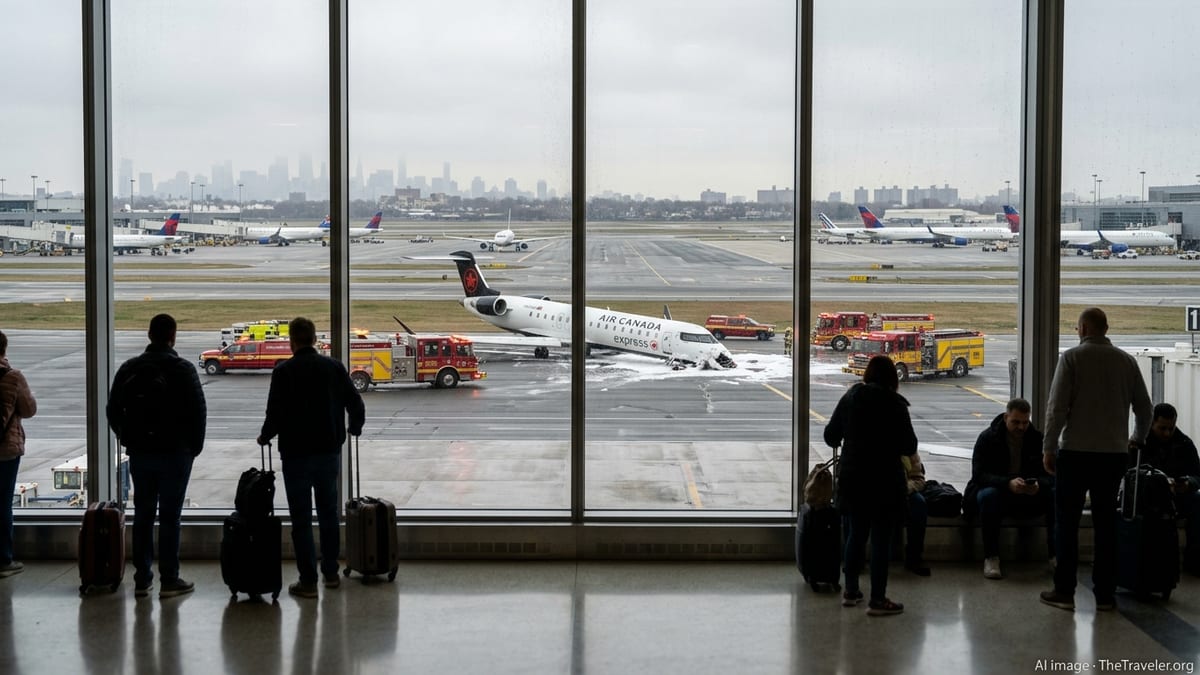
Deadly Collision on the Runway
Publicly available information identifies the aircraft as Air Canada Express Flight 8646, a Bombardier CRJ900 operated by Jazz Aviation on behalf of Air Canada. The regional jet was completing its approach to Runway 4 on Sunday night when it struck a Port Authority airport rescue and firefighting vehicle that was moving across the active runway.
Reports indicate that the impact sheared off much of the jet’s nose and cockpit section. The pilot and copilot, both in the forward section of the aircraft, were pronounced dead, making this one of the most serious accidents at LaGuardia in recent years involving a commercial passenger flight.
According to published coverage, the crash occurred around 11:45 p.m. on March 22, as the flight arrived from Montréal–Trudeau International Airport with more than 70 passengers and four crew on board. Images shared by major news outlets show the regional jet at rest on the runway with emergency foam, scattered debris, and the heavily damaged fire vehicle nearby.
Initial tallies from official bulletins cited at least 39 injuries among passengers and crew, with two additional ground personnel in critical condition in the struck vehicle. Most survivors were able to evacuate the aircraft via emergency slides, supported by airport firefighters and medics who were already on scene.
Hours-Long Closure and Regionwide Flight Disruption
The collision immediately brought operations at LaGuardia to a halt. Flight tracking data and airline statements show that all arrivals and departures were suspended overnight as emergency responders secured the scene and investigators began documenting the wreckage. The airport’s runways remained closed into Monday, with some reports citing a reopening target of early to mid-afternoon on March 23.
The shutdown rapidly cascaded through the wider New York air network. Airlines diverted incoming flights to John F. Kennedy International and Newark Liberty, while dozens of early-morning departures from LaGuardia were canceled outright. By mid-morning Monday, publicly available schedules showed scores of cancellations and delays, particularly on short‑haul business routes to Boston, Washington, Chicago, and Toronto.
Travelers across the Northeast reported missed connections and last‑minute rebookings as carriers scrambled to adjust. Social media posts and local coverage described long customer service lines, crowded gate areas at JFK and Newark, and travelers resorting to Amtrak and intercity buses when same‑day flights were unavailable.
The timing has been particularly disruptive for business travelers and spring break passengers. Many New York travelers who had planned tight connections through LaGuardia on Monday were advised to seek alternate airports or postpone nonessential trips while airlines rebalanced aircraft and crews.
What Is Known About the Ground Vehicle and Emergency Response
According to detailed reporting from several outlets, the vehicle involved was a large airport rescue and firefighting truck operated by the Port Authority of New York and New Jersey. The truck was reportedly responding to a separate incident involving another aircraft that had reported an unusual odor on board and requested assistance while still on the ground.
Air traffic control recordings circulating in the public domain capture a controller clearing the fire vehicle to cross the runway and then urgently attempting to halt its movement seconds before the collision. In the audio, the controller can be heard calling repeatedly for the truck to stop and later expressing distress after realizing the jet and vehicle had made contact.
Emergency resources were already positioned at LaGuardia for the earlier aircraft issue, which meant fire crews, medics, and Port Authority police were able to respond almost immediately once the Air Canada Express jet came to a stop. Passengers described in published accounts how responders quickly surrounded the aircraft, deployed foam, and began assisting injured travelers off the jet and away from debris.
The firefighting vehicle itself sustained massive damage. Reports referencing early statements from the Port Authority note that two personnel in the truck were transported in critical condition to a Queens hospital. Images from the scene show the vehicle overturned or heavily crushed on one side, underscoring the force of the impact with the regional jet.
Investigation and Safety Questions Ahead
An investigation led by the U.S. National Transportation Safety Board is now underway, with support from aviation regulators in Canada and technical representatives from the airline and aircraft manufacturer. Public information released so far indicates that a full “go team” of crash investigators has been dispatched to LaGuardia to examine the wreckage, analyze flight data and cockpit voice recorders, and review air traffic control procedures.
Key questions for investigators will likely include how the runway crossing was managed, whether the timing of clearances for both the jet and the fire truck contributed to the accident, and how communication unfolded among controllers, vehicle operators, and flight crews in the critical seconds before impact. Analysts also expect close scrutiny of lighting, visibility, signage, and potential blind spots affecting both the vehicle driver and the cockpit crew during landing.
LaGuardia, one of the United States’ busiest slot‑controlled airports, already faces operational complexity due to tight runway layouts, intersecting taxiways, and intense peak‑hour traffic. Aviation safety specialists quoted in early coverage note that the crash is likely to renew debate about runway incursion risks at older urban airports and the safeguards in place to separate aircraft from ground vehicles during emergencies.
In the short term, travelers using LaGuardia can expect some ongoing disruptions as the investigation proceeds and as the airport gradually returns to normal operations. Airlines are advising passengers to monitor flight status closely, allow extra time for security and rebooking, and consider flexible routing through other New York–area airports while the full impact of the accident continues to ripple through schedules.
Impact on Air Canada Customers and Future Bookings
For Air Canada and its partner Jazz Aviation, the accident immediately affects not only the passengers and crew of Flight 8646 but also a broader network of travelers with itineraries touching New York. Public dashboards and airline notices show that several Air Canada and Air Canada Express services into LaGuardia have been canceled or rerouted, with some traffic shifting to Newark and JFK while the situation stabilizes.
Air Canada has stated in publicly available information that it is working to assist affected passengers, including rebooking on alternative flights and offering support to those injured or stranded overnight. Travel industry analysts suggest that passengers with upcoming bookings into LaGuardia on regional jets may see aircraft swaps, schedule adjustments, or temporary reductions in frequency while the airline manages fleet availability and inspection requirements.
For travelers planning near‑term trips to New York, experts quoted in Canadian and U.S. media recommend building additional time into itineraries, especially when connecting through LaGuardia on the same day. Flexible tickets, travel insurance that covers disruption, and a willingness to use alternate airports may help reduce stress as airlines and regulators respond to the aftermath of the crash.
While the full findings of the investigation may take months, the collision at LaGuardia is already reshaping operational planning, passenger expectations, and safety conversations on both sides of the border. For many travelers passing through New York in the coming days, the accident is a stark reminder of the complex choreography behind every landing and takeoff, and of how quickly that delicate balance can be disrupted.