

More news on this day
New York’s LaGuardia Airport was plunged into chaos late Sunday after an Air Canada Express regional jet arriving from Montreal collided with an airport fire truck on the runway, killing two crew members, injuring dozens and forcing a shutdown that has disrupted air travel across the New York region.
Get the latest news straight to your inbox!
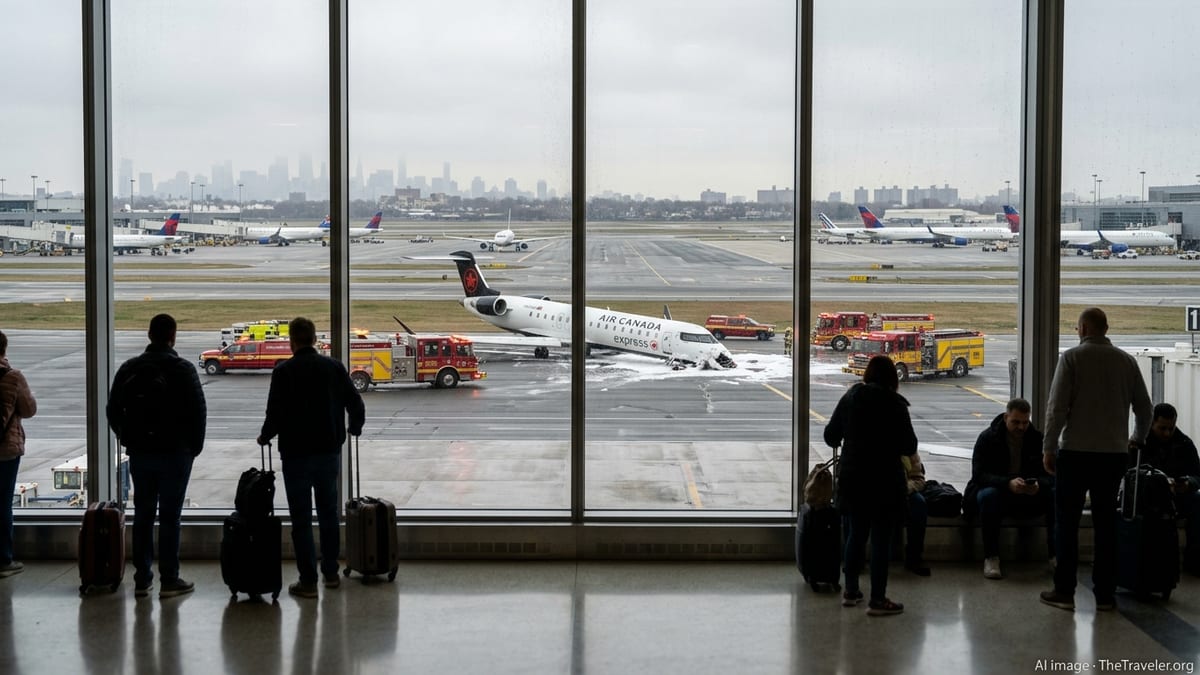
Collision on Runway 4 Leaves Aircraft Torn Open
According to published coverage, the accident involved Air Canada Express Flight 8646, a Bombardier CRJ-900 operated by Jazz Aviation on behalf of Air Canada. The flight was nearing the end of its journey from Montreal’s Trudeau airport when it touched down on Runway 4 at LaGuardia late on the night of March 22.
Reports indicate that as the jet rolled out after landing, it struck a Port Authority Aircraft Rescue and Firefighting vehicle that was crossing the active runway. Initial images and video shared by passengers and bystanders show the forward section of the aircraft catastrophically damaged, with the nose and cockpit area largely torn away and debris scattered across the tarmac.
Two pilots in the cockpit were killed in the impact, according to widely cited news reports. Multiple passengers and members of the cabin crew were injured, some seriously, as the sudden deceleration hurled occupants forward and caused significant structural damage to the front of the cabin.
Publicly available information shows that the specialized fire vehicle involved is vastly heavier than a typical road-going truck, designed to respond rapidly to fuel fires and other emergencies on airport property. The collision between the fully loaded jet and the multi-ton crash truck appears to have concentrated destructive force at the aircraft’s nose, leaving the fuselage otherwise largely intact but heavily compromised at the front.
LaGuardia Closure Sends Shockwaves Through New York Air Travel
In the immediate aftermath of the crash, all arrivals and departures at LaGuardia were suspended as emergency crews converged on Runway 4 and surrounding taxiways. Flight-tracking data and airline alerts show a cascade of cancellations and diversions through Monday, with the Federal Aviation Administration listing LaGuardia as closed to routine traffic until at least early afternoon on March 23.
The shutdown has created ripple effects across the region’s tightly interconnected aviation network. Flights bound for LaGuardia have been diverted to John F. Kennedy International and Newark Liberty International, adding strain to already busy schedules at those airports. Airlines are rerouting aircraft and crews while passengers scramble to rebook, many facing long hold times and crowded customer service lines.
Published timetables and carrier advisories indicate that some airlines have preemptively canceled large portions of their LaGuardia schedules through the day, citing the runway closure, anticipated inspection work and the need to clear a mounting backlog once limited operations resume. Travelers heading to or from New York are being urged to check their flight status frequently and consider alternative airports or ground transportation where possible.
For many passengers, the disruption is being felt far beyond New York. Because LaGuardia serves as a crucial hub and focus city for several major carriers, delayed aircraft and crews are rippling through the national network, leading to missed connections and schedule changes at airports across the United States and Canada.
Questions Focus on Runway Incursion and Airfield Safety
As images of the shattered aircraft circulate, attention is rapidly turning to how a heavily laden passenger jet and an airport fire truck came to occupy the same stretch of runway at the same moment. Early reconstructions in national and aviation media describe a complex sequence of clearances involving both the landing aircraft and emergency vehicles responding to a separate issue on the airfield.
According to publicly available recordings and written summaries, the fire truck had been dispatched to investigate reports of a possible problem involving another aircraft when it entered the movement area near Runway 4. At roughly the same time, the Air Canada Express jet was cleared to land. Subsequent analysis shared by aviation specialists points to a potential runway incursion, a situation in which an unauthorized aircraft or vehicle is present on a runway designated for landing or takeoff.
The National Transportation Safety Board has announced through public statements that it is sending a team to New York to investigate. The inquiry is expected to examine a range of factors, including air traffic control procedures, communication between the control tower and ground vehicles, airfield signage and lighting, and the training and workload of personnel involved in runway and taxiway operations at LaGuardia.
Past safety recommendations from regulators and industry groups have highlighted the risk posed by runway incursions, particularly at older, space-constrained airports like LaGuardia where multiple runways, taxiways and terminals intersect in a tight footprint. The circumstances of Sunday night’s collision are likely to renew debate over how much redundancy and automation should be built into systems designed to prevent vehicles from inadvertently entering active runways.
Impact on Passengers, Airlines and Future Operations
For the 70-plus passengers on Flight 8646, the crash and its aftermath have been described in public accounts as chaotic and terrifying, with some travelers reporting smoke, debris and a sudden loss of lighting as they moved to exit the aircraft. Evacuation slides were deployed and survivors were escorted across the runway and into waiting buses as emergency crews continued to work the scene.
Hospitals in Queens and elsewhere in New York have reported receiving multiple patients from the airport, including members of the flight crew and occupants of the fire vehicle. While the most severe injuries and fatalities occurred at the front of the aircraft and within the truck, medical staff are treating a broader group of passengers for trauma ranging from fractures to smoke inhalation and shock.
Air Canada and its regional partner have publicly expressed condolences for those killed and injured and are working to support affected passengers, including arranging onward travel and crisis counseling. Industry analysts note that the loss of a regional jet, combined with the extended closure of a major airport, may have financial implications for the carrier, though the broader cost to airlines, the Port Authority and the traveling public is still being tallied.
Looking ahead, aviation experts interviewed in published coverage suggest that the LaGuardia collision is likely to intensify scrutiny of ground movement procedures at busy airports worldwide. The investigation’s findings could prompt new technology investments, revised rules governing vehicle access to active runways and updated training for controllers, pilots and emergency responders, with the goal of preventing another tragedy on a crowded urban airfield.
New York Travelers Face Days of Knock-On Disruptions
While investigators begin their work on the runway, travelers across the New York area are bracing for several days of travel headaches. Airline operations planners note in public briefings that even once LaGuardia reopens, it will take time to reposition aircraft, reassign crews and clear the backlog of stranded passengers.
Schedules released early Monday show a patchwork of limited flights, with some airlines operating only a fraction of their normal LaGuardia service. Many carriers are waiving change fees for affected customers, encouraging them to rebook via alternative airports or travel dates to ease pressure on the constrained operation.
For business and leisure travelers alike, the incident underscores the fragility of a system in which a single runway accident can reverberate through an entire region’s transportation network. With LaGuardia serving as a primary domestic gateway for Manhattan and much of the northeastern United States, the fallout from the Air Canada Express collision is likely to be felt not only in New York but across airline route maps for days to come.
As New Yorkers wake to the reality of a deadly crash at one of their main airports, many are turning to publicly available flight and transit information to navigate a travel landscape suddenly reshaped by tragedy, delays and uncertainty.