

More news on this day
Air Canada has quietly pushed its suspension of flights to both Dubai and Tel Aviv to March 23, 2026, extending what was meant to be a short disruption into one of the longest Middle East shutdowns by a major Western carrier as the fast‑escalating Iran war continues to shake global air travel.
Planned Restarts Pushed Back Again
Air Canada initially halted its Tel Aviv service in late February as Israel closed airspace and carriers assessed security risks tied to missile and drone attacks. Flights to Dubai were paused soon after, as Iranian strikes and debris damaged infrastructure in the United Arab Emirates and triggered temporary airport shutdowns. At first, the airline signaled a brief pause, cancelling Tel Aviv flights until March 8 and Dubai flights until March 3.
Those dates have now slipped. The carrier has extended the suspension of both Dubai and Tel Aviv routes through March 22, with March 23 set as the earliest tentative restart. The decision places Air Canada among the most conservative of major international airlines in terms of returning to affected hubs, reflecting the volatility of a conflict that has repeatedly closed swathes of Middle Eastern airspace with little warning.
Industry analysts note that airlines are balancing intense demand for westbound and eastbound connections through the Gulf against heightened insurance costs, complex rerouting requirements and the potential for sudden operational shutdowns. For Air Canada, which relies heavily on Toronto and Montreal as long‑haul gateways, the choice to keep aircraft and crews away from the conflict zone removes risk but leaves a gap in its global network just as spring travel demand builds.
The extended suspension also comes as the airline invests in broader international growth, including new European routes for summer 2026. That contrast, expanding in some regions while staying parked in others, underscores how sharply the Iran war has redrawn the map for long‑haul planning, even for carriers geographically distant from the front lines.
Impact on Passengers and Bookings
For travelers already ticketed to Dubai or Tel Aviv on Air Canada through March 22, the extension means disrupted plans and scrambling for alternatives. The airline is offering flexible rebooking and, in many cases, fee‑free changes on affected itineraries, while encouraging customers to consider rerouting through European hubs that still have limited access to Israel and the Gulf when security conditions allow.
But finding a replacement flight is becoming harder by the day. With multiple Gulf and European carriers also cutting or suspending services to the region, remaining seats are scarce and often far more expensive than original bookings. Travel agents report that some passengers are opting to postpone trips indefinitely, especially leisure travelers who are wary of flying into a live conflict zone or transiting through hubs that have experienced direct missile strikes.
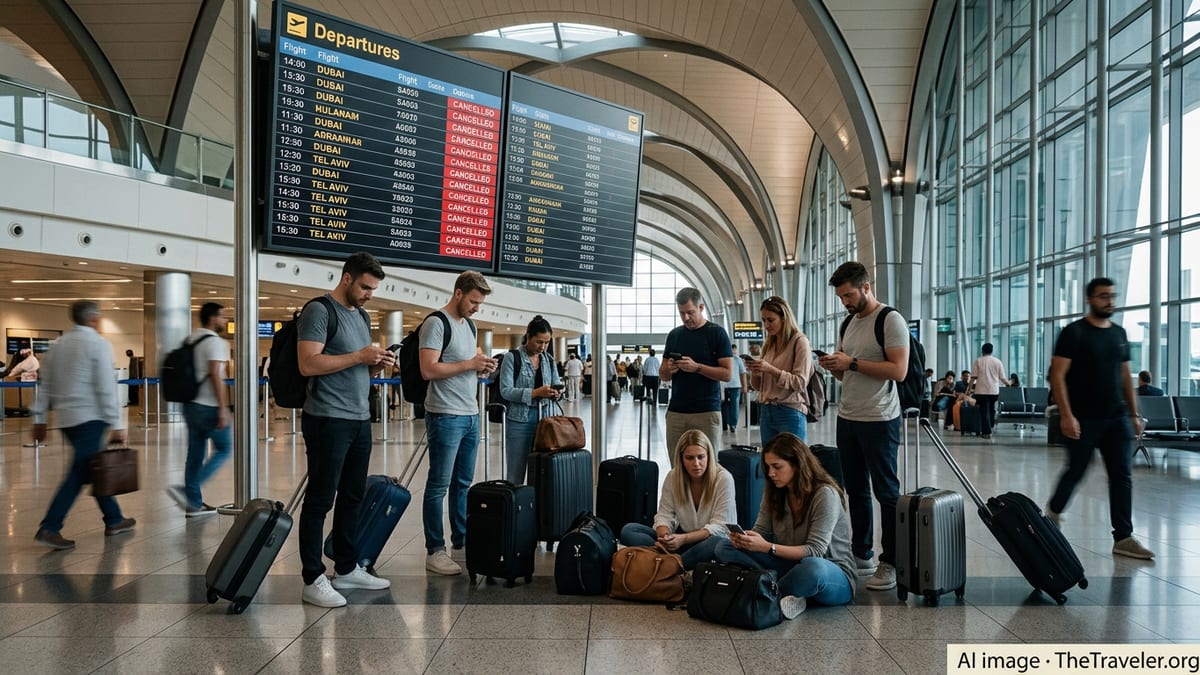
Passengers already en route when airspace closures took effect have faced the most acute disruption, with diversions, overnight airport stays and improvised itineraries stretching journeys by days. Travelers interviewed at major European hubs describe check‑in queues dominated by rebooking requests, printed travel advisories changing by the hour, and a steady stream of cancellations posted on departure boards for flights touching Israel, the Gulf and Iran’s neighborhood.
Corporate travel managers are similarly reassessing risk policies. Many multinational firms have imposed temporary bans on nonessential travel to Israel and the Gulf, or required special approvals for itineraries passing near the conflict zone. That shift is likely to dampen premium‑cabin demand into the second quarter of 2026, eroding some of the yield gains airlines had enjoyed from a strong rebound in transatlantic and transpacific business travel.
Gulf Hubs under Strain as War Disrupts the Skies
The suspension of Air Canada’s Dubai service is especially symbolic, given the city’s status as one of the world’s busiest international hubs and a key east‑west bridge for Canadian travelers heading to India, Southeast Asia and Africa. Since February 28, repeated missile and drone attacks linked to the Iran war have damaged parts of Dubai and neighboring Abu Dhabi, forcing emergency closures at their airports and grounding or diverting thousands of flights.
Across the wider Gulf, airspace closures in the United Arab Emirates, Qatar, Bahrain and Kuwait have transformed the region’s normally dense flight patterns. Airlines from Europe and Asia that once relied on overflying Iran or routing through Dubai, Doha or Abu Dhabi have been forced into lengthy detours that add hours to flight times and burn significantly more fuel. Aviation consultancies warn that if the disruption continues, carriers may introduce fuel surcharges or scale back frequencies altogether on some long‑haul routes.
Data from air traffic monitors and independent aviation trackers point to tens of thousands of cancellations across the Middle East since the conflict began, with Dubai, Doha and Abu Dhabi bearing a disproportionate share of the disruption. Evacuation and humanitarian flights have been prioritized into limited air corridors, while scheduled commercial services operate only sporadically when security conditions permit.
For passengers, the once seamless connections that turned Gulf hubs into preferred transit points between North America, Europe and Asia now come with an overlay of uncertainty. Travel experts advise that anyone booking long‑haul itineraries for the coming weeks build in generous layovers, avoid tight self‑connects and remain prepared for last‑minute schedule changes until regional airspace patterns stabilize.
Israel Routes Face Prolonged Uncertainty
Tel Aviv’s Ben Gurion Airport has a long history of operating under heightened security, but the latest phase of the broader Middle East conflict has introduced new levels of unpredictability. Following the joint United States and Israeli strikes on Iran and Tehran’s retaliatory attacks across the region, Israel’s airspace has experienced intermittent closures that have repeatedly disrupted international schedules.
Air Canada’s extended pause keeps it aligned with a cluster of global carriers that have opted to wait for clearer assurances on air defense effectiveness and missile risk before resuming Israel service. While some regional and low‑cost airlines have returned on a limited basis, most long‑haul operators continue to assess conditions day by day, wary that a single high‑profile incident involving a commercial aircraft could trigger an even broader industry pullback.
Travel demand to Israel remains highly polarized. On one hand, there are passengers determined to reach family members, attend religious commemorations or manage urgent business, regardless of the difficulty. On the other, a large segment of leisure travelers is deferring pilgrimages, tours and conferences until security advisories ease. Tour operators surveyed by trade publications report cancellation rates far above seasonal norms and a wave of requests to shift bookings into late 2026 or 2027.
The resulting stop‑start pattern complicates planning not just for airlines but also for hotels, ground transport providers and local tourism boards, all of which depend on predictable airlift. Until carriers like Air Canada commit firmly to restored frequencies and aircraft types on the Tel Aviv routes, downstream travel industries will struggle to forecast staffing needs and revenue for the peak travel months ahead.
What Travelers Should Do Now
For Canadians and other international travelers holding tickets to Dubai or Tel Aviv after March 23, the key message from travel advisors is to stay flexible and monitor communications closely. Even with a published restart date, Air Canada and other airlines retain wide discretion to cancel or retime flights at short notice if military activity, government directives or airport damage make operations unsafe.
Experts recommend registering contact details with airlines and booking platforms, opting into real‑time alerts and downloading carrier apps to receive push notifications about gate changes or cancellations. Travel insurance policies that include trip interruption and war‑related disruption clauses are seeing renewed interest, although coverage varies widely and often excludes active conflict zones, making it essential to scrutinize the fine print.
Travel planners also urge passengers to consider alternative routings that avoid the most volatile airspace where possible. For journeys that are not time sensitive, postponing travel or shifting to destinations outside the immediate conflict area may offer more certainty and fewer last‑minute surprises. For those who must travel for urgent reasons, building in extra days at the start and end of a trip can provide a buffer if flights are delayed or rerouted.
With no clear timeline for de‑escalation in the Iran war and regional governments periodically tightening or relaxing airspace restrictions, the only constant for Middle East air travel in early 2026 is change. Air Canada’s latest extension of its Dubai and Tel Aviv suspensions illustrates just how fluid the situation remains, and why travelers should treat any schedule in the region as provisional until wheels are up.