

More news on this day
An Air Canada Express flight arriving from Montréal–Trudeau International Airport collided with an airport fire truck on a runway at New York’s LaGuardia Airport late on March 22, 2026, killing two crew members, injuring dozens and triggering major flight disruptions across one of the United States’ busiest air travel hubs.
Get the latest news straight to your inbox!
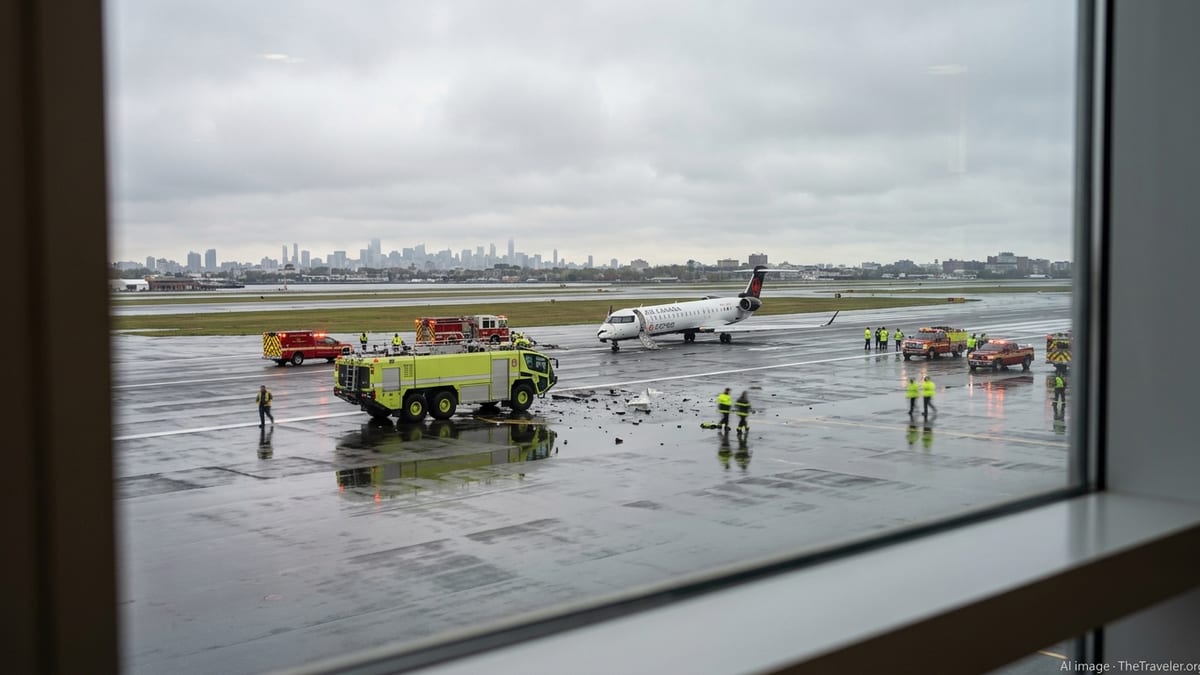
Collision on Landing at LaGuardia Airport
Publicly available information identifies the aircraft as Air Canada Express Flight 8646, a Bombardier CRJ900 operated by regional carrier Jazz Aviation on behalf of Air Canada. The international service departed Montréal–Trudeau International Airport on Sunday night bound for LaGuardia in Queens, New York.
According to published coverage and aviation tracking data, the crash occurred as the regional jet landed on Runway 4 shortly before midnight local time. The aircraft struck an airport Aircraft Rescue and Firefighting vehicle that was crossing the runway, crushing the nose section of the jet and severely damaging the fire truck.
Reports indicate that there were 72 passengers and 4 crew members on board. The cockpit area bore the brunt of the impact, and images from the scene show the forward fuselage mangled, with the jet resting nose-up on the runway while emergency stairways were positioned at the exits to evacuate passengers.
Photos reviewed from the scene show debris scattered around the front of the aircraft, with parts of the cockpit structure torn away and the fire truck lying damaged nearby. The aircraft, tail number C-GNJZ, has been described in preliminary reporting as a total loss.
Fatalities, Injuries and Passenger Evacuation
Information compiled from news reports and official summaries states that the flight’s pilot and copilot were killed in the collision. The destruction of the cockpit left little survivable space at the front of the aircraft, while the cabin behind remained largely intact.
Dozens of people suffered injuries of varying severity. Reports from New York media and national outlets describe at least 39 passengers and crew taken to area hospitals, along with two Port Authority personnel who had been in the fire truck. Early accounts indicate that most of the injuries among passengers were non-life-threatening, including fractures, cuts and possible head and back trauma consistent with a violent deceleration.
Emergency responders converged on the runway within minutes. Publicly available photographs show passengers being led down mobile stairways in the rain and assisted onto buses on the tarmac. Some travelers were treated at the scene before being transported for further evaluation, while others were processed through the terminal after medical checks.
Reports from local hospitals on Monday morning suggested that many of those admitted had already been released, although a smaller number of passengers and first responders remained under observation or in treatment for more serious injuries.
Weather, Airport Closure and Widespread Travel Disruptions
The collision unfolded during a period of challenging weather in the New York area. Airport and media updates ahead of the crash noted heavy rain and low visibility at LaGuardia on Sunday evening, with standing water visible on portions of the tarmac and earlier delays reported for arriving and departing flights.
Following the accident, a ground stop was declared at LaGuardia. The Federal Aviation Administration’s publicly posted information shows that all arrivals and departures were halted overnight, with the airport expected to remain closed until at least early afternoon on March 23 to allow for emergency operations and the on-site investigation.
Airlines began diverting inbound flights to other New York–area airports, particularly John F. Kennedy International Airport and Newark Liberty International Airport. Flight tracking data and airport boards on Monday morning reflected cascading disruptions, with numerous cancellations, diversions and extended delays affecting both domestic and international routes.
Passengers scheduled to travel through LaGuardia faced long lines and uncertain itineraries as carriers rebooked travelers onto later flights or alternate airports. Travel industry analysts noted that, because LaGuardia is a key short-haul business and leisure gateway, the immediate impact was felt across the U.S. Northeast and eastern Canada, including Montréal, Toronto and other regional hubs.
Early Details on Runway Operations and ATC Recordings
Published accounts referencing publicly available air traffic control recordings describe a chaotic sequence in the moments leading up to the crash. According to that material, a ground operations or fire vehicle was cleared to cross Runway 4 around the same time Flight 8646 was on short final approach.
Audio reviewed by multiple news outlets captures a controller attempting to halt the truck seconds before the collision, followed by calls noting that the aircraft had struck a vehicle and that emergency responders were being dispatched. Commentary from other pilots on the frequency reflects shock as they observed or became aware of the impact.
Initial summaries of airport diagrams and communication sequences suggest that the fire truck had been responding to an unrelated incident involving another aircraft that had reported an odor in the cockpit. The precise timing of clearances, the controller’s workload and the visibility from both the cockpit and the truck are expected to be central questions for investigators.
Aviation safety specialists contacted by news organizations have emphasized that runway incursions involving ground vehicles are rare but high-risk events, particularly in low-visibility conditions or during complex emergency responses. The LaGuardia crash is already being compared to past global incidents in which airliners collided with airport equipment or vehicles during landing or takeoff.
Investigation Underway and What Travelers Should Expect
The National Transportation Safety Board has announced through public channels that it is sending a “go team” to New York to examine the accident. The team is expected to analyze the jet’s flight data and cockpit voice recorders, review air traffic control logs and recordings, inspect the damaged aircraft and fire truck, and study airport procedures in place at LaGuardia.
Investigators typically focus on multiple layers of potential contributing factors, including human performance, communication protocols, airport surface movements and the impact of weather. In this case, attention is likely to center on how a rescue vehicle responding to a separate situation came to occupy an active runway as an arriving aircraft landed, and whether additional safeguards could have prevented the intersection of flight and ground traffic.
For travelers, airline advisories on Monday urged anyone booked to or from LaGuardia to monitor flight status closely and consider flexible routing through alternate airports where feasible. Many carriers traditionally implement temporary waivers or rebooking options after a major disruption, and observers anticipate a similar response as the situation stabilizes.
In Montréal and New York, the crash has drawn particular attention because Flight 8646 operated a heavily used transborder route connecting two major business and leisure markets. As investigators begin their work and the runway reopens, aviation observers expect a sustained focus on how one of North America’s most constrained airports manages emergency traffic on the ground while continuing to accommodate dense schedules of commercial flights.