

More news on this day
An Air Canada Express flight arriving from Montréal–Trudeau International Airport struck an airport fire truck on a runway at New York’s LaGuardia Airport late Sunday, killing two crew members and injuring dozens, according to early reports from news outlets and aviation trackers.
Get the latest news straight to your inbox!
Collision on Runway 4 Prompts Airport Shutdown
Publicly available flight data and news coverage indicate that Air Canada Flight 8646, a Bombardier CRJ-900 operated by Jazz Aviation on behalf of Air Canada, was landing on Runway 4 at LaGuardia when it collided with an airport fire truck on Sunday night, March 22. The regional jet had departed Montréal–Trudeau International Airport on a scheduled evening service to New York.
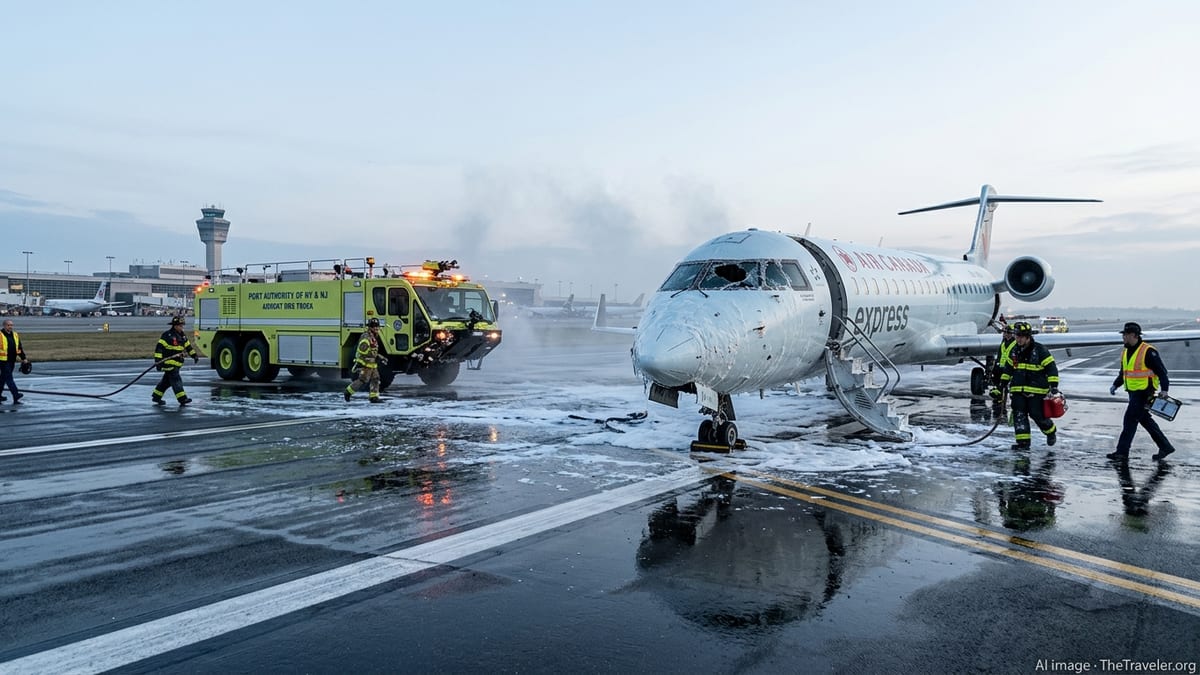
Images and descriptions circulating through major media and aviation forums show the aircraft’s forward fuselage severely crushed, with the cockpit section destroyed after the impact. The collision occurred as the aircraft was decelerating on the runway, leaving the jet disabled on the pavement and the fire truck heavily damaged.
Reports from multiple outlets state that the pilot and copilot died in the crash. Dozens of passengers and cabin crew were transported to area hospitals with a range of injuries, some described as serious but largely non-life-threatening in initial coverage. Several occupants of the fire truck were also reported injured.
Following the collision, airport operations at LaGuardia were halted. Aviation authorities announced that no arrivals or departures would operate until at least early Monday afternoon, leading to widespread cancellations and diversions across the New York air travel system.
Emergency Response and Passenger Evacuation
According to published coverage and on-the-ground accounts, emergency vehicles converged on Runway 4 within minutes of the impact. Airport rescue and firefighting units deployed foam and suppression equipment around the damaged jet and the fire truck as a precaution against fuel leaks and potential fire.
Passengers described, in media interviews and social media posts cited in news reports, a chaotic but rapid evacuation. With the nose of the aircraft crushed, exits farther aft were used to move people off the jet, and slide deployments were visible in photos shared by witnesses. Many passengers were seen being led to buses for medical screening and transport to the terminal.
Local hospitals in Queens and elsewhere in New York City began receiving patients late Sunday and into early Monday. Publicly available information suggests that the majority of those injured were treated and later released, while a smaller number remained under observation for more serious trauma.
Officials overseeing airport fire and rescue operations are being scrutinized for how the responding vehicle came to be crossing or occupying the active runway while the arriving flight was still landing. Early indications from aviation specialists point to the complexity of coordinating emergency ground movements while runway operations continue.
Runway Crossing and Emerging Timeline
Detailed tracking data from flight-monitoring services, combined with recordings of radio communications reviewed by multiple news organizations, provide a preliminary timeline of the events leading up to the crash. These sources indicate that the Air Canada Express jet was on final approach to Runway 4 around 11:45 p.m. local time.
Shortly before the collision, an airport operations fire truck was reportedly cleared to cross the same runway while responding to a separate situation involving another aircraft at LaGuardia. Audio recordings shared by aviation enthusiasts and referenced in published coverage capture an urgent attempt by air traffic personnel to halt the vehicle seconds before impact, followed by acknowledgments that a collision had occurred.
The National Transportation Safety Board has launched an investigative team to New York to examine the circumstances of the crash. The team is expected to review cockpit voice and flight data recorders, radar tracks, ground vehicle movements, and staffing and workload in the control tower at the time of the incident.
Investigators are also likely to focus on runway incursion safeguards at LaGuardia, including ground radar, signage, lighting, and procedural barriers intended to prevent vehicles and aircraft from occupying the same section of pavement simultaneously.
Widespread Flight Disruptions for Travelers
The shutdown of LaGuardia Airport following the crash created an immediate ripple effect for travelers across North America. According to data compiled by airline-tracking services and summarized in news outlets, hundreds of flights were delayed or canceled on Monday morning, affecting passengers on both domestic and international routes.
Airlines began diverting inbound LaGuardia flights to nearby airports in the New York region, including John F. Kennedy International Airport and Newark Liberty International Airport. Some Montréal–New York services and other regional connections were either rerouted or canceled outright, with carriers citing the extended runway closure and limited gate capacity.
Travelers bound for New York reported crowded terminals, long rebooking lines, and extended hold times with airline call centers. Many were advised to consider rail and intercity bus alternatives for short-haul journeys in the busy Northeast Corridor while LaGuardia’s operations remained constrained.
Airport and airline updates indicated that delays would likely continue beyond the formal reopening time as carriers reposition aircraft and crew. Travelers heading into or out of New York over the next several days are being urged, in public advisories and media reporting, to monitor flight status frequently and allow extra time for check-in and security screening.
Focus on Safety Culture and Regional Jet Operations
The incident involving Flight 8646 is drawing attention to the safety environment at busy urban airports and the role of regional jets in cross-border travel. The Bombardier CRJ-900, widely used on shorter North American routes, typically carries around 70 to 80 passengers and operates frequent shuttle-style services between major business centers such as Montréal and New York.
Aviation analysts quoted in early coverage note that runway incursions involving vehicles and aircraft, while relatively rare, remain a persistent concern. High traffic density, constrained airfield layouts, and complex ground operations at airports like LaGuardia can magnify the consequences of any breakdown in communication or situational awareness.
Industry observers are watching closely to see whether the crash leads to changes in ground movement procedures, additional training for controllers and emergency crews, or enhancements to technology designed to detect and prevent conflicts on runways. The crash may also accelerate discussions about infrastructure upgrades at space-limited airports that serve dense metropolitan areas.
For travelers, the Flight 8646 tragedy underscores how quickly a routine regional hop can be disrupted by an unexpected airport emergency. As investigations continue, airlines serving LaGuardia and Montréal–Trudeau are expected to review their own safety practices and contingency plans to reassure passengers who rely on these heavily traveled routes.