

More news on this day
An Air Canada Express flight from Montreal to New York collided with an airport fire truck on the runway at LaGuardia Airport late Sunday, killing both pilots and triggering hours of closures and cascading delays for travelers across the New York region.
Get the latest news straight to your inbox!
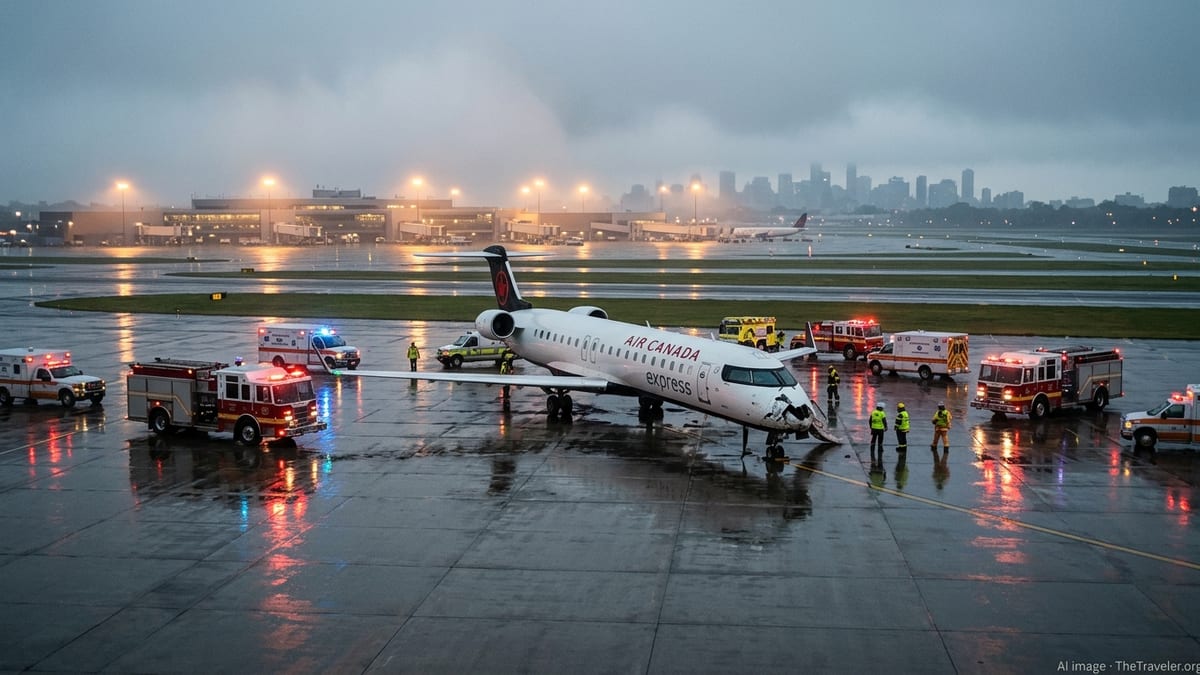
Fatal Collision on Runway 4 at LaGuardia
According to publicly available information, Air Canada Express Flight AC8646, operated by Jazz Aviation, was landing at LaGuardia Airport on the night of March 22, 2026, when it struck an Aircraft Rescue and Firefighting truck on Runway 4. Coverage from outlets including the Associated Press and other major news organizations describes a violent impact that tore away the Bombardier CRJ900’s cockpit section and left debris scattered across the runway.
Reports indicate that both the pilot and copilot were killed in the collision. Initial tallies from published coverage state that there were 72 passengers and four crew members on board the regional jet, with dozens of people transported to area hospitals. Most injuries have been described as non life threatening, although some were initially characterized as serious.
Images published by major news outlets show the nose of the aircraft crushed and partially separated from the fuselage, with emergency crews surrounding the jet under heavy rain. The fire truck involved in the collision belonged to the Port Authority’s Aircraft Rescue and Firefighting unit and was reportedly moving in response to a separate incident at the time of impact.
Background information compiled by aviation databases notes that the aircraft, registered as C GNJZ, was about 20 years old and configured as a CRJ900LR. The flight was operating as a regularly scheduled international service from Montréal–Trudeau International Airport to LaGuardia.
Emergency Runway Response and Evolving Timeline
Publicly available accounts of air traffic control audio and timeline reconstructions suggest that the fire truck had been cleared to cross Runway 4 as it responded to another aircraft that had reported a potential issue on board. Subsequent reporting describes urgent radio traffic in which a controller appeared to attempt to halt the truck’s movement just moments before the collision with Flight AC8646.
Media summaries of the preliminary sequence of events indicate that the Air Canada Express jet was on final approach in rainy nighttime conditions when the collision occurred around 11:40 p.m. local time. Weather reports for New York City at the time described heavy rain and standing water on portions of the airfield, conditions that may have complicated both visibility and the broader emergency response.
In the aftermath of the crash, emergency vehicles from multiple agencies converged on the runway area, with triage points reportedly established on the tarmac and in terminal areas. Passengers were seen being evacuated from the aircraft and escorted to the terminal, where they were assessed for injuries and later rebooked or provided with onward travel arrangements.
Further details about the movements of both the aircraft and the fire truck in the minutes before impact are expected to be central to the formal investigation, including the role of runway incursion safeguards and surface movement procedures at LaGuardia.
Severe Disruptions Across New York’s Air Network
The collision triggered an immediate ground stop at LaGuardia, according to information published by the Federal Aviation Administration and widely cited by national news organizations. The airport’s runways were closed for safety checks and investigative work, with statements from airport and airline channels indicating that operations did not resume until early afternoon on March 23.
During the closure, dozens of inbound flights were diverted to John F. Kennedy International Airport and Newark Liberty International Airport, while others were rerouted to secondary airports in the wider region or returned to origin. Passengers at LaGuardia reported extensive delays, long lines and rebooking challenges as airlines worked through the backlog created by the overnight crash and ensuing shutdown.
By Monday morning, live flight tracking platforms showed a heavy concentration of cancellations and delays centered on LaGuardia, with knock on effects at connecting hubs throughout North America. Travelers attempting to reach New York were frequently advised through airline and airport channels to check flight status, consider alternate airports and expect extended wait times.
For many passengers already in New York for business or leisure, the disruption translated into missed connections, extended hotel stays and last minute changes to itineraries. Travel industry analysts quoted in wider coverage noted that LaGuardia’s role as a key short haul and business travel hub magnified the impact, particularly on Monday morning traffic.
What Travelers Need to Know Now
As of Monday, March 23, published airport and airline information indicates that LaGuardia has reopened with reduced capacity while the damaged runway and surrounding areas undergo detailed inspection and cleanup. Many airlines have implemented flexible rebooking policies for customers scheduled to travel through LaGuardia over the next several days, including options to switch to flights at JFK or Newark without standard change fees, subject to fare rules.
Travelers planning to fly into or out of the New York area in the coming days are being urged through official advisories and airline communications to monitor flight status closely and allow extra time at the airport. Some carriers are spacing out departures to manage congestion, while ground transportation providers are reporting higher than usual demand between the three major regional airports as passengers reposition.
For international travelers connecting through New York, disruptions at LaGuardia may affect downstream flights even at airports far from the region, particularly on transborder routes between the United States and Canada. Montreal, Toronto and other Canadian gateways served by Air Canada and its partners may experience residual delays as aircraft and crews are repositioned.
Hotel operators near LaGuardia and JFK are already seeing increased last minute bookings from stranded passengers, according to hospitality industry updates. Visitors with time sensitive plans in New York are being advised to keep confirmation numbers, boarding passes and receipts, which may be useful for insurance claims or reimbursement under airline policies.
Early Investigation and Safety Questions
Public statements from the National Transportation Safety Board describe the launch of a multidisciplinary team to New York to examine the circumstances of the crash. According to the agency’s published updates, investigators are expected to review cockpit voice and flight data recorders, air traffic control recordings, airport surveillance footage and the condition of both the aircraft and the fire truck.
Aviation reference material and news coverage point out that this is the first fatal accident involving an Air Canada flight since the early 1980s, a fact that underscores the rarity of such events in modern commercial aviation. The collision at LaGuardia will likely focus attention on runway safety systems, ground vehicle procedures and coordination between air traffic control and emergency services at busy metropolitan airports.
Industry analysts quoted in media coverage suggest that the investigation may examine whether existing technology such as runway incursion warning systems, surface radar and vehicle tracking tools were fully implemented or effective at the time of the crash. Weather conditions, visibility, staffing levels and workload in the control tower are also expected to form part of the broader analysis.
While the formal investigation is expected to take many months, early findings and safety recommendations will be closely watched by airlines, airport operators and travelers. Any interim advisories could influence procedures not only at LaGuardia but at other high density airports where aircraft and emergency vehicles share complex, congested runway environments.