

More news on this day
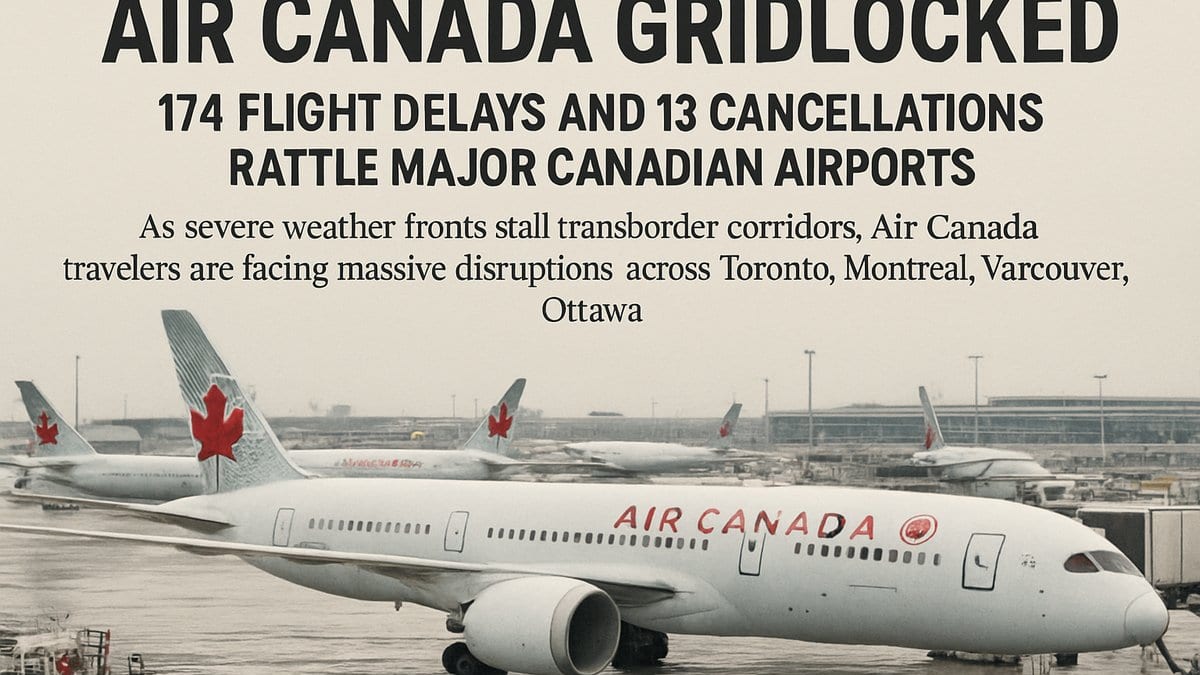
Air Canada’s network came under severe strain as 174 flight delays and 13 cancellations rippled across major Canadian airports, snarling operations at key hubs and leaving passengers facing hours of disruption.
Get the latest news straight to your inbox!
Delays Mount Across Major Canadian Hubs
Publicly available flight tracking data for Air Canada’s mainline and regional operations indicates that a total of 174 services operated behind schedule, alongside 13 outright cancellations, over a recent 24-hour period. The disruption was felt most acutely at Toronto Pearson, Montreal Trudeau and Vancouver International, which together handle a large share of the airline’s domestic and international traffic.
The pattern of irregular operations shows rolling delays building through the morning peak and spilling into the afternoon and evening banks. At Toronto Pearson, the airline’s largest hub, late-arriving aircraft and crew rotations contributed to knock-on schedule slippages, particularly on high-frequency domestic routes linking Toronto with Montreal, Ottawa, Vancouver and Calgary.
Montreal Trudeau and Vancouver International also experienced notable congestion as delayed inbound flights compressed departure windows. Regional spokes feeding into these hubs, including services to cities in Atlantic Canada and the Prairies, recorded higher-than-usual delay counts as aircraft and crews were repositioned.
While the majority of affected flights operated within one to two hours of their scheduled times, a subset of services saw longer waits, reshaping travel plans for passengers with tight connections and time-sensitive itineraries.
Operational Strain After Safety and Weather Turbulence
The gridlock comes against a wider backdrop of operational strain in North American aviation. Recent weeks have brought episodes of severe weather in several regions, as well as heightened scrutiny of airport and airline safety practices following high-profile incidents involving multiple carriers. These pressures have narrowed the margin for recovery when day-of-operation issues arise, especially at busy hubs.
Air Canada’s network remains tightly scheduled across its core domestic corridors, where aircraft often operate multiple short segments per day. When an early rotation is delayed by conditions such as low visibility, congested taxiways or extended ground handling, subsequent legs can inherit and amplify the disruption. On days with already stressed airspace and airport capacity, this can quickly translate into broad network ripple effects.
In addition, the airline continues to balance aircraft utilization, crew availability and ongoing maintenance requirements in a climate of sustained travel demand. Industry analysts have noted that even relatively modest staffing gaps or short-notice technical inspections can contribute to cancellations or extended delays when operational buffers are limited.
The result, as reflected in the latest delay and cancellation figures, is a system that becomes vulnerable to cascading disruption when several minor stressors align at once.
Passenger Impact at Canada’s Busiest Airports
For travelers, the numbers translate into long queues at check-in and security, crowded gate areas and a surge in last-minute itinerary changes. At Toronto Pearson, reports from airport dashboards and passenger forums describe clusters of delayed Air Canada departures showing rolling estimated times, forcing passengers to repeatedly adjust ground transportation and meeting plans.
In Montreal and Vancouver, travelers faced similar challenges as departure boards filled with “delayed” notices. Some passengers on short-haul routes experienced aircraft swaps or were rebooked onto later services, while those on transcontinental and international flights encountered tighter connections at downstream hubs.
The 13 cancellations recorded on the network added another layer of complexity. In those cases, passengers were shifted to alternate flights where space permitted, sometimes routing through different hubs or extending journeys by several hours. Accommodation and meal needs for severely disrupted itineraries placed additional pressure on airport services and nearby hotels.
Families traveling with children, seniors and those with mobility needs were among the most affected by extended waiting times, as terminal facilities struggled to absorb the volume of disrupted passengers seeking assistance, rebooking options and updated information.
What Is Driving the Gridlock?
Several overlapping factors appear to underlie the latest wave of delays and cancellations on Air Canada’s network. Peak-period congestion at major hubs, complex aircraft and crew rotations, and the lingering effects of previous operational disruptions can all play a role in stretching schedules beyond their intended limits.
In the broader Canadian and North American aviation context, resource constraints remain a recurring theme. Airlines across the continent have cited tight staffing in certain operational roles, along with high aircraft utilization, as challenges in quickly absorbing irregular operations. For Air Canada, which operates a dense schedule through a small number of primary hubs, localized bottlenecks can have outsized consequences.
Weather patterns also continue to influence day-to-day reliability. Even when no single severe storm dominates headlines, a patchwork of lower ceilings, high winds or precipitation across multiple regions can impose reduced arrival and departure rates, extra spacing between aircraft and occasional ground holds.
Combined, these elements help explain how a single day’s performance can feature triple-digit delays and a cluster of cancellations, even absent a singular, headline-grabbing cause.
Guidance for Affected and Upcoming Travelers
Public advisories and airline customer updates emphasize the importance of closely monitoring flight status, particularly for passengers connecting through Toronto, Montreal or Vancouver. Travelers are being urged to check for real-time information via airline and airport channels before leaving for the airport, and to build additional buffer time into their plans where possible.
Consumer advocates note that passengers whose journeys are significantly disrupted should familiarize themselves with their rights under Canadian air passenger protection rules, which set out specific obligations for carriers in cases of controllable delays and cancellations. These may include rerouting options, meal vouchers or, in some situations, compensation.
Travel planning specialists also recommend considering earlier departures on days with critical commitments, selecting longer connection windows where routing allows, and keeping essential items such as medication and a change of clothes in carry-on baggage in case of overnight disruptions.
With Air Canada’s latest figures highlighting how quickly gridlock can develop across a tightly interconnected network, travelers passing through Canada’s busiest airports in the coming days may continue to face a less predictable experience, even as operations gradually work back toward the published schedule.