

More news on this day
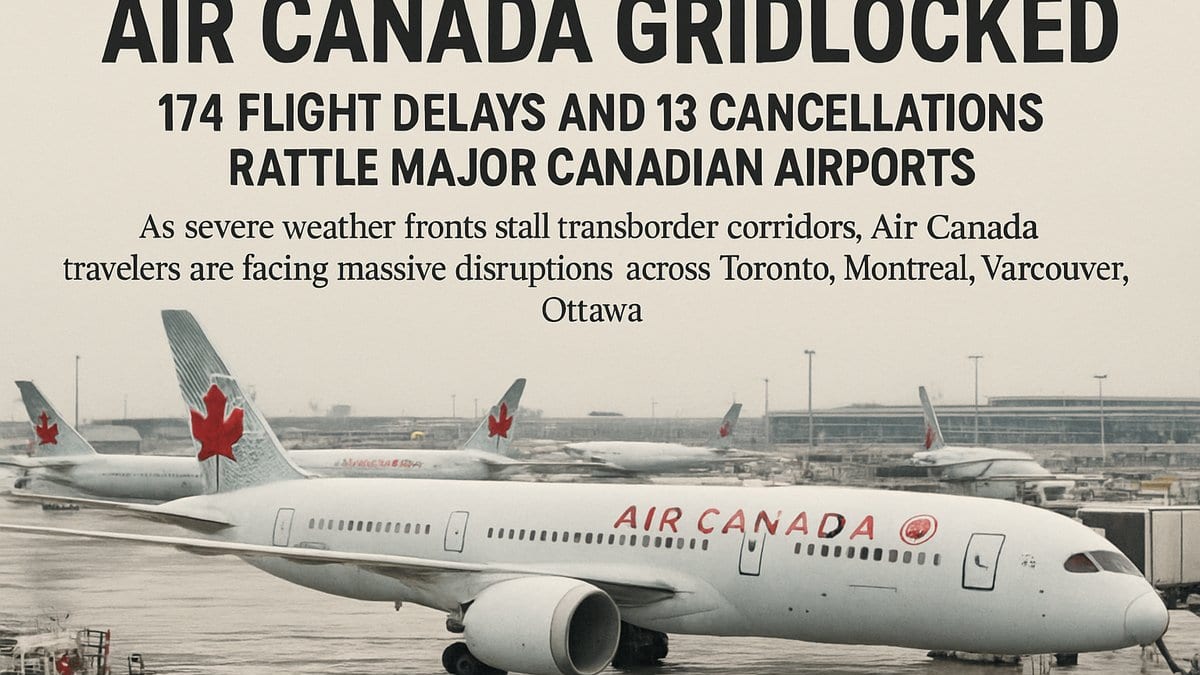
Air Canada’s operations came under renewed scrutiny as 174 flight delays and 13 cancellations rippled across major Canadian airports, creating crowded terminals, missed connections and mounting frustration among travelers watching departure boards turn red.
Get the latest news straight to your inbox!
Major Canadian Hubs Bear the Brunt
Publicly available tracking data and airline schedule information indicate that the latest wave of disruptions was concentrated at Air Canada’s largest hubs, including Toronto Pearson, Montreal Trudeau, Vancouver and Calgary. These airports anchor the carrier’s domestic and international network, meaning that delays on a handful of key routes can quickly cascade across the system.
Toronto Pearson, already known as one of the most delay-prone airports in North America, once again featured prominently in the disruption picture. A mix of congested airspace, tight turnaround times and residual winter weather challenges has left the country’s busiest airport particularly vulnerable when operations begin to slip behind schedule, with late-arriving aircraft often setting off a chain reaction across evening departures.
In Montreal and Vancouver, similar patterns emerged as mid-day and late-afternoon flights began departing behind schedule, compressing overnight operations and narrowing connection windows. For travelers headed to transatlantic and transpacific destinations, even relatively modest delays on feeder flights were enough to strand some passengers in hub cities or force last-minute rebookings on alternative routings.
Calgary, serving as a critical Western Canada hub, also experienced knock-on impacts as aircraft and crews arrived late from eastern cities. While the total number of outright cancellations remained in the low double digits, the concentration of delayed flights at peak travel times created a perception of gridlock that was felt throughout terminal concourses.
Weather, Congestion and Network Knock-on Effects
Recent Canadian press coverage and operational summaries for late winter and early spring point to a combination of lingering severe weather and structural congestion as key factors behind the latest disruption wave. Storm systems earlier in the season had already forced airlines to pare back schedules and reposition aircraft, leaving little margin to absorb fresh operational shocks.
Industry analysts note that hubs like Toronto Pearson and Montreal Trudeau operate close to capacity during peak hours, so relatively small slowdowns in air traffic control flow or ground handling can lead to substantial delays. When departures begin to stack up, airlines often opt to “pre-cancel” a limited number of flights, concentrating on protecting long-haul services and high-demand routes while trimming frequencies on shorter domestic segments.
These strategic cancellations, while reducing the risk of passengers becoming stranded at intermediate points, still contribute to a visible spike in daily disruption tallies. For travelers booked on the affected services, the distinction between a weather-related decision and an internal network adjustment may be largely academic as they scramble to secure new itineraries or overnight accommodation.
Aviation observers also point to ongoing challenges in recruiting and retaining specialized staff across Canada’s aviation ecosystem. Shortages in ground handling personnel, maintenance crews and, in some regions, air traffic controllers can magnify the impact of bad weather or technical issues, prolonging recovery times after an initial disruption event.
Safety Spotlight After High-Profile Incident
The gridlock comes against a backdrop of heightened attention on Air Canada’s operations following a recent high-profile collision involving an Air Canada Express jet at New York’s LaGuardia Airport. That crash, which prompted international headlines and a detailed investigation, has increased public scrutiny of the carrier’s safety and operational practices, even on days when problems center on punctuality rather than hardware or procedures.
While the LaGuardia incident unfolded in the United States, Canadian travelers have been quick to link those developments with their own experiences of delays and cancellations at home. Commentaries in Canadian and international outlets have questioned whether the airline’s rapid post-pandemic growth and complex hub structure have outpaced its ability to deliver consistently reliable and predictable service.
Regulators and investigators continue to examine the circumstances around the LaGuardia crash, and there is no formal suggestion that the recent spate of delays and cancellations is tied to safety shortcomings. However, the timing has reinforced a broader narrative of strain within North American air travel, where carriers, airports and oversight bodies are all working to rebuild confidence while managing record passenger volumes and stressed infrastructure.
For many passengers caught in the latest disruption cycle, the immediate concern is less about investigative findings and more about tangible service outcomes, from clear communication on gate screens to realistic rebooking options when itineraries begin to fall apart.
Passenger Rights and Compensation Questions
The disruption numbers have renewed public interest in Canada’s Air Passenger Protection Regulations, a framework that outlines when airlines must provide compensation, care, or alternative transportation. Consumer-rights advocates and legal analysts note that eligibility often depends on whether a delay or cancellation is deemed within the carrier’s control, and on the length of the disruption.
Recent guidance materials and case summaries highlight how weather, air traffic control constraints and security-related issues are generally categorized as outside airline control. In those situations, travelers may be entitled to assistance such as food vouchers or hotel rooms, but not necessarily direct financial compensation. Conversely, when disruptions arise from crew scheduling, maintenance planning or other operational decisions, obligations can increase.
Travelers navigating these rules often face a complex and sometimes confusing process. Publicly available information from regulators and consumer organizations encourages passengers to retain boarding passes, document delay times and submit claims through official airline channels, while being prepared for follow-up communication or additional documentation requests.
With 174 delays and 13 cancellations recorded in a short period, the latest gridlock is likely to generate a fresh wave of claims and complaints. Analysts expect that how those claims are handled will influence public perception of Air Canada’s commitment to service recovery and accountability at a time when competition from rival carriers is intensifying.
Network Resilience Under Pressure
Operational data and expert commentary over the past year indicate that Air Canada, like many global carriers, has been trying to balance ambitious capacity plans with the realities of aging infrastructure and unpredictable weather. The Canadian network’s dependence on a handful of mega-hubs means that disruptions at one airport can reverberate nationwide within hours.
Some aviation specialists argue that incremental schedule adjustments, including slightly longer turnaround times and more conservative connection windows, could reduce the risk of large-scale delay clusters such as the one that produced 174 delays and 13 cancellations. However, they also acknowledge that such measures may reduce aircraft utilization and increase costs, pressures that any carrier must weigh carefully in a competitive market.
The latest disruption episode is prompting renewed discussion about the resilience of Canada’s air transport system overall. Airports, air navigation authorities and airlines are under growing pressure to coordinate contingency planning, from de-icing logistics and snow removal to gate allocation strategies during irregular operations.
For travelers, the takeaway from this most recent gridlock will likely be a mix of caution and adaptation. Many are building larger buffers into their itineraries, especially when connecting through major hubs or traveling at peak times. As spring and summer travel seasons approach, the way Air Canada manages recovery from episodes like this one will be closely watched by passengers, competitors and regulators alike.