

More news on this day
An Air Canada Express CRJ-900 regional jet landing at New York’s LaGuardia Airport from Montreal collided with a fire truck on a runway late Sunday night, killing both pilots, injuring multiple people and prompting federal regulators to temporarily halt operations at one of the United States’ busiest urban airports.
Get the latest news straight to your inbox!
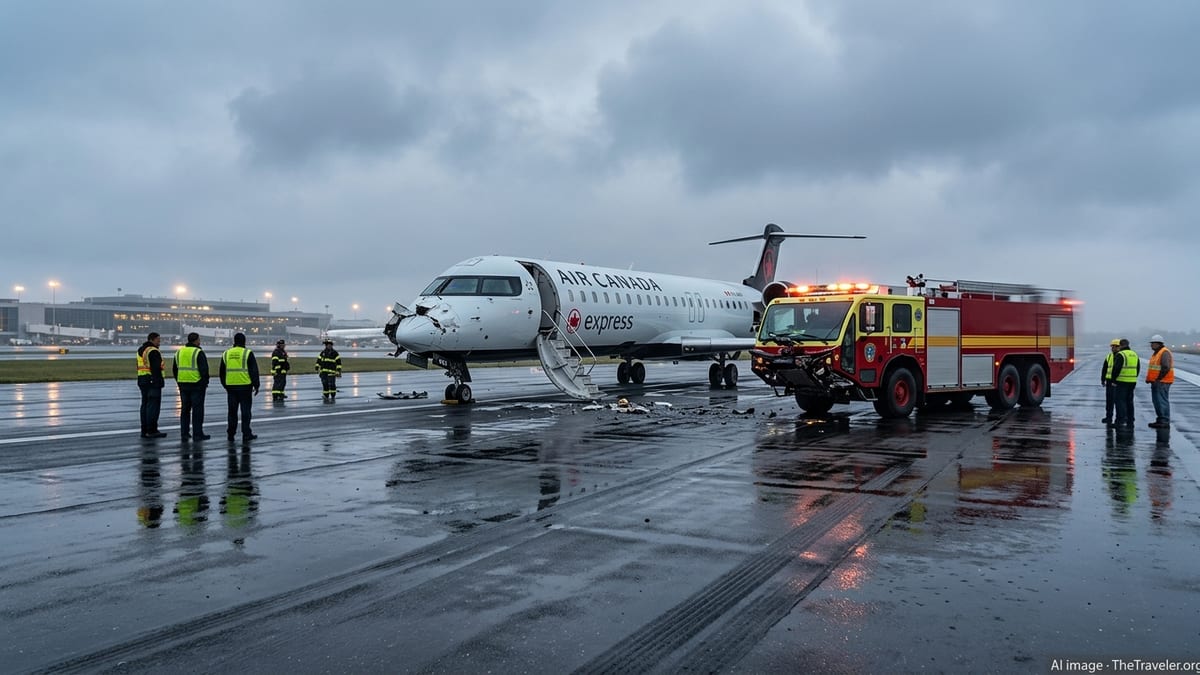
Late-Night Collision on Runway 4
Publicly available flight-tracking data and initial media reports indicate that the aircraft, operating as Air Canada Express Flight 8646, was landing on Runway 4 at LaGuardia on the night of March 22 when it struck an airport fire truck that was crossing the active runway. The Bombardier CRJ-900, operated by regional carrier Jazz Aviation for Air Canada, had departed Montréal–Trudeau International Airport earlier in the evening with dozens of passengers and crew on board.
Images from the scene show the jet stopped on the runway with its nose pitched sharply upward and the forward fuselage crushed where it made contact with the heavy fire apparatus. The cockpit section appears almost completely destroyed, consistent with reports that the pilots suffered fatal injuries. The remainder of the fuselage remained largely intact, and passengers were able to evacuate the aircraft.
Reports from local outlets note that the fire truck was responding to a separate incident involving another aircraft when it attempted to cross the runway. Preliminary accounts suggest that the collision occurred at relatively low ground speed during the landing roll, but the height and mass of the emergency vehicle resulted in catastrophic damage to the front of the regional jet.
Weather conditions around the time of the accident were reported to be rainy, with wet pavement and reduced visibility in the New York City area. While it is too early to determine whether weather played any role, the conditions added complexity to already busy late-evening operations at LaGuardia.
Casualties and Injuries Reported
According to published coverage, the captain and first officer of Flight 8646 were killed in the impact. Both were based in Canada and were the only fatalities reported in connection with the accident as of Monday morning. The remaining crew members and passengers survived but several required medical treatment.
Reports indicate that more than three dozen occupants from the aircraft were transported to area hospitals, with injuries ranging from minor to serious. Most passengers were later released, while a smaller number remained under observation. Initial tallies vary among outlets as emergency responders and hospitals reconcile their counts, a common situation in the immediate aftermath of a mass-casualty declaration.
The two Port Authority staff members riding in the fire truck sustained injuries described in local reporting as non-life-threatening. They were also taken to hospital for evaluation. The condition of those individuals, along with a detailed breakdown of injuries aboard the aircraft, is expected to be clarified as official summaries are released in the coming days.
Passengers have described a chaotic but ultimately orderly evacuation, with cabin crew directing travelers away from the damaged front of the aircraft and across the wet tarmac to safety. Visual evidence from the scene shows deployed escape slides and emergency vehicles clustered around the jet in the minutes after the crash.
FAA Ground Stop and Widespread Travel Disruption
Following the collision, the Federal Aviation Administration implemented an immediate ground stop at LaGuardia, halting departures and arrivals while emergency crews responded and the extent of runway damage and debris was assessed. National Airspace System status messages cited an “aircraft emergency” and indicated that the airport would remain closed until at least early afternoon on March 23.
The shutdown forced airlines to divert inbound flights to other New York-area airports, including John F. Kennedy International and Newark Liberty International, as well as to more distant alternates along the East Coast. Outbound flights from LaGuardia were canceled or significantly delayed, creating knock-on disruptions throughout domestic and transborder networks.
LaGuardia handles tens of millions of passengers annually and is a key gateway for business and leisure travel in the northeastern United States. The closure during peak Monday travel hours added uncertainty for travelers beginning the workweek or connecting onward to other destinations. Airlines began issuing travel waivers, allowing affected passengers to rebook without change fees, while advising travelers to monitor flight-status tools and news updates.
Airport operations teams must now clear debris, inspect surface damage and verify that runway lighting, navigation aids and safety systems are functioning properly before traffic can safely resume. Depending on the findings, additional closures or partial runway restrictions could extend delays for several days.
Early Investigation and Safety Questions
The National Transportation Safety Board has announced the deployment of a specialized “go team” to New York to examine the crash, a standard response for serious aviation incidents in the United States. According to publicly posted NTSB information, investigators are expected to focus on air traffic control communications, airport vehicle procedures, crew actions and any contributing environmental factors.
Background information compiled by aviation-specialist outlets and reference sources notes that preliminary data show the airport fire truck had been cleared to cross Runway 4 around the same time the Air Canada jet was on short final approach. Audio purported to be from LaGuardia tower frequencies, widely circulated online, suggests that the controller later attempted to stop the vehicle as the jet approached, though the authenticity and timing of those recordings will be formally assessed as part of the investigation.
Safety analysts point out that runway incursions and conflicts between aircraft and ground vehicles have been a long-standing focus for regulators, and previous incidents at LaGuardia and other major airports have led to procedural changes and technology upgrades. The circumstances of this collision are likely to renew scrutiny of staffing levels in control towers, communication protocols with emergency responders and the layout of taxiways and service roads around active runways.
Investigators are also expected to examine the aircraft’s flight data and cockpit voice recorders, along with radar tracks and airport surveillance footage, to reconstruct the final moments before impact. Canadian authorities and the aircraft manufacturer are anticipated to support the U.S.-led probe, given the Canadian registration and design of the CRJ-900.
Impact on Travelers and Airport Reputation
For travelers, the immediate concern remains disrupted itineraries and uncertainty about when normal operations at LaGuardia will resume. Many passengers scheduled to arrive or depart on March 23 have been rebooked through alternate airports, often adding connections or overnight stays. Travel advisors recommend allowing extra time for security screening and ground transfers, as surrounding airports experience a surge in diverted and re-accommodated passengers.
LaGuardia, which has undergone extensive terminal modernization and infrastructure upgrades in recent years, has long contended with a reputation for congestion and operational challenges tied to its compact footprint and dense airspace. The collision involving Flight 8646 highlights the inherent complexity of balancing safety and efficiency in such a constrained environment.
While aviation remains one of the safest modes of transportation, high-profile ground collisions can influence traveler perception in the short term, particularly among infrequent flyers. Industry observers note that clear communication from airlines, the airport operator and investigative agencies about what is known, what is still being examined and what corrective actions might follow will be crucial in maintaining public confidence.
As LaGuardia works to restore full operations and investigators begin their detailed work, passengers across North America and beyond are feeling the ripple effects, with the incident serving as a stark reminder of how closely interconnected modern air travel networks have become.