

More news on this day
A close call between an arriving Air Canada regional jet and an EVA Air Boeing 777 at New York’s John F. Kennedy International Airport is focusing fresh attention on runway-area safety at one of North America’s busiest hubs, as publicly available information highlights how a simple taxi instruction and a moment’s inattention can bring two heavily loaded airliners uncomfortably close to disaster.
Get the latest news straight to your inbox!
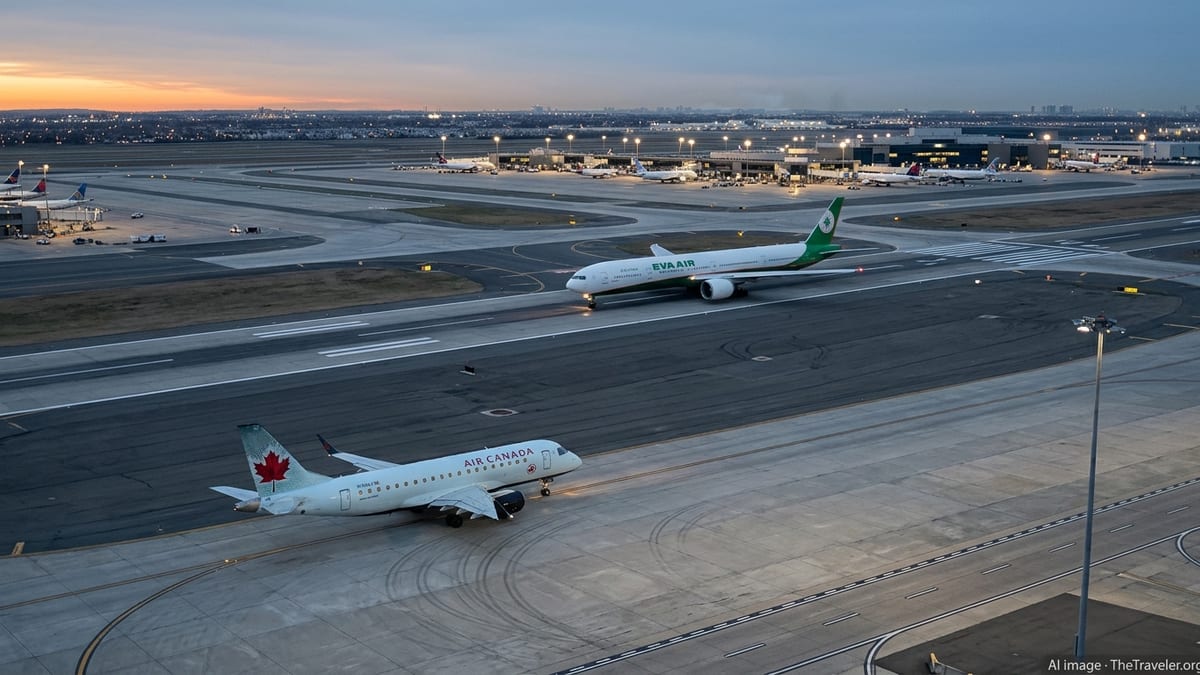
Taxi Mix-Up Brings Two International Flights Too Close for Comfort
The incident unfolded at JFK on March 19, 2026, when an Air Canada Jazz Embraer 175 operating a flight from Montreal to New York landed on Runway 31R and was instructed to vacate via taxiway WW, then turn right onto taxiway B and hold short of taxiway V. According to publicly shared flight-tracking data and transcripts circulated in online aviation forums, the Canadian-operated jet instead continued on taxiway B and passed beyond the designated holding point.
Roughly seven minutes later, an EVA Air Boeing 777-300ER arriving from Taipei also landed on Runway 31R. Reports indicate that the widebody jet rolled out along the same runway while the Air Canada aircraft remained in a position on taxiway B that created an unplanned reduction in separation. While the two aircraft did not collide and there were no reported injuries or damage, the geometry of the runway and taxiway layout meant that a continuing taxi error or loss of control could have had far more serious consequences.
Radio transmissions referenced in public discussions suggest that air traffic controllers quickly intervened, issuing instructions to maintain spacing and prevent the situation from escalating. Despite the absence of physical contact between the two aircraft, the episode is being treated in the aviation community as a significant runway-area safety event due to the combination of heavy traffic, large aircraft and a brief loss of procedural separation.
For travelers, the incident serves as a reminder that some of the most critical moments in flight occur not at cruise altitude but in the confined, fast-changing environment of a major hub’s runways and taxiways, where pilots and controllers manage high workloads under strict time and spacing constraints.
Busy Transborder Corridor Highlights Shared Safety Stakes
The near miss resonated strongly in both the United States and Canada because it involved a cross-border Air Canada service and a long-haul EVA Air flight linking New York with Taipei. These routes are central to business, family and tourism travel, and the aircraft types involved underscore the scale of modern international operations. The Embraer 175 is a workhorse of North American regional and transborder networks, while EVA Air’s 777-300ER is a long-haul flagship configured to carry hundreds of passengers across the Pacific.
Publicly available fleet information shows that EVA Air’s 777-300ERs typically seat more than 300 passengers across multiple cabins, while regional jets such as the Embraer 175 seat under 100. Even without direct contact, any runway-area event that brings such aircraft into closer proximity than intended is taken seriously because of the potential for cascading consequences if conditions were slightly different.
The JFK to Montreal and JFK to Taipei routes also involve coordination between U.S. and Canadian regulators and air navigation providers, along with the airlines’ own safety and training departments. Reports indicate that each organization will review the circumstances in line with established practices whenever an aircraft crosses a designated holding line or otherwise deviates from clear taxi instructions near an active runway.
Travelers may not see immediate impacts beyond occasional delays or revised ground procedures, but events like this often lead to behind-the-scenes refinements in training syllabi, simulator scenarios and taxi chart briefings. Over time, incremental adjustments on both sides of the border contribute to maintaining a strong safety record for transborder and long-haul international flights.
Runway Safety Under Scrutiny at Major North American Hubs
The JFK event arrives at a time when runway incursions and surface incidents are already under public and regulatory scrutiny in North America. Recent safety reports and media coverage have documented a series of close calls at large airports, prompting renewed focus on ground movement procedures, controller staffing and the use of surveillance technology to detect conflicts.
At JFK, surface surveillance systems are designed to alert controllers when an aircraft passes a critical point or enters an area that could compromise separation. Publicly available summaries of earlier incidents at the airport describe how such systems have previously warned of developing conflicts, giving controllers vital seconds to issue corrective instructions. The latest near miss appears to fit into a pattern in which technology and human intervention combine to keep minor deviations from turning into major accidents.
Aviation safety analyses frequently point out that the majority of runway incursions involve human factors such as momentary distraction, unfamiliarity with an airport’s layout or misinterpretation of a taxi clearance. JFK’s intersecting runways and complex web of taxiways can be especially challenging for crews arriving from airports with simpler ground configurations, including regional jets flying into New York after short transborder segments.
In response to earlier events around the continent, airports and regulators have promoted measures such as enhanced taxiway signage, clearer phraseology, revised controller procedures and voluntary pilot training modules focused on ground operations. The latest JFK incident is likely to be examined in that context as part of a broader effort to reduce the risk of runway incursions at high-density hubs.
Implications for Passengers and Future Travel Through JFK
For passengers flying between the United States, Canada and Asia, the close call at JFK is a reminder that safety in commercial aviation is built on many layers of protection. Even when an aircraft crosses a holding line or strays closer than intended to an active movement area, other defenses such as cockpit cross-checks, ground radar alerts and controller oversight are designed to catch and correct the error before it leads to a collision.
Travelers may notice subtle changes in the aftermath of such events, including longer rollout distances, additional holding points, or slightly extended taxi times while controllers sequence arriving and departing aircraft more conservatively. Airlines may also adjust their internal guidance, encouraging flight crews to spend extra time during approach briefings reviewing JFK’s taxi diagrams and anticipated exit points, especially for crews less familiar with the airport.
From a broader travel perspective, high-profile near misses can temporarily unsettle some passengers, particularly when widely discussed on social media and in online forums. However, aviation statistics consistently show that serious runway collisions remain extremely rare relative to the volume of daily operations at major airports like JFK, Toronto Pearson and other key hubs linking North America and Asia.
As investigations and internal reviews proceed, the JFK incident is expected to feed into ongoing international efforts to refine runway safety practices, inform training for both regional and long-haul crews, and ensure that airports serving dense transborder and intercontinental traffic continue to improve the way aircraft move on the ground.