

More news on this day
Air Canada has joined Delta Air Lines, United Airlines, American Airlines and a growing list of global carriers in cancelling or suspending flights across the Middle East after coordinated United States and Israeli strikes on Iran prompted Tehran to launch retaliatory attacks on Gulf states and forced widespread airspace closures.
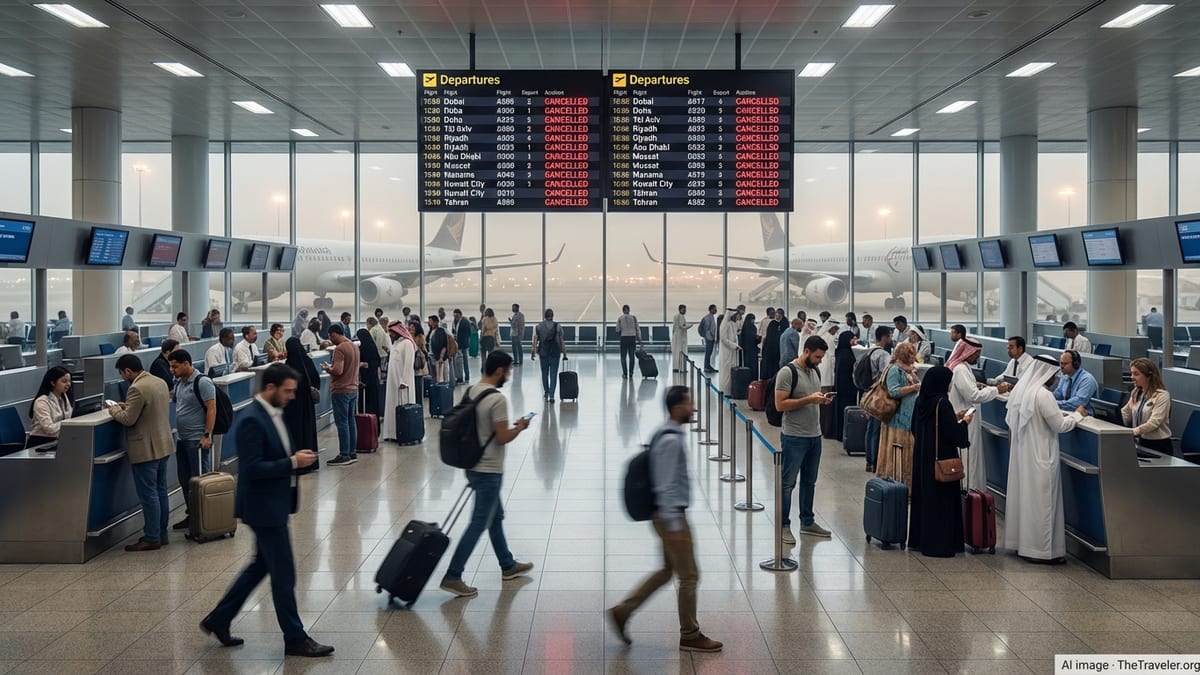
Rapid Escalation Forces Airlines to Ground and Divert Flights
The sweeping disruption unfolded on February 28 after US and Israeli forces carried out major strikes against targets in Iran, triggering a wave of retaliatory missile attacks on military facilities and infrastructure in Bahrain, Kuwait, Qatar, the United Arab Emirates and Saudi Arabia, as well as Israel. Governments across the region responded by partially or fully closing their airspace, instantly transforming some of the world’s busiest aviation corridors into no-go zones.
Flight-tracking data showed skies above Iran, Iraq, Kuwait, Bahrain and Israel virtually empty by Saturday afternoon as carriers scrambled to reroute long-haul services between Europe and Asia and halt point-to-point traffic into the Gulf and Levant. Aviation authorities in Iran, Israel, Iraq, Kuwait and the UAE all announced temporary suspensions or severe restrictions on civilian flights, describing the risk level to commercial aviation as unacceptably high given ongoing military operations and missile intercepts.
Europe’s aviation safety regulator reinforced that assessment with a conflict-zone bulletin for large parts of the Middle East and Gulf region, warning of a high risk to civil aviation from missile strikes, anti-aircraft activity and misidentification in crowded skies. Airlines responded by cancelling hundreds of flights and imposing wide detours that add hours to some intercontinental journeys.
For travelers, the result has been a sudden wave of last-minute cancellations, diversions and missed connections, with major hubs in Dubai, Doha, Abu Dhabi and Jeddah experiencing cascading disruption just as weekend traffic was peaking.
North American Carriers Pull Back From Gulf and Levant Routes
Among North American airlines, Air Canada moved quickly on Saturday to suspend flights touching key Middle Eastern gateways, joining Delta, United and American in a coordinated retreat from the conflict zone. The Canadian flag carrier cancelled services involving Dubai and other Gulf points, citing regional airspace closures and heightened security risks to overflights, as well as liability concerns tied to war-risk insurance.
Delta Air Lines and United Airlines halted services to Tel Aviv and began avoiding Iraqi and Iranian airspace on long-haul routes, while American Airlines extended its existing suspension of flights to Israel and warned of potential knock-on effects for codeshare services operated by its Gulf and European partners. The three US majors said they were monitoring guidance from Washington and from international aviation safety bodies while offering customers waivers for rebooking and refunds.
The decision by these carriers underscores how quickly political and military developments in the Gulf can reshape transatlantic and transpacific travel patterns. In recent years, US and Canadian airlines had cautiously rebuilt capacity to Tel Aviv and select Gulf hubs, attracted by strong corporate and diaspora traffic. The sudden loss of those routes, even temporarily, not only cuts connectivity for North American travelers to the Middle East but also reduces onward options to South Asia and East Africa that rely on Gulf hubs for one-stop itineraries.
Airlines face a difficult balance between maintaining global networks and guaranteeing passenger safety. In this instance, executives have been unequivocal that safety considerations and regulatory directives override commercial interests, at least until the trajectory of the conflict becomes clearer.
Gulf Hubs Hit Hard as Airspace Closes Across the Region
The most immediate operational shock has been felt in the Gulf, where the UAE, Qatar, Bahrain, Kuwait and parts of Saudi Arabia sit at the crossroads of East–West air traffic. Authorities in the UAE temporarily suspended flights at Dubai International and Al Maktoum International, effectively freezing movements through one of the world’s busiest international hubs. Qatar and Bahrain also shut their skies, forcing home carrier Qatar Airways and regional rivals to ground or divert large portions of their fleets.
Emirates and flydubai suspended operations to and from Dubai after regional airspace closures made it impossible to maintain normal schedules. Other Gulf and regional airlines, including Saudia, Air Arabia and Kuwait Airways, cancelled or curtailed services across the Middle East, with particular impact on flights to Iran, Iraq, Israel, Jordan and Lebanon. Airport operators in Abu Dhabi and Doha warned passengers to expect extensive delays, diversions and cancellations that could extend at least into Sunday and potentially longer, depending on military and diplomatic developments.
Data from global aviation analytics firms indicated that more than a third of scheduled flights into Israel were cancelled on Saturday, alongside a rising share of services into Gulf states. In the wider region, more than 260 flights across the Gulf Cooperation Council countries and neighboring markets were scrapped in the space of 24 hours, a figure expected to climb as carriers update schedules and reposition aircraft.
Because Gulf hubs are central to connecting Europe and North America with South and Southeast Asia, disruptions there ripple far beyond the Middle East. Travelers flying between cities such as London and Bangkok, Toronto and Mumbai or New York and Nairobi via the Gulf now face longer routings through alternate hubs, fewer daily options and sharply reduced spare capacity to absorb irregular operations.
Ripple Effects for Global Networks and Traveler Itineraries
The closure of much of the Middle East’s upper airspace is forcing airlines on Europe–Asia and North America–South Asia routes to consider longer southern or northern detours, adding significant flight time and fuel burn. With Russian airspace already off limits to many Western carriers because of the war in Ukraine, routing flexibility was limited even before the latest crisis. The new avoid zones over Iran, Iraq and adjacent Gulf states remove yet another critical corridor.
For airlines, that means higher operating costs, more complex flight planning and tighter aircraft utilization, pressuring margins on some of their most profitable long-haul routes. Analysts note that while short-lived disruptions can be absorbed over weeks or months, a prolonged closure of Middle Eastern airspace could force permanent timetable changes, aircraft redeployments and potential capacity cuts on weaker city pairs.
For passengers, the day-to-day impact is more tangible. Travelers to and from the Middle East face outright cancellations or multi-day delays, while those using the region as a transit point may find themselves rebooked via European, African or South Asian hubs with longer total journey times. Many airlines have activated flexible change policies, but limited spare seats during peak travel periods mean some customers may be stranded or forced to alter itineraries significantly.
Travel insurers and corporate travel managers are also reassessing risk exposure. Companies with staff based in or transiting through the Gulf and Levant are reviewing travel approvals, while leisure travelers are being urged to stay in close contact with airlines and tour operators and to monitor government travel advisories, which have shifted rapidly over the course of the weekend.
What Travelers Should Expect in the Coming Days
Industry officials caution that the situation remains highly fluid, with the outlook for resuming normal flight operations tied directly to military decisions in Washington, Tehran, Tel Aviv and Gulf capitals. Aviation authorities are likely to keep conflict-zone bulletins in place for at least several days, and possibly weeks, if missile and drone strikes continue or expand to new targets.
In the near term, travelers booked on flights to or through the Middle East are being advised to assume that schedules may change with little notice. Airlines, including Air Canada and its US counterparts, are prioritizing communication through direct messages and mobile apps, while urging passengers not to travel to airports without confirmed, operating flights. Many carriers are waiving change fees and fare differences for affected routes, although policies vary by airline and ticket type.
For those with non-essential trips, postponement may be the most practical option until airspace restrictions ease and a clearer pattern of reliable operations emerges. For travelers who must fly, experts recommend building in longer connection times, packing essentials in carry-on luggage in case of unexpected overnight stays, and remaining flexible about routings and carriers.
Even if direct hostilities ease in the coming days, the aviation industry expects a cautious, phased reopening of airspace, with airlines incrementally restoring services as security assessments improve. Until then, the unprecedented alignment of Air Canada, Delta, United, American and dozens of international carriers in pulling back from the Middle East highlights how quickly a regional conflict can redraw the map of global air travel.