

More news on this day
Air Canada is continuing to provide assistance to passengers and families in the wake of the fatal Air Canada Express Flight 8646 accident at New York’s LaGuardia Airport, where a regional jet arriving from Montreal collided with an airport firefighting truck on March 22, 2026.
Get the latest news straight to your inbox!
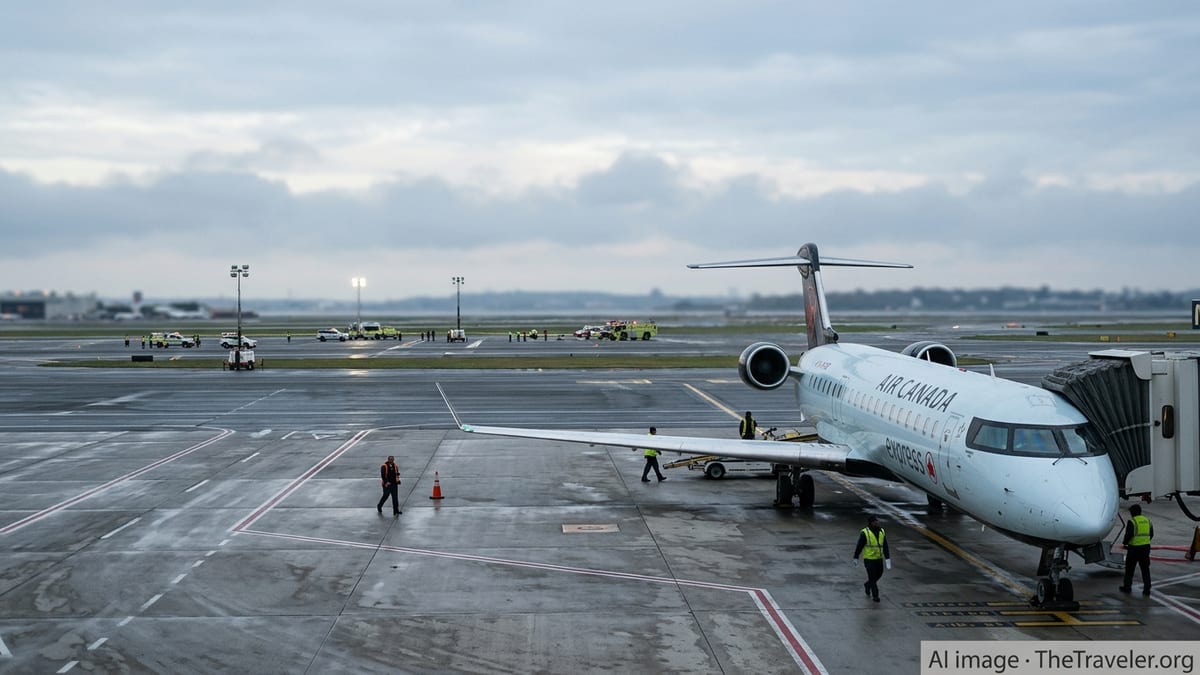
Air Canada Outlines Continuing Assistance Measures
Publicly available information shows that Air Canada has moved from an immediate crisis response to a longer-term support phase for those affected by Flight 8646. The flight, operated by Jazz Aviation under the Air Canada Express brand, was carrying 72 passengers and 4 crew members when it struck an airport firefighting vehicle during landing at LaGuardia. Two people, identified in reports as the pilots, lost their lives and dozens more were injured, many of whom were transported to trauma centers in Queens.
According to published coverage, the airline activated its emergency response plan shortly after the accident. This type of plan typically coordinates medical assistance, travel arrangements, and basic needs for survivors and their families. Reports indicate that Air Canada has been assisting with onward travel for passengers who were able to leave New York, as well as accommodations and practical support for those who remain in the city for medical treatment or to be near hospitalized relatives.
Information shared through airline updates and news reports suggests that Air Canada has made customer-care teams and call-center staff available to help travelers rebook disrupted itineraries. The accident contributed to significant schedule disruption at LaGuardia and across the wider New York area, leaving many passengers on unrelated flights seeking information about their options. The carrier has emphasized flexibility in re-accommodating customers whose trips were affected by the airport closure and subsequent delays.
In addition to logistical help, media coverage indicates that Air Canada is coordinating with third-party specialists to provide emotional and psychological support for those directly involved in the crash. Such services often include counseling hotlines, on-the-ground support at hotels or hospitals, and longer-term follow-up for individuals coping with trauma.
Details of the LaGuardia Runway Collision
Flight 8646 was a regularly scheduled service from Montréal–Trudeau International Airport to LaGuardia. The aircraft, a Bombardier CRJ900 operated by Jazz Aviation, approached Runway 4 on the evening of March 22 amid reports of poor weather and earlier delays in the New York area. Publicly accessible flight-tracking data and accident summaries indicate that, as the jet landed, it collided with an airport firefighting truck that was crossing the runway to respond to a separate emergency.
Accident summaries report that the front section of the aircraft, including the cockpit and forward galley, sustained severe damage. Both pilots were killed in the impact. A total of 76 people were on board, and reports indicate that 41 individuals, including passengers, cabin crew, and the two occupants of the firefighting vehicle, were hospitalized in the aftermath. Many of those injured were later released, while a smaller group remained under care in New York hospitals in the days following the crash.
The collision triggered a full emergency response at LaGuardia and led to the closure of the airport. Federal aviation records show that operations were halted for many hours while emergency crews responded and investigators documented the scene. Runway 4/22, where the incident occurred, remained closed as debris was cleared and structural assessments were carried out. The event has been described in aviation summaries as the first fatal accident at LaGuardia in more than three decades.
Early reconstructions of the sequence of events, based on air traffic control recordings and preliminary investigative notes, suggest that the firefighting vehicle had been cleared to enter or cross the active runway shortly before the aircraft landed. A full determination of timing, communication, and visibility conditions is expected to come later from formal safety investigations.
Impact on Travelers and New York Flight Operations
The crash and subsequent airport shutdown had a ripple effect on travel across the New York metropolitan area. According to aviation operations reports, LaGuardia implemented a ground stop immediately after the collision, halting both arrivals and departures. Many flights were diverted to John F. Kennedy International Airport and Newark Liberty International Airport, where airlines worked to absorb unexpected passenger loads.
In the hours that followed, those alternate airports also experienced strain. Publicly available accounts describe extended delays, long lines at rebooking counters, and aircraft waiting for gates or departure slots. Some services were canceled outright as airlines struggled with crew-duty limits, aircraft positioning, and congestion at already busy terminals.
For Air Canada passengers, the disruption was felt both on the accident flight and across the carrier’s broader transborder schedule. Travelers connecting through New York, including those heading to and from Canadian hubs such as Montreal and Toronto, faced missed connections and overnight delays. The airline’s customer updates have highlighted flexible rebooking policies and fee waivers in the immediate period after the accident, reflecting standard industry practice following a major operational disruption of this scale.
Travel industry observers note that the incident has added to existing pressure on northeastern U.S. airspace, which has seen frequent delays linked to weather, staffing constraints, and high demand. The Flight 8646 accident has intensified scrutiny of how quickly traffic can be rerouted when a primary airport shuts down, and how airlines and airport authorities communicate real-time changes to passengers.
Investigations and Safety Focus After Flight 8646
Multiple agencies in the United States and Canada have opened investigations into the Flight 8646 collision. Public statements from transportation safety boards and aviation regulators indicate that teams are examining runway incursion risks, air traffic control procedures, the movement of emergency vehicles, and airport staffing levels at the time of the accident. Particular attention is being paid to how a firefighting truck came to be crossing an active runway as an arriving flight was touching down.
Preliminary summaries have highlighted several areas of interest, including weather conditions, runway surface state, and overall traffic volume at LaGuardia during the evening of March 22. Investigators are also reviewing cockpit voice and flight data recordings from the CRJ900, as well as radio communications between pilots, controllers, and emergency crews. Reports indicate that findings from these data sources will shape recommendations intended to reduce runway incursion risks across the national airspace system.
Runway incursions, in which an aircraft or vehicle mistakenly enters a protected area of a runway, have been an ongoing concern in aviation safety discussions. Aviation safety databases already list the Flight 8646 accident as a significant example of the severe consequences such events can have, even in the absence of airborne collision risk. The LaGuardia crash is expected to feature in future training materials for both pilots and ground personnel, with a focus on coordination between emergency response activities and active flight operations.
Air Canada and Jazz Aviation have indicated through public information channels that they are cooperating fully with investigative efforts. While the causes and contributing factors will take time to establish, safety analysts anticipate that the case will influence guidance on how emergency vehicles move around busy airports, particularly during adverse weather or high-traffic periods.
How Air Canada’s Response Shapes Traveler Confidence
In the days since the accident, attention has turned to how Air Canada’s handling of the aftermath may affect traveler confidence in both the airline and the broader regional jet network. Aviation commentators note that passengers increasingly look at how carriers manage rare but serious incidents when deciding whom to fly with, especially on cross-border routes that rely heavily on regional partners.
Publicly visible aspects of the response have included clear safety messaging about the rarity of such accidents, flexible options for customers whose travel plans were disrupted, and acknowledgments of the human impact of the crash. While formal investigations will address technical questions, many travelers are focused on whether the airline appears transparent, responsive, and compassionate in dealing with those directly affected.
Industry analysts suggest that Air Canada’s continued support, particularly for injured passengers and the families of the deceased crew, may play an important role in how the brand recovers from the tragedy. Follow-through on counseling offers, assistance with medical logistics, and long-term outreach are seen as indicators of whether immediate promises translate into sustained care.
For the wider traveling public, the Flight 8646 crash is also a reminder of the complex layers of safety that underpin modern air travel, from air traffic control and airport infrastructure to airline training and emergency planning. As investigations progress and more details emerge, travelers and industry stakeholders alike will be watching closely to see how lessons from LaGuardia translate into tangible safety improvements across North American airports.