

More news on this day
Air Canada is extending travel assistance, counseling referrals, and flexible rebooking to passengers and families affected by Air Canada Express Flight 8646, which collided with an airport firefighting vehicle while landing at New York’s LaGuardia Airport on March 22, 2026.
Get the latest news straight to your inbox!
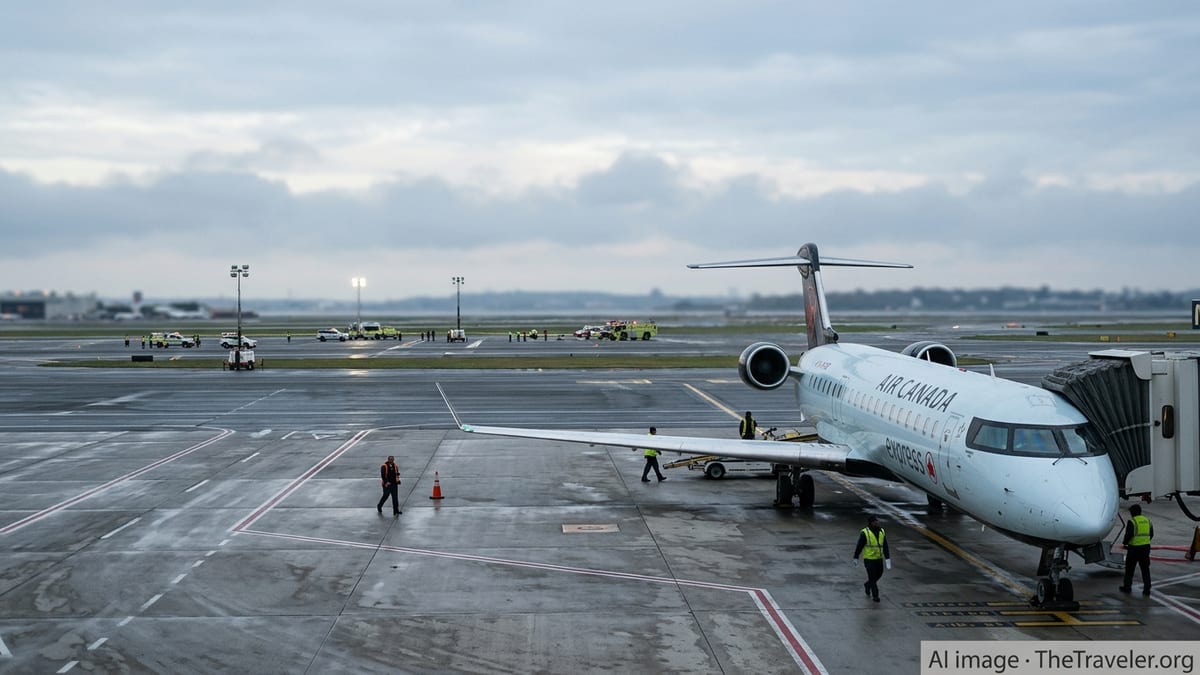
Airline Response Following the LaGuardia Collision
Publicly available information shows that Air Canada and its regional partner Jazz Aviation moved quickly to activate emergency response protocols after Flight 8646 struck a fire truck on Runway 4 at LaGuardia. The Bombardier CRJ900, operating from Montreal to New York, suffered severe damage to the forward fuselage, resulting in the deaths of both pilots and multiple injuries among passengers, crew, and the truck’s occupants. The incident has been described in aviation records as the first fatal commercial accident at LaGuardia in more than three decades.
According to published coverage, the airline has been coordinating directly with local authorities, airport operators, and Canadian and United States investigative agencies to support the official inquiry while maintaining care for those on board. In practice, that support spans immediate medical assistance, onward travel arrangements, and help with documentation and personal effects.
Reports indicate that Air Canada’s emergency family assistance team was activated shortly after the crash, with staff deployed to New York–area airports and hospitals to provide language support, logistical guidance, and information to relatives traveling from Canada and other destinations. This model is consistent with crisis frameworks used by large international carriers, where specialist teams are trained to respond to rare but severe incidents.
While formal investigations into the collision continue, the airline has emphasized, through public statements and media briefings referenced in news reports, that looking after injured passengers, families of the deceased, and affected employees remains a central focus in the immediate aftermath.
Care for Passengers, Families, and Crew
For travelers who were on Flight 8646, support has taken several forms. Published reports note that medical triage began on the runway and continued at nearby trauma centers in Queens, where dozens of passengers and crew were transported with injuries ranging from minor to serious. Once patients were stabilized, airline representatives assisted with basic needs such as clothing, toiletries, and communication tools for those who had lost their belongings in the wreckage.
In parallel, the carrier has been offering flexible travel options for passengers who were able to continue their journeys. Public information suggests that affected customers were given priority rebooking on alternative Air Canada and partner flights, including routings via John F. Kennedy International Airport and Newark Liberty International Airport while LaGuardia remained closed and then partially restricted.
Emotional and psychological support is also a key component of the airline’s ongoing response. Based on standard industry practice and references in media coverage, passengers, crew members, and their immediate families are being provided access to counseling referrals and critical incident stress resources. These services typically include multilingual hotlines and connections to mental health professionals experienced in aviation-related trauma.
For the families of the two pilots who died in the collision, publicly available information indicates that Air Canada and Jazz Aviation are coordinating dedicated family liaison contacts. These liaisons usually assist with travel and accommodation near memorial services, help navigate administrative procedures, and serve as a consistent point of contact during what is expected to be a lengthy investigation.
Impact on New York–Area Air Travel
The collision triggered a temporary shutdown of LaGuardia Airport, with aviation data showing that a ground stop was declared shortly after the crash and extended into the following day. Numerous flights were diverted to other New York–area airports, and hundreds of passengers found themselves unexpectedly rerouted or delayed as runway inspections and debris removal continued.
Runway 4, the site of the crash, has remained closed for investigative work and repairs, according to operational updates referenced in news reports. While other runways have allowed LaGuardia to resume partial operations, the loss of one landing and departure surface has constrained capacity at an airport already known for congestion and tight scheduling.
These disruptions have affected not only Air Canada but also a variety of domestic and international airlines operating in and out of the New York market. Travelers have faced longer-than-usual delays, last-minute gate changes, and reroutings through alternate hubs such as Boston, Toronto, and Washington, as carriers adjust schedules and aircraft rotations.
For inbound and outbound passengers on Air Canada’s Montreal–New York services, publicly available flight-tracking information shows a mix of cancellations, consolidations, and equipment changes in the days following the crash. The airline has encouraged affected travelers, through its website and general media guidance, to check flight status frequently and to allow extra time when connecting through New York–area airports.
Safety Investigation and Operational Review
Investigative agencies in both the United States and Canada have opened formal inquiries into the circumstances that led to Flight 8646 colliding with the airport firefighting truck. Aviation summaries describe the event as a runway incursion, in which the fire vehicle was crossing the active runway to respond to an unrelated emergency as the CRJ900 landed.
According to publicly available preliminary information, the investigation is examining air traffic control communications, ground vehicle movements, weather conditions, and the flight crew’s actions in the moments before impact. Data from the aircraft’s flight recorders, as well as recordings of radio exchanges between controllers, the flight crew, and airport emergency services, are expected to play a central role in reconstructing the sequence of events.
While the inquiry is still in its early stages, Air Canada and Jazz Aviation are participating as interested parties, as is typical in such cases. This participation usually involves providing technical data about the aircraft, maintenance records, training documentation for flight and cabin crew, and details on operational procedures for approaches into LaGuardia under adverse weather and reduced visibility.
Industry observers note that the findings from this investigation are likely to influence not only Air Canada’s internal safety reviews but also broader discussions about runway incursion risks at busy metropolitan airports. Topics under scrutiny may include communication protocols between air traffic control and airport rescue vehicles, signage and lighting on service roads, and potential improvements in surface movement radar and alerting systems.
What Travelers Can Expect in the Coming Weeks
For travelers planning trips between Canada and New York in the coming weeks, the aftermath of Flight 8646 is likely to remain visible in the form of schedule adjustments and increased safety awareness. Flight search data and schedule updates show that some Air Canada Express frequencies into LaGuardia may be temporarily reduced or shifted to other area airports while runway capacity is constrained.
Travelers with existing reservations on routes that previously used the affected flight number are being encouraged, through airline advisories cited in media reports, to monitor their bookings closely. Reissued itineraries may involve different departure times, alternative New York airports, or changes in operating carrier as Air Canada coordinates with partners to maintain connectivity.
From a customer-experience perspective, passengers can expect continued emphasis on flexibility and support. That typically includes fee waivers for itinerary changes linked to the incident’s operational fallout, extended validity for unused tickets, and dedicated customer care channels for those directly or indirectly affected by the crash and its ripple effects.
The incident involving Flight 8646 has also heightened traveler interest in airline safety records and crisis response capabilities. For many passengers, visible measures such as clear communication, proactive rebooking, and access to support services are becoming key factors in evaluating carriers, especially when flying into complex airspace and crowded airports like those serving the New York metropolitan region.