

More news on this day
Air Canada and aviation regulators are releasing new details and travel advisories after an Air Canada Express jet collided with an airport fire truck on landing at New York’s LaGuardia Airport on March 22, killing both pilots and injuring dozens of people.
Get the latest news straight to your inbox!
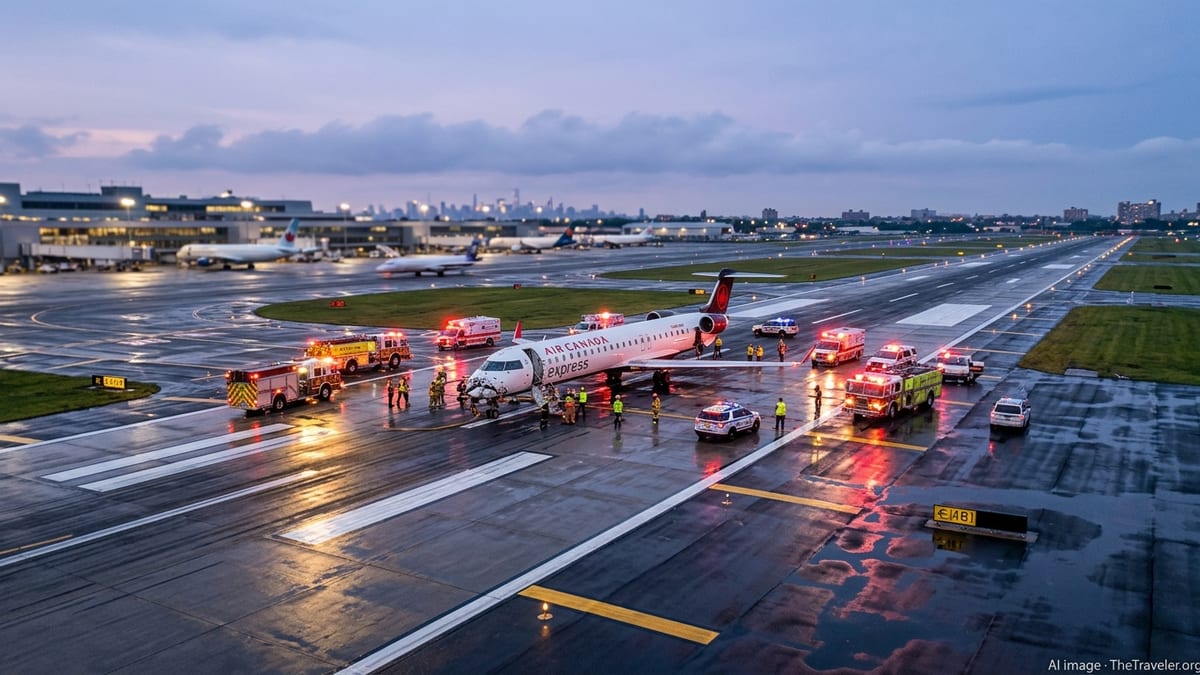
What Happened During Air Canada Express Flight 8646
Publicly available information identifies the flight involved as Air Canada Express Flight 8646, operated by Jazz Aviation on a Bombardier CRJ900 between Montréal–Trudeau International Airport and LaGuardia. The aircraft was carrying 72 passengers and four crew members when it attempted to land on Runway 4 on the night of March 22.
Investigative summaries and media reports describe a runway collision between the regional jet and a LaGuardia airport firefighting truck operated by the Port Authority of New York and New Jersey. The truck was crossing the active runway en route to check on an unrelated aircraft that had previously experienced rejected takeoffs. As Flight 8646 touched down, the jet struck the vehicle at high speed.
The impact destroyed the forward section of the CRJ900, killing the captain and first officer. Accounts from the scene indicate that a flight attendant, still strapped into her jumpseat, was thrown clear of the fuselage and survived, while dozens of passengers and crew sustained injuries ranging from minor to serious. A majority of those injured were transported to hospitals in the New York City area.
Early timelines assembled from radar data and air traffic control recordings suggest that the sequence from final approach to impact unfolded in less than a minute. This compressed timeframe is emerging as a key factor as investigators analyze how a routine regional arrival turned into LaGuardia’s first fatal crash in more than three decades.
Latest Statements and Actions From Air Canada
In the days following the accident, Air Canada has issued public statements acknowledging the deaths of the two pilots and expressing condolences to all those affected. The airline has confirmed that Flight 8646 was operated by its regional partner Jazz Aviation under the Air Canada Express brand and that both pilots were Canadian nationals based in Canada.
Air Canada reports that its teams are working with Jazz Aviation, airport authorities, and investigators to support the ongoing safety probe. Publicly available corporate updates indicate that the airline has deployed specialized assistance teams to New York to help passengers, crew, and family members, and has activated crisis support resources in Canada and the United States.
The airline has also reminded travelers that it is offering flexible rebooking options for affected itineraries involving LaGuardia and nearby airports. While specifics vary by ticket and route, Air Canada has encouraged customers to review their booking status through the carrier’s official channels and to monitor airport operations closely given lingering disruption in the New York airspace.
Air Canada and Jazz Aviation are not commenting on possible causes while the investigation is in progress. Instead, the companies are directing attention to the work of accident investigators and emphasizing that safety findings will be reviewed in detail once official reports are published.
What Investigators Are Focusing On So Far
The U.S. National Transportation Safety Board has dispatched a team to New York, with assistance from Canada’s Transportation Safety Board, to examine the collision. Preliminary descriptions of the inquiry indicate that investigators are concentrating on three main areas: runway incursion risk, air traffic control procedures, and airport emergency vehicle operations.
According to published coverage of air traffic control audio, a controller cleared a fire truck to cross Runway 4 shortly before Flight 8646 landed. Subsequent analysis will look at timing, visibility, and situational awareness in the control tower, including how ground and airborne movements were coordinated on a wet, low-visibility night.
Investigators are also examining the port authority firefighting unit’s response timeline and routing across the airfield. Questions include why the truck was on the active runway at the moment of landing, what instructions were received, and how those instructions were interpreted. Standard operating procedures for emergency dispatch at LaGuardia, including communication protocols between tower controllers and airfield vehicles, are expected to come under close scrutiny.
On the aircraft side, the NTSB is gathering data from the cockpit voice recorder and flight data recorder, as well as physical evidence from the broken fuselage and landing gear. These sources will help reconstruct speed, braking, and pilot actions during the final seconds before impact, along with any last-minute evasive maneuvers. A preliminary report typically emerges within weeks, while a full final report can take many months.
Impact on LaGuardia Operations and Current Travel Disruptions
The collision led to an immediate ground stop at LaGuardia, with the airport fully closed for hours while emergency crews responded and investigators documented the scene. Public travel advisories state that normal flight operations did not begin to resume until the afternoon of March 23, creating a cascade of delays and cancellations across multiple airlines.
Passengers scheduled to arrive or depart from LaGuardia in the days after the crash have faced residual disruption, including re-routings through Newark, John F. Kennedy, and regional airports in the Northeast. Airline alerts and airport notices urge travelers to reconfirm their flights, arrive early, and prepare for ongoing schedule changes as runway and gate usage are adjusted.
For Air Canada customers, the LaGuardia closure and reduced capacity have affected flights from Montréal, Toronto, and other Canadian cities. Some services have been temporarily consolidated or shifted to alternate New York–area airports. Travelers connecting onward from New York to other U.S. destinations are being advised to build extra time into their itineraries or consider rebooking through different hubs.
Industry observers note that the accident comes amid a period of broader strain on North American air traffic infrastructure, with staffing pressures and previous runway-incursion incidents at other airports already under review. The LaGuardia collision is expected to intensify calls for more robust ground surveillance technology and tighter procedures for managing emergency vehicles in complex, high-traffic environments.
What Passengers Need to Know Right Now
For travelers planning trips involving LaGuardia or Air Canada routes to New York in the coming days, the most important step is to check flight status frequently. Schedules remain subject to change as the airport manages recovery operations and as airlines adjust capacity based on aircraft availability and regulatory guidance.
Passengers directly involved in Flight 8646, as well as their families, are being directed through official channels to dedicated assistance resources. Public statements from both Air Canada and Jazz Aviation emphasize that medical, counseling, and logistical support are being coordinated for those affected by the accident.
Travelers with upcoming bookings should review fare rules and change policies, as many carriers, including Air Canada and U.S. airlines operating at LaGuardia, have issued short-term flexibility waivers for itineraries touching the airport around March 22 to March 25. These waivers typically allow one-time changes without standard fees, though any fare differences may still apply.
More broadly, the accident is prompting renewed traveler questions about runway safety and emergency procedures. Aviation safety records continue to show that serious runway collisions are rare relative to the volume of daily flights in North America, yet the LaGuardia crash highlights how quickly risks can escalate when multiple operational pressures converge. As investigators work to understand the precise chain of events, travelers can expect further updates from regulators, airlines, and airports on measures intended to prevent a similar tragedy in the future.