

More news on this day
Travelers across China are facing another wave of air travel disruption as Air China, China Southern, China Eastern, and several regional carriers cancel more than a dozen flights on key domestic and international routes, snarling traffic through major hubs in Beijing, Shanghai, Guangzhou, Chengdu, and other cities.
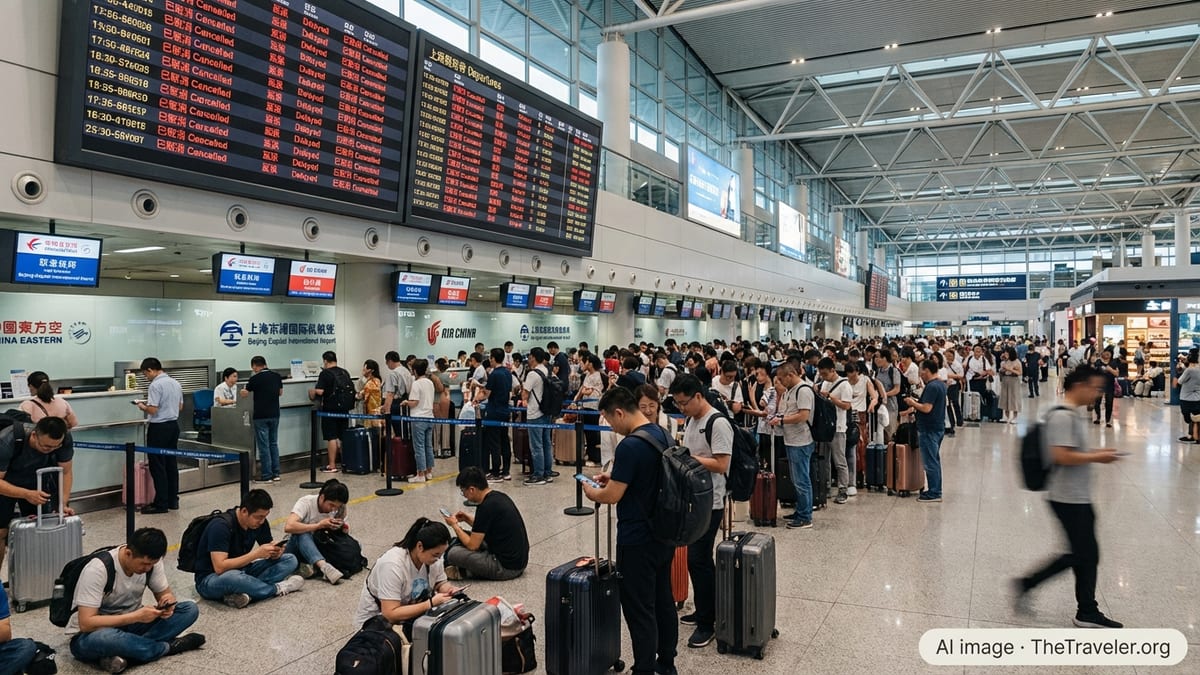
Fresh Cancellations Hit China’s Busiest Air Corridors
The latest round of schedule cuts follows a pattern of rolling disruptions that has unsettled China’s aviation network since early January. According to recent operational data, more than a dozen flights were cancelled in a single update period, on top of wider waves of suspensions and delays reported in recent weeks across major airports. While the number of cancelled flights on a given day can fluctuate, the impact on passengers is cumulative, with missed connections, overnight holds, and rebookings cascading through the system.
Air China, China Eastern, and China Southern remain at the center of the turmoil, as they operate a large share of trunk routes linking the capital and coastal megacities with inland hubs. Their schedule adjustments now ripple quickly across the network, particularly during peak travel windows and tight aircraft rotations. Regional and specialty carriers, including Shenzhen Airlines, Sichuan Airlines, Tibet Airlines, and others, have been swept up as well, either cancelling their own departures or absorbing spillover demand from stranded passengers.
Industry analysts note that these seemingly modest tallies of cancellations, when layered over hundreds of delays, can effectively jam key corridors. A single grounded aircraft on a trunk route can remove hundreds of seats from circulation and disrupt follow-on sectors for the rest of the day. For travelers boarding at intermediate hubs such as Chengdu or Xi’an, that can mean learning of a cancellation only hours before departure.
Beijing, Shanghai, Guangzhou and Chengdu Bear the Brunt
China’s main aviation gateways have once again emerged as the hardest hit. Beijing Capital and Beijing Daxing, Shanghai Pudong and Hongqiao, Guangzhou Baiyun, and Chengdu’s dual airports have all reported fresh cancellations in recent updates, trimming departures to and from other regional centers. The concentration of long-haul, transfer, and high-frequency domestic services at these hubs makes even a small cluster of cancellations highly disruptive.
Recent airport operations data highlighted that Beijing Capital and Chengdu Tianfu were among the facilities with some of the highest numbers of suspended departures in January, particularly on routes connecting the capital to western and southern China. Shanghai Pudong and Guangzhou Baiyun likewise saw a mix of outright cancellations and extensive delays, affecting both business flyers and leisure travelers at the start of the year’s peak travel season.
Chengdu’s role as a critical bridge between eastern coastal cities and China’s vast western regions has heightened the impact of each cancellation there. Suspended flights between Chengdu and Beijing, Urumqi, Hangzhou, and other cities blunt connectivity for both point-to-point passengers and those using Chengdu as a transfer hub. In Guangzhou, a hub for southern and international traffic, cancellations on services heading to northern and inland cities underscore how quickly bottlenecks can form when aircraft and crews fall out of their planned rotations.
Passengers Stranded as Cancellations Align With Peak Demand
The timing of the recent disruptions has proved especially painful for travelers. The latest cancellations have landed amid the broader Chunyun period, the 40-day travel rush surrounding Lunar New Year, when China’s transport networks typically operate at or near capacity. In this context, scrubbing even a limited number of flights can leave passengers with few timely alternatives, particularly on popular city pairs and late-evening departures.
Travelers at major terminals in Beijing, Shanghai, Guangzhou, Shenzhen, Chengdu, and other cities have reported long queues at airline service counters and self-service kiosks as they attempt to secure new itineraries. When multiple carriers cancel flights on the same corridor, available seats on remaining services are quickly snapped up, often forcing passengers into next-day departures or circuitous routing through secondary airports.
In some recent incidents tracked by aviation data providers, cancellations were accompanied by several hundred delays across the same network on the same day, a combination that compounds disruption. Passengers whose flights were technically still operating often faced significant pushbacks from scheduled departure times, missed connections, and extended time on the tarmac as airports worked through congestion and revised slot allocations.
Operational Pressures, Weather and Airspace Constraints Intertwine
While airlines and airport authorities have not cited a single overarching cause for the latest series of cancellations, a familiar trio of factors appears to be at play: weather instability, tight scheduling, and airspace constraints. Patchy winter conditions over northern and central China, including low clouds, fog, and occasional snow, have limited runway throughput and forced temporary ground holds at some airports. Even when not severe, such conditions can lower capacity and trigger rolling delays that cascade into cancellations later in the day.
Operational pressures within the airlines themselves are another driver. Carriers have been rebuilding domestic capacity after earlier slowdowns and have scheduled dense rotations for aircraft and crew to capture surging demand. In such an environment, even minor disruptions can knock aircraft out of position, making it difficult to operate later legs on time. To stabilize operations, airlines will sometimes cancel select flights entirely, consolidating passengers onto other departures in order to restore the network’s rhythm.
Airspace management is also a perennial challenge in China, where commercial flights share limited corridors with other users. Temporary restrictions or congestion in heavily trafficked zones can force reroutes, altitude changes, and spacing that reduce overall capacity. When these constraints align with peak periods at busy hubs such as Beijing, Shanghai, and Guangzhou, carriers may choose to prune schedules rather than risk uncontrolled knock-on delays across multiple airports.
Air China, China Eastern and China Southern Under Scrutiny
The sheer scale of China’s three largest state-backed carriers ensures that they attract the most attention whenever disruption hits. Recent data from operational tracking services and airport reports shows Air China and China Eastern accounting for a significant share of cancellations and delays relative to their peers, simply because they operate so many high-frequency domestic routes through the country’s busiest hubs. China Southern, while sometimes less prominently featured in the numbers, has also been heavily exposed at Guangzhou, Shenzhen, and other southern bases.
In multiple recent disruption episodes, Air China has led cancellation figures at Beijing Capital and Chengdu, with trunk routes to Shenzhen, Xi’an, Urumqi, and other major cities among those suspended. China Eastern and its affiliates have seen elevated disruption at Shanghai Pudong and Shanghai Hongqiao, where cancellations to destinations such as Guangzhou, Kunming, and Urumqi have undercut both business and leisure travel. China Southern’s cancellations on northbound and westbound routes from Guangzhou and Shenzhen have similarly strained capacity on some of the country’s busiest domestic corridors.
These carriers have emphasized that safety remains the paramount concern, and that cancellations are implemented in line with regulatory requirements when conditions or operational parameters fall outside acceptable ranges. However, frequent travelers note that the recurrence of large-scale disruptions in quick succession raises questions about schedule robustness, contingency planning, and the resilience of the broader network heading into the heart of the holiday travel season.
Regional Airlines and Secondary Hubs Feel the Ripple Effects
Although the headlines focus on the flagship brands, regional and specialty airlines have been drawn into the disruption as both causes and victims. Recent cancellation tallies have included services operated by Sichuan Airlines, Tibet Airlines, Shenzhen Airlines, Shanghai Airlines, XiamenAir and others, particularly on routes feeding into or out of the big four hubs. When these carriers cancel, the impact is often magnified in smaller markets that have fewer daily frequencies and limited alternative transport options.
Secondary hubs such as Xi’an, Hangzhou, Kunming, Nanjing, Chongqing, and Shijiazhuang have all reported waves of delays and smaller clusters of cancellations connected to the same weather systems and airspace constraints that have hit Beijing, Shanghai, Guangzhou, and Chengdu. In some cases, flights from these cities were cancelled not because of local conditions, but because inbound aircraft from disrupted hubs never arrived, or because crew duty-time limits were reached before a turnaround could be completed.
The knock-on effects extend beyond individual passengers to regional economies and tourism flows. Cities that have spent years cultivating new routes and frequencies to expand their connectivity can see those gains temporarily undermined when repeated cancellations erode traveler confidence. For outbound tour operators and corporate travel planners in these markets, the unpredictability of air service can complicate package design and business scheduling.
What Affected Travelers Are Being Offered
Airlines involved in the latest disruptions have generally offered standard remedies such as free rebooking on the next available flight, refunds for cancelled sectors, and, in some cases, meal vouchers or basic accommodation for passengers left overnight without options. Policies vary by carrier and by the cause of the cancellation; flights halted for safety or weather reasons typically receive different compensation rules than those cut for strictly operational or commercial reasons.
Major carriers including Air China, China Eastern, and China Southern have encouraged passengers to manage changes through official apps and websites where possible, a strategy aimed at easing pressure on airport customer service counters and call centers. However, travelers report that when disruption is widespread, digital channels can become just as congested, with long virtual wait times and limited rebooking inventory showing up on screens.
Some international passengers have also faced challenges aligning airline remedies with separate hotel and tour bookings, particularly where third-party platforms or agencies are involved. Travel insurers and credit card protection programs can sometimes bridge this gap, but only when policies explicitly cover weather or operational disruption. Consumer advocates advise travelers to retain boarding passes, cancellation notices, and receipts to support any later claims.
How Travelers Can Navigate Ongoing Uncertainty
With recent data showing repeated waves of cancellations and more than a thousand daily delays across major Chinese airports during some January peaks, travel experts recommend that passengers build additional buffers into their itineraries in the weeks ahead. That may mean scheduling longer connection times, avoiding late-night departures that offer fewer same-day alternatives, and favoring morning flights that are less exposed to accumulated delays.
Where possible, passengers are also advised to monitor flight status closely through both airline channels and airport information boards, as some cancellations have been announced only a few hours before scheduled departure. Signing up for mobile alerts and checking in online early can help travelers receive timely updates and position themselves for rebooking opportunities if flights are cut.
For those planning new trips, flexibility has become a key asset. Choosing tickets that allow for no-fee date changes or refunds, even at a modest premium, can provide valuable protection when network-wide disruptions flare. Travel planners say that, given the recent pattern of cancellations affecting everything from trunk routes like Beijing to Shanghai and Guangzhou to Chengdu, travelers should be prepared for continued volatility, even if the total number of affected flights on a single day appears limited.