

More news on this day
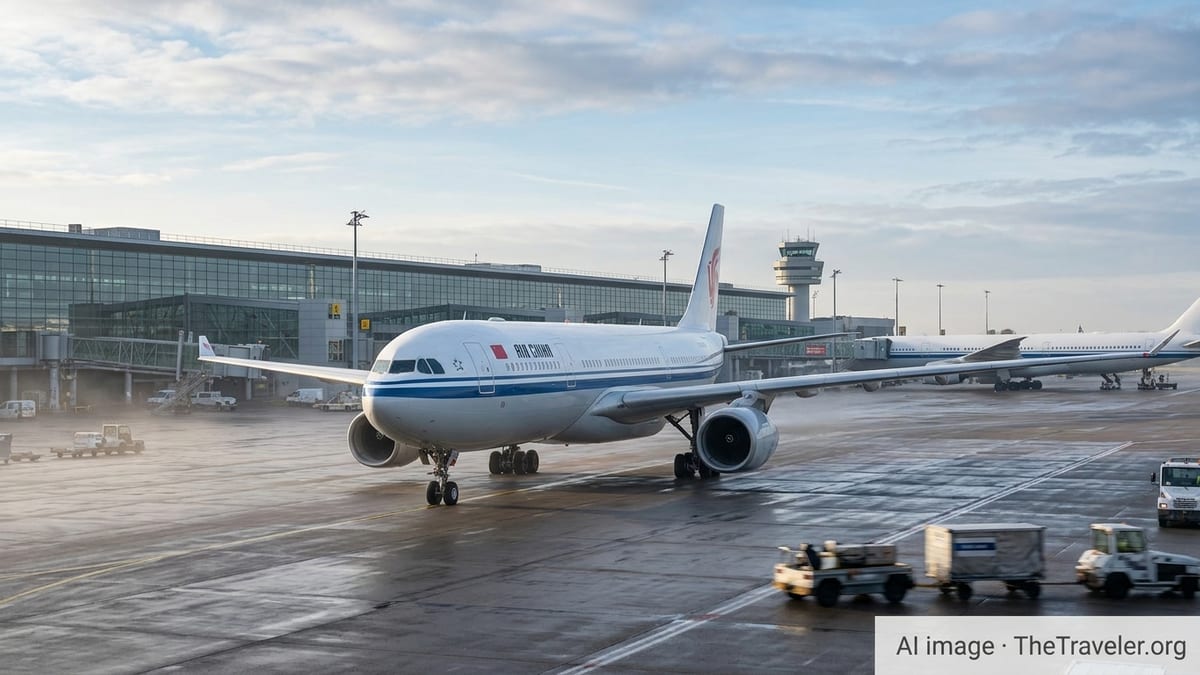
Air China is set to debut new nonstop services linking Brussels with both Beijing and Chengdu in late March 2026, reinforcing the Chinese flag carrier’s European network and giving the Belgian capital fresh connections to two of China’s most influential cities.
Get the latest news straight to your inbox!
Beijing and Chengdu Join Brussels on Air China Map
According to published schedules, Air China will introduce direct flights between Brussels Airport and Beijing Capital International Airport from 24 March 2026, followed by a Brussels link to Chengdu Tianfu International Airport two days later. The new routes place Brussels among a small group of European gateways with nonstop services to multiple major Chinese cities on a single mainland carrier.
Industry route trackers indicate that the Beijing Capital to Brussels route is planned to operate three times weekly in the initial launch phase, using Airbus A330-200 aircraft. The schedule shows a departure from Beijing in the early hours and an early morning arrival in Brussels, with the return sector leaving around midday and landing back in the Chinese capital the following morning.
For Chengdu, information in aviation scheduling databases points to at least a weekly rotation between Chengdu Tianfu and Brussels, using the larger Airbus A330-300. The planned timings mirror the Beijing service pattern, with overnight departures from China, morning arrivals in Belgium and early afternoon returns to Tianfu.
These additions place Beijing and Chengdu alongside other Chinese cities already linked to Brussels by different carriers, turning the Belgian capital into one of Western Europe’s more diversified hubs for China-bound traffic.
Strengthening Brussels as a China Gateway
Publicly available information from Brussels Airport and aviation publications shows that Chinese airlines have steadily expanded their presence at the airport over the past few years. Hainan Airlines already connects Brussels with Beijing, Shanghai, Shenzhen and, more recently, Chongqing, illustrating rising demand for point-to-point and connecting traffic between Belgium and China.
With Air China’s arrival, Brussels gains another member of a global alliance and a national flag carrier in its long-haul portfolio. Industry coverage notes that as part of a major airline grouping, Air China can feed passengers from Brussels into an extensive European network via partner hubs, while also channeling European travelers deeper into China and onward across Asia and Oceania.
Airport-focused reports highlight that the new flights are expected to support Brussels’ strategic objective of reinforcing its position as a European hub for Asian connectivity. The services add bellyhold cargo capacity for high-value exports such as pharmaceuticals, machinery and electronics from Belgium and neighboring countries, while enabling faster import flows from Chinese manufacturing centers.
The move also complements broader efforts at Brussels Airport to diversify its long-haul portfolio beyond North America and the Middle East. Analysts point out that competition among European airports for limited long-haul capacity from Asian carriers remains intense, making each new intercontinental route a significant win in network development terms.
Beijing–Chengdu Shuttle Underpins the Network
Separate from the Brussels launches, network data indicates that Air China continues to deepen connectivity between Beijing and Chengdu, one of China’s fastest-growing aviation markets. Chengdu Tianfu, which opened in 2021, is designed as a major hub for western China, and improved shuttle frequencies between Tianfu and Beijing help funnel passengers from Brussels and other international routes into a wider domestic network.
Industry analyses describe the Beijing–Chengdu corridor as a core artery for both business and leisure travel, linking the political and administrative center of China with Sichuan’s commercial and technology clusters. Additional frequencies on this domestic trunk make it easier for travelers arriving in Beijing from Brussels to connect onward to Chengdu with shorter connection times and more scheduling flexibility.
For passengers starting their journeys in western China, stronger links to Beijing also provide redundancy and alternative options if direct flights from Chengdu to Europe are fully booked or seasonally adjusted. As Air China adds Brussels to its list of European destinations from both Beijing and Chengdu, the reinforced shuttle between the two Chinese hubs effectively widens the catchment area for the new services.
Route planners note that this layered approach, combining international nonstops with dense domestic connectivity, is a common strategy among large network carriers aiming to balance premium long-haul demand with the need to fill widebody aircraft from multiple origin points.
Benefits for Business, Tourism and Academic Travel
According to coverage in European and Chinese business media, the new links are expected to appeal strongly to corporate travelers, especially those active in pharmaceuticals, logistics, automotive and clean technology. Brussels hosts key European Union institutions and international organizations, while Beijing is China’s political center and Chengdu has emerged as a major base for high-tech manufacturing and research.
Travel analysts suggest that more nonstop options can shorten journey times for executives moving between company headquarters, plants and regulatory bodies. Direct flights also tend to be attractive for delegations attending trade fairs, policy dialogues and investment forums held in both Europe and China, particularly at a time when rebuilding in-person exchanges remains a priority after the pandemic years.
Tourism boards and education sector observers likewise see potential upside. Belgium gains easier access to China’s outbound tourism market, including travelers keen to explore European heritage cities, chocolate and beer culture, and nearby destinations in France, the Netherlands and Germany. At the same time, students and researchers moving between Chinese universities in Beijing and Chengdu and institutions in Belgium and neighboring countries can benefit from shorter, more predictable itineraries.
Reports indicate that demand patterns may initially be strongest from corporate and visiting-friends-and-relatives segments, with leisure flows gradually building as travel confidence and visa procedures continue to normalize. Airlines typically adjust capacity in response to these evolving trends, so observers will be watching booking data closely through the first summer season of operations.
Competitive Dynamics on China–Europe Corridors
Industry commentary positions Air China’s Brussels launches within a broader realignment of China–Europe air traffic. Chinese carriers have taken on a larger share of capacity between the two regions compared with the pre-2019 period, as European airlines cautiously rebuild their long-haul schedules and navigate airspace constraints over parts of Eastern Europe and Russia.
Brussels now sits in a competitive landscape that includes major European hubs such as Frankfurt, Paris, Amsterdam and London, all of which host multiple Chinese carriers and routes. Analysts note that Brussels differentiates itself with a strong role in EU governance, a compact and efficient airport infrastructure and growing specialization in cargo, especially pharmaceuticals and e-commerce.
The entrance of Air China on the Brussels–Beijing route, where another Chinese airline already operates, introduces a new layer of choice in schedules, cabin products and alliance connections. The additional Chengdu link further diversifies the market by opening a direct path to western China that avoids hubs in eastern coastal cities.
Observers suggest that how the new flights perform will depend on several factors, including macroeconomic conditions in Europe and China, corporate travel budgets, exchange rates and ongoing geopolitical developments. For now, the launch underscores a gradual but notable trend toward restoring and expanding long-haul connectivity between China and key European political and economic centers, with Brussels, Beijing and Chengdu forming the latest triangle in that network.