

More news on this day
Air China is set to reshape China–Belgium air connectivity from March 2026, adding new nonstop services that place Beijing alongside Chengdu and Brussels in a tighter tri-city network.
Get the latest news straight to your inbox!
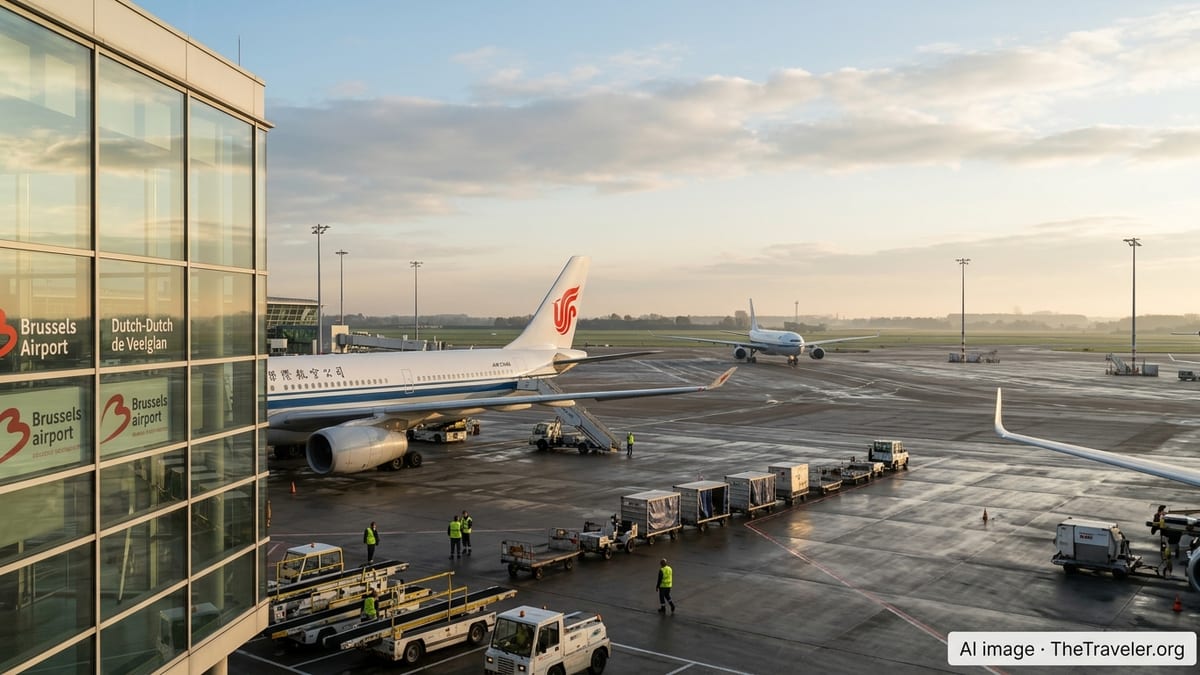
Beijing and Chengdu Join Brussels in Expanded Air China Network
According to published schedules, Air China plans to launch direct flights from Brussels Airport to both Beijing Capital International Airport and Chengdu Tianfu International Airport as part of the airline’s summer 2026 program. Industry timetable filings and airport announcements indicate that Beijing will be served daily from Brussels, while Chengdu will see three weekly frequencies, creating a dual mainland China link from the Belgian hub.
Information from Brussels Airport and airline schedule trackers shows that services to Beijing are scheduled to start on March 24, 2026, followed by Chengdu Tianfu on March 26, 2026. The new pattern positions Brussels as one of the relatively few European gateways with nonstop connectivity to both the Chinese capital and the fast-growing Sichuan metropolis operated by the same carrier.
Publicly available data on Air China’s international expansion suggests the move fits into a broader strategy of rebuilding and diversifying long haul connectivity after the pandemic period. By pairing a political and cultural capital like Beijing with an emerging western China hub such as Chengdu, the airline is aiming to distribute traffic flows more evenly across its domestic network while strengthening its presence in continental Europe.
Timetables, Frequencies and Star Alliance Connectivity
Reports from aviation scheduling outlets indicate that Air China’s Brussels–Beijing route is planned as a daily service, timed to capture both intercontinental and intra-European connections. The Chengdu Tianfu–Brussels route, listed as operating three times per week, complements that pattern by offering additional options for central and western China without over-saturating the market.
Brussels Airport communications describe the new Beijing service as operating in a daytime window that lines up with short haul arrivals from key European markets, including France, the Netherlands, Germany and the Nordic countries. This timing is designed to allow one-stop itineraries between secondary European cities and Beijing, replacing the two-stop routings that became common when China–Europe capacity was sharply reduced.
Air China’s membership in Star Alliance is expected to enhance the reach of the new flights. Publicly available alliance and airport information indicates that travelers will be able to combine Air China’s Brussels services with flights operated by other Star Alliance members such as Brussels Airlines, Lufthansa, Swiss and Austrian Airlines. This integration may prove particularly important for corporate travel programs and frequent flyers seeking through-ticketing, baggage interline and lounge access across the network.
Strategic Role of Beijing and Chengdu in China’s Aviation Map
Industry analysis of Air China’s route portfolio highlights the central role of Beijing Capital International Airport as the carrier’s primary hub, with extensive domestic and international connections. The Brussels service adds another European capital to a long haul network that already includes major gateways such as Frankfurt, Paris and London, reinforcing Beijing’s status as an intercontinental transfer point.
Chengdu Tianfu International Airport, opened as a new hub to relieve pressure on Chengdu Shuangliu, has quickly become one of China’s most dynamic growth platforms. Local government updates and air transport statistics show that Tianfu has been adding international capacity to Asia, the Middle East and Europe, and Air China’s Brussels route is positioned as a flagship example of that expansion. The new link gives Chengdu another direct connection into the European Union, supplementing existing services operated by other Chinese and European carriers.
For Air China, deploying Brussels flights from both Beijing and Chengdu allows the airline to tap into different demand profiles. Beijing traditionally anchors government, diplomacy and premium corporate traffic, while Chengdu offers access to technology, manufacturing, agribusiness and tourism flows linked to western China. Combining both origins into a single European gateway may also improve aircraft utilization and operational flexibility across the network.
Implications for Business, Tourism and Cargo Flows
Economic development agencies in Belgium and regional Chinese authorities have repeatedly emphasized the importance of direct air links in supporting trade and investment. With Brussels now gaining nonstop passenger services from both Beijing and Chengdu, logistics operators see an opportunity to route higher value, time-sensitive cargo through a shorter supply chain linking western China’s manufacturing clusters with Benelux and neighboring markets.
Freight analysts note that passenger widebody flights typically carry significant belly cargo capacity, which can complement dedicated freighter operations already serving China–Europe lanes. By adding Chengdu Tianfu and reinforcing Beijing connections into Brussels, Air China is contributing additional lift that may appeal to exporters of pharmaceuticals, technology components and e-commerce parcels moving between the two regions.
On the tourism side, national tourism boards and destination marketers are expected to promote the new flights as a fresh option for leisure travelers. The daily Beijing service offers Belgian and wider European visitors another nonstop route into China’s capital, while the three-weekly Chengdu link opens easier access to attractions such as Sichuan’s panda reserves, hotpot cuisine and nearby mountain landscapes. For Chinese outbound travelers, Brussels offers proximity to historic cities across Belgium, northern France, the Netherlands and western Germany.
Broader Context of Europe–China Air Service Recovery
The addition of Brussels routes from both Beijing and Chengdu comes against a backdrop of gradually recovering air traffic between Europe and China. Industry reports show that overall capacity on China–Europe corridors has been rebuilding unevenly, with some hubs regaining or surpassing pre-pandemic levels while others are still below historic peaks. Airlines have been cautious in adding long haul capacity, balancing demand uncertainty with the need to restore connectivity.
In this environment, Air China’s decision to position Brussels as a dual-hub destination from both Beijing and Chengdu underlines the airport’s role as a Star Alliance stronghold and political center for the European Union. The new flights join services from other Chinese carriers that already link Brussels with cities such as Beijing, Shanghai, Shenzhen and Chongqing, contributing to a more diversified Chinese presence at the airport.
Aviation analysts suggest that if load factors and yields on the new routes prove sustainable, the move could encourage further expansion, including potential frequency increases or additional European destinations linked to Chengdu and Beijing. For now, the March 2026 launch marks a concrete step in the continuing normalization and diversification of air links between China and Europe, with Air China placing Beijing alongside Chengdu and Brussels as key pillars in its transcontinental network.